Create Meta Ad Variations for Every Product Benefit
Turn the strategy into creatives
Create ready-to-test Meta ads for your product
Paste your product page. ADEN'S LAB turns the offer, audience, and positioning into complete ad concepts with images, headlines, and copy.
No design brief or prompt writing required.

Most Meta ads lose because they try to sell too many reasons to buy at once. I’d fix that by running one benefit per ad, then testing that angle on its own.
Here’s the short version:
- I start by turning product features into customer outcomes
- I give each outcome its own ad angle
- I make 3–5 versions of that same angle
- I test benefits first, then test headlines, visuals, and CTAs second
- I watch for fatigue, because results can drop in 3–7 days
- I keep a list of winning angles so I can reuse them
This matters because single-focus ads often do better than feature-packed ads. The article cites 52% higher conversion rates, 34% higher engagement, and 28% lower CPC for tighter, problem-led messaging.
If I had to sum up the whole article in one line, it’s this: <u>stop writing one ad for everyone, and start writing one ad for one reason to care.</u>
A simple way to think about it:
| Step | What I do | Why it matters |
|---|---|---|
| 1 | List features and convert them into benefits | People buy outcomes, not raw product details |
| 2 | Match each benefit to an angle and audience | Different people care about different things |
| 3 | Write several ad versions for one benefit | I can test hooks without mixing messages |
| 4 | Test one benefit against another | I can see what lowers CAC |
| 5 | Rotate new versions before fatigue hits | Good ads fade, so I need replacements ready |
The article also shows how this works for e-commerce, SaaS, and lead gen, with examples built around price, speed, risk reversal, trust, automation, and time savings.
So if I want clearer data, lower waste, and ads that speak to one buying motive at a time, this is the system I’d use.
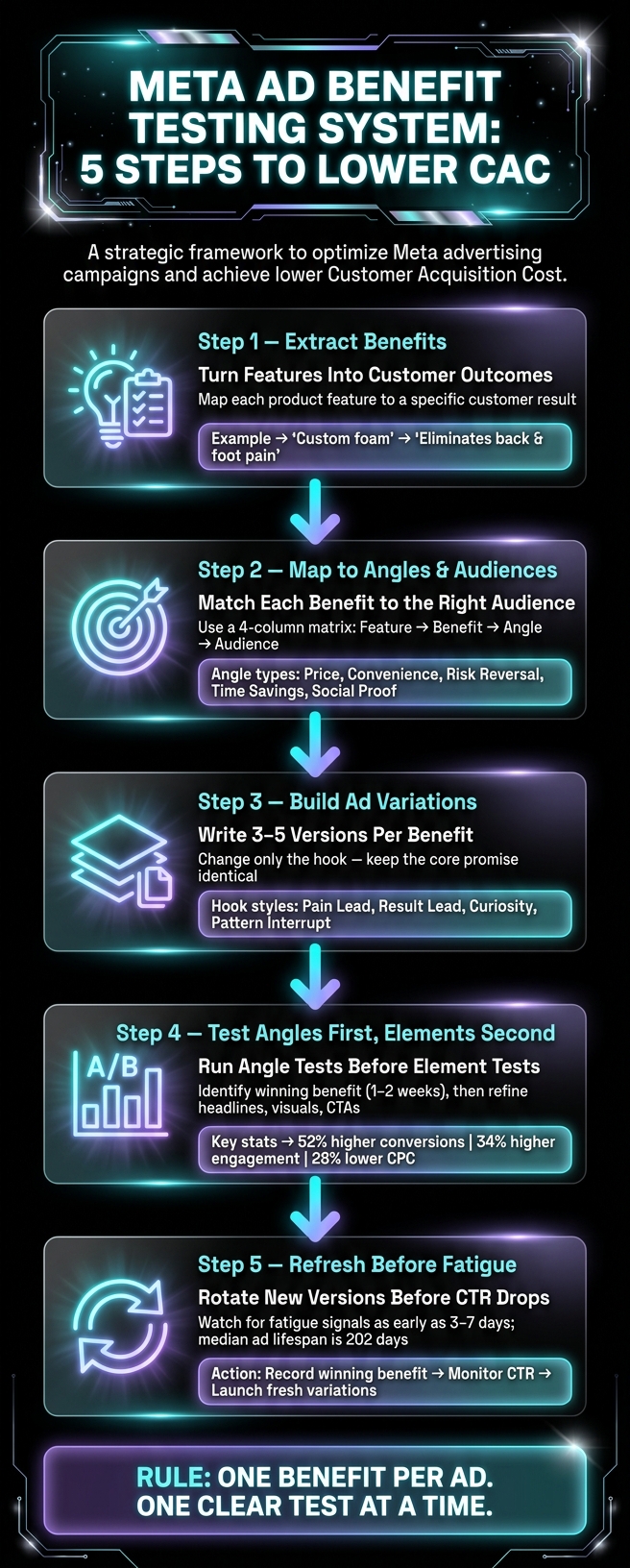
Meta Ad Benefit Testing System: 5-Step Framework to Lower CAC
1. Extract Product Benefits and Map Them to Ad Angles
Separate features from benefits before writing ads
A feature tells you what a product has. A benefit tells you what the customer gets. That difference shapes the whole ad.
Take custom-molded foam. That’s the feature. The benefit is eliminating foot, knee, and back pain. One describes the product. The other gives someone a reason to buy. Before writing any ad, stop and ask: What does this mean for the customer?
Here’s what that looks like across a few common offer types:
| Feature (Raw Capability) | Benefit (Customer Outcome) | Angle Type |
|---|---|---|
| Custom-molded foam | Eliminates back and foot pain | Pain Relief |
| 15-minute meal plans | No more 5 PM panic | Convenience |
| 100-night trial | Risk-free sleep | Risk Reversal |
| 30-second setup | Immediate tracking | Time Savings |
| Pocket-sized serum | Easy to use on-the-go | Portability |
Each row can become its own ad.
Group benefits into angles you can test
Once you’ve listed the benefits, sort them by angle type. Different people react to different ideas. Some care most about price. Others want convenience, pain relief, transformation, social proof, authority, or urgency.
A simple four-column worksheet helps here:
- Feature
- Benefit
- Angle
- Audience
That matrix gives you the raw material for ad variations and keeps the message tight and specific.
Match each angle to the audience that cares most
Not every benefit hits the same way for every audience. A budget-conscious shopper will care most about direct price comparisons. A time-poor operator running a small business is more likely to respond to 30-second setups and one-screen management. A hesitant first-time buyer often needs risk reversal, like a guarantee or 100-night trial, before they’ll click anything.
When you know which audience cares about which benefit, you stop guessing and start matching. Then you can turn each benefit-angle pair into multiple copy and creative variations.
sbb-itb-628c49f
2. Build a System for Turning Each Benefit Into Multiple Ad Variations
Use a variation matrix for copy and creative
Once you’ve mapped your benefits to angles, turn that work into a repeatable ad template. The easiest way is to build a matrix: one row for each benefit, and one column for each ad element: hook, primary text, headline, visual, CTA, and placement.
This gives you a simple way to match each benefit with the audience most likely to care about it. It also keeps your tests clean. When you track the hook, primary text, headline, visual, CTA, and placement for each version, every ad stays focused on one benefit instead of drifting in three directions at once.
| Benefit Type | Hook Direction | Suggested Creative Style | Best Placement |
|---|---|---|---|
| Price/Value | Result Lead: "Save $200 on food waste this month" | Split-screen (old price vs. new price) | Feed |
| Quality/Durability | Pattern Interrupt: "The last [product] you'll ever buy" | Product on a clean background | Stories |
| Ease of Use | Problem Callout: "Tired of the 5 PM dinner panic?" | Lifestyle product shot | Reels |
| Social Proof | Curiosity: "Why 50,000+ families switched" | Testimonial card | Feed |
Once the matrix is in place, keep each variation tied to a single benefit so the results are easier to read.
Write multiple versions without blending benefits
Blending benefits can water down the message. It also makes performance harder to interpret. A better move is to create 3 to 5 variations per benefit and change only the hook, while keeping the core promise the same.
For example, if you’re working with a time-saving SaaS benefit, you might write one version that leads with pain, one with the result, and one with curiosity.
You should also test short and long copy for that same benefit. Some audiences need very little context. Others want a bit more before they click. That’s worth finding out through the test, not guessing upfront.
One more thing: avoid personal-attribute phrasing. Use outcome-based language instead.
That setup makes bulk creative generation faster and much easier to manage.
Use ADEN'S LAB to produce static Meta variations faster
Use ADEN'S LAB to generate multiple static Meta variations from a product or landing page URL in under 90 seconds. Then take the best-performing benefit angles and turn them into test-ready direct response ads.
It also helps to refresh ads on a regular cadence so you don’t run into creative fatigue.
Next, apply the same system to e-commerce, SaaS, and lead gen offers.
How To Turn 1 Facebook Ad Into 10 Winners (My Whole Process)
3. Benefit-Led Ad Variations for E-commerce, SaaS, and Lead Gen
Use the matrix from the previous section to turn each benefit into its own angle based on the offer type. The goal is simple: take one benefit and build one clear Meta angle, one headline, and one visual around it.
E-commerce examples: price, quality, shipping, and risk reversal
For e-commerce, the price benefit can turn into a split-screen static ad with the headline "Luxury scent, soap price." The primary text compares the product head-to-head with a high-end option. It’s a simple move, but it makes the value plain fast.
The shipping benefit changes the angle completely. Instead of talking about cost or product features, it leans into speed and immediacy. Use the headline "Order today. Sleep better tonight." Pair it with a hand-held product shot, add a fast-shipping badge, and use the CTA: "Get it Now".
For quality, lead with risk reversal. A guarantee like "Sleep through the night or get your money back" works well, with the 100-night trial in the primary text. For the visual, a testimonial card or UGC-style creative fits this angle well.
SaaS examples: time savings, automation, fewer errors, and revenue impact
For a project management or workflow tool, the time savings benefit can become a pain-focused hook: "Monday morning. You're already behind on emails. The last thing you need is to waste mental energy on [Task]." Use a UI screenshot with a visible "Time Saved" metric and a direct CTA: "Start Free Trial".
The fewer errors angle should sound different. Start with a tense, familiar moment. Headline: "Stop the 5 PM panic". Then use primary text that spells out the mess of manual tracking. A before/after static works well here: messy spreadsheet on the left, clean dashboard on the right.
For automation, keep the visual clean. A plain background with a single "Automate" button can do the job. In the primary text, focus on what the tool removes from the process. Use the CTA: "See It in Action".
Lead generation examples: trust, clarity, expertise, and urgency
Service and consultation offers often fall back on vague CTAs like "Book a free call." A sharper angle ties the offer to a clear result.
The clarity angle is a good example. Use the headline "Book a 15-min audit. See your top 3 leaks and what to fix first." Then keep the primary text to one sentence that names the problem it solves. That headline makes the offer easier to grasp and cuts down click uncertainty.
For trust, be specific. Use the headline "The audit used by 2,000+ teams" and write primary text that points to a concrete result. Pair it with a testimonial card or a logo people know.
If expertise is the angle, use a third-party endorsement like "As seen in Vogue" or use a founder quote as the primary text instead of a vague claim about credibility.
For urgency, focus on late-stage leads. Use the headline "Only 3 spots left this month" with bold text overlay on a simple background. In the primary text, spell out exactly what they get, and use the CTA: "Claim Your Spot".
Next, test each benefit on its own so you can see which ones lower CAC and which ones scale.
4. Test Which Benefits Lower CAC and Scale Best
Once your benefit-led variants are ready, the next move is simple: find out which benefit brings CAC down the fastest.
Set up tests so each ad result maps to one benefit
Test one benefit at a time so you can see what’s doing the work. A common mistake is changing the benefit, the creative, and the audience all at once. When that happens, the result is muddy. You may see movement, but you won’t know what caused it.
A better setup is to group ads by benefit angle inside separate ad sets. Name each ad set after the benefit angle in your matrix. Then keep the audience, optimization, attribution, and budget the same across those ad sets. If one ad set beats the others, you can tie that result back to the benefit itself.
Run angle tests and element tests separately
Angle tests and element tests do two different jobs, so don’t mash them together.
Angle tests help you find the winning benefit. Element tests help you get more out of that winner.
Start by asking: which benefit lands best? That’s an angle test. You’re putting 3–5 different hooks in front of the same audience. Think price vs. speed vs. risk reversal.
Then, once one angle pulls ahead, move to an element test. Now the question changes: how can I get more from the angle that already won? At that point, you test new headlines, another image style, or a tighter CTA while keeping the core benefit the same.
| Testing Focus | Objective | Number of Variations | Typical Time Window |
|---|---|---|---|
| Angle Test | Identify which primary benefit/hook resonates most with the audience. | 3–5 distinct angles | 1–2 weeks or until clean data |
| Element Test | Refine the winning benefit with new headlines, visuals, or CTAs. | 3–5 iterations of the winner | 3–7 days for fast cycles, up to 4 weeks for slower ones |
Look at weekly trends, not day-to-day swings. Daily numbers can bounce around for all kinds of reasons. Give each test enough time to gather clean, statistically significant data before cutting it off.
Then use the winning angle as the starting point for your next refresh cycle.
Build a repeatable refresh cycle with ADEN'S LAB
When a winner shows up, don’t sit on it until it burns out. Rotate new versions in before results slide.
Even strong static ads don’t last forever. The median winning static ad runs for 202 days. But in fast-moving ad accounts, results can dip in as little as 3–7 days. That gap tells you something important: there’s no fixed shelf life. You have to watch the account.
The process is pretty direct:
- Record which benefit won
- Watch for CTR to start slipping
- Launch fresh static versions of that same angle before the drop gets worse
This is where ADEN'S LAB helps. You paste in your product link, and the platform generates new static Meta ad variations in under 90 seconds. That means you’re not stuck waiting on design work when fatigue starts to hit.
Track the winning benefit, watch CTR decline, and get new variations live before fatigue sets in. The aim isn’t to find one good ad and hope it lasts. It’s to build a repeatable library of winners.
Conclusion: Build a Benefit Library and Keep Testing
Now the process is in place: pull real benefits from customer language, give each ad one benefit, build a few versions around that benefit, and test angles before you tweak smaller parts.
Every proven benefit becomes an asset. Keep it organized, update it with new creative, and retire it when results start to slip.
The point is discipline. One benefit per ad. One clear test at a time.
When you find a winner, the next job is to refresh it. Creative fatigue still kills winning ads. Add new angles, cut weak ones, and refresh top ads before CTR drops. ADEN'S LAB fits right into that loop - drop in your product or landing page link and generate new static Meta ad variations in under 90 seconds.
The goal isn’t one great ad. It’s a library of proven benefits that keeps lowering CAC.
FAQs
How do I find the best product benefit to test first?
Start with the strongest value proposition tied to a clear customer pain point. A simple way to find those angles is to review long-running ads in the Meta Ad Library and pull the main benefits from your product page, especially anything linked to cost, quality, or convenience.
Then test a few clearly different benefit angles with the same audience. That helps you see which message hits hardest before you scale.
How much budget do I need for one-benefit Meta ad tests?
There’s no fixed budget for one-benefit Meta ad tests. The goal isn’t to hit one magic number. The goal is to spend enough to get in front of a large enough audience and see whether people are interested.
To keep costs in check, run tests when needed, pause weak variations, and move more budget to the ads that perform best. You should also plan for several testing rounds per ad set so you can collect enough data to spot the benefit-led angle that wins.
When should I refresh a winning Meta ad variation?
Refresh a winning Meta ad variation when you start seeing creative fatigue. For most campaigns, that shows up within two to four weeks, though timing depends on your budget and audience size.
The warning signs are pretty clear:
- Rising ad frequency
- Lower click-through rates
- Higher cost per click
- Weaker conversion performance
When that happens, don’t throw out the message that’s working. Keep the winning messaging angle, but change the way the ad looks and feels.
Create Ads That Print Money
Your competitors aren't waiting — why should you? Drop your product link → get scroll-stopping ads in 90 seconds.