The Best Budget Split for Meta Ad Creative Testing
Turn the strategy into creatives
Create Meta ads for your product
Paste your product page. ADEN'S LAB turns the offer, audience, and positioning into complete ready-to-use Meta static ads.
Free to try No prompt writing

To maximize your Meta ad performance in 2026, balancing your budget between testing new ideas and scaling proven ads is critical. Here's a quick breakdown:
- 80/20 Budget Split: Ideal for mature accounts. Allocate 80% to top-performing ads and 20% to testing new concepts.
- 60/40 Budget Split: Better for new or rebuilding accounts. Spend 60% on testing and 40% on proven ads to discover new winners faster.
- Testing Budget Formula: Calculate based on your goals:
- Monthly Testing Budget = (New Concepts × Target Conversions × CPA) + (Variants × Target Impressions × CPM/1,000).
- Key Metrics: Focus on hook rate (20%+), CTR (25–35% above baseline), and CPA (at or below target).
- Avoid Creative Fatigue: Rotate ads every 7–10 days to maintain performance.
Pro Tip: Use separate campaigns for testing (ABO) and scaling (CBO or Advantage+). Once a test ad hits 50 conversions at target CPA, move it to scaling.
Balancing testing with scaling ensures sustained results while finding new high-performing ads.
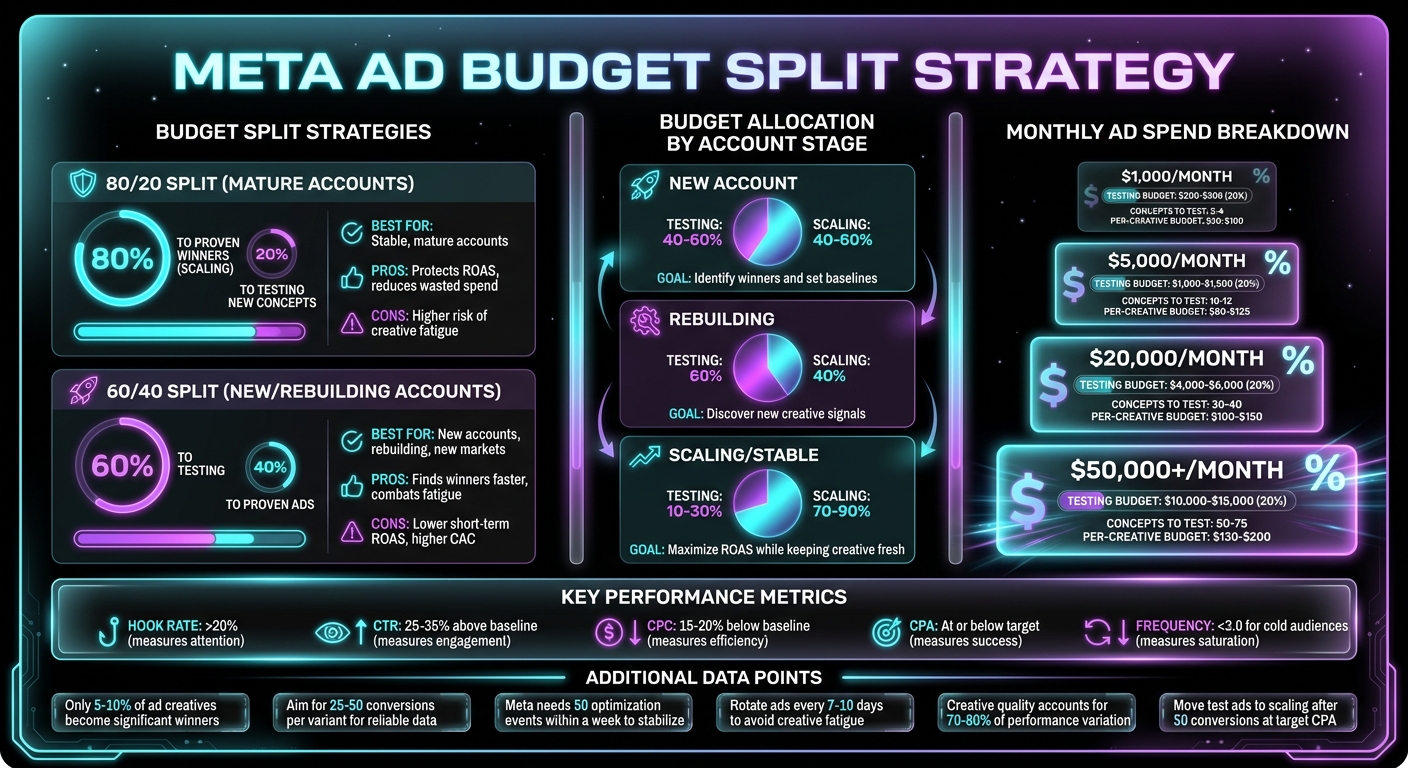
Meta Ad Budget Split Strategy Guide: 80/20 vs 60/40 by Account Stage
The 80/20 Budget Split: How to Allocate Your Meta Ad Budget

Understanding the 80/20 Rule
The 80/20 budget split is a straightforward approach: dedicate 80% of your budget to proven "control" creatives that reliably drive revenue, while reserving 20% for testing new ideas to keep your campaigns fresh and avoid creative fatigue.
Think of testing as an investment in data. It helps you identify which creatives are winners and which aren’t worth further investment. The aim is to gather enough data to make confident decisions without taking resources away from your top-performing ads.
"Creative testing isn't a percentage. It's how you buy information." - Cedric Yarish, AdManage
Here’s why this matters: only 5% to 10% of ad creatives typically become significant winners. Without a structured allocation, you risk either overspending on unproven concepts or failing to test enough to find new successes. The 80/20 rule ensures your top-performing ads continue to generate revenue while you consistently search for your next big hit.
How to Calculate Your Monthly Testing Budget
Instead of relying on a flat percentage, calculate your testing budget based on the cost of collecting enough data to make informed decisions. Use this formula:
Monthly Testing Budget = (Concepts to Validate × Target Conversions × CPA) + (Variants to Screen × Target Impressions × CPM/1,000)
Here’s an example: If you’re validating 4 new concepts, each requiring 25 conversions at a $40 CPA, the cost would be 4 × 25 × $40 = $4,000. You can also use AI to cut Meta CPA and make your testing budget go further. Add $1,200 for screening 20 variants with 5,000 impressions each at a $12 CPM. Your total testing budget would come to $5,200.
This approach scales with your monthly ad spend. Here’s how it might look:
| Monthly Ad Spend | Testing Budget (20%) | Concepts to Test | Per-Creative Budget |
|---|---|---|---|
| $1,000 | $200–$300 | 3–4 | $50–$100 |
| $5,000 | $1,000–$1,500 | 10–12 | $80–$125 |
| $20,000 | $4,000–$6,000 | 30–40 | $100–$150 |
| $50,000+ | $10,000–$15,000 | 50–75 | $130–$200 |
Aim for 25–50 conversions per variant to ensure your data is reliable. Meta’s algorithm generally needs 50 optimization events within a week to stabilize performance. Anything fewer than 10 conversions is likely just noise.
Once you’ve calculated your testing budget, you can compare the 80/20 split with other allocation strategies, like the 60/40 model.
80/20 vs. 60/40: Which Budget Split Should You Use?
The best budget split depends on your account’s maturity and goals. Established accounts often benefit from the 80/20 split, while newer or rebuilding accounts might need a 60/40 approach.
The 60/40 split allocates 60% to scaling and 40% to testing, prioritizing discovery over efficiency. While this may temporarily reduce ROAS, it accelerates the process of finding new winning creatives. For instance, RevenueCat adopted this strategy in 2025/2026 to rebuild their performance campaigns, temporarily shifting to 60% testing and 40% proven winners.
| Budget Split | Best For | Pros | Cons |
|---|---|---|---|
| 80/20 | Mature accounts, stable scaling | Protects ROAS; reduces wasted spend | Higher risk of creative fatigue |
| 60/40 | New accounts, rebuilding, new markets | Finds winners faster; combats fatigue | Lower short-term ROAS; higher CAC |
For advertisers spending less than $5,000 a month, a 60/40 split - or even a higher testing allocation - might be better. Smaller budgets collect data more slowly, so dedicating more to testing can help you uncover winners faster. Once you’re spending $20,000 or more monthly, you can shift to 80/20 or even 85/15, as the larger dollar amount will still generate enough data.
"The right creative testing budget is the smallest spend that buys enough signal to make a confident decision, while keeping your winners funded." - Cedric Yarish, AdManage
These strategies provide a solid foundation for structuring your Meta ad testing campaigns effectively.
Put the playbook to work
Apply this playbook to your page
Paste your website and the Lab will turn the strategy you are reading into a ready-to-test ads.
Free to try No prompt writing
How to Set Up Your Meta Ad Testing Campaign
Setting Up Separate Campaigns for Testing and Scaling
To get the best results, run two distinct campaigns: one for testing new creatives and another for scaling successful ones. This approach prevents budget overlap and ensures your data stays clean.
For your testing campaign, use Ad Set Budget Optimization (ABO). This method allocates a fixed budget at the ad set level, so each creative gets equal exposure. Without this control, Meta's algorithm might favor one creative too early, skewing your results.
When it's time to scale, switch to Campaign Budget Optimization (CBO) or Advantage+ Shopping Campaigns (ASC). These tools let Meta's algorithm manage your budget, directing funds to the top-performing ads automatically. This way, you can focus on maximizing revenue without constant adjustments.
Once a creative in your testing campaign achieves 50 conversions at your target KPI, move it into the scaling campaign using its Post ID. This preserves any social proof - likes, comments, and shares - that the ad has already accumulated.
Now, let’s look at some key guidelines to make your testing campaign as effective as possible.
Creative Testing Guidelines That Work
When testing creatives, keep things manageable. Limit each ad set to 3–6 ads. If you add too many, Meta's algorithm might prematurely favor one, leaving others without enough data to evaluate.
Your daily budget should be 1–2x your target CPA per ad set. For instance, if your target CPA is $40, allocate $40–$80 per day per ad set to gather meaningful data efficiently.
Set up "kill rules" to pause ads that spend 2–3x your target CPA or AOV without generating a purchase. Allow 3–5 days before making any optimization decisions; this gives Meta’s delivery system enough time to exit the learning phase.
"Every ad set is a theory. You have to know why you are testing the ads within it." - Structured Agency
Focus on testing one variable at a time. For example, if you're testing headlines, keep visuals and CTAs the same. This ensures that any performance changes can be linked directly to the headline.
Lastly, consider using ADEN's LAB to streamline your creative production process.
Using ADEN's LAB to Generate High-Volume Ad Creatives

Creative fatigue is a common challenge, but ADEN's LAB offers a way to keep your campaigns fresh. Traditional UGC production can cost $50–$300 per video, plus 30–50% usage fees. Testing 30–50 creatives monthly at those rates isn’t feasible for most advertisers.
ADEN's LAB simplifies this by producing high-performing static Meta ads in under 90 seconds. Depending on your plan, you can create anywhere from 30 to 200 static ads per month, with costs as low as $0.90 per ad on the Apex Mode plan. This eliminates the creative bottleneck and allows you to test at the scale needed to find consistent winners.
Static ads remain one of the most effective and budget-friendly formats on Meta. They’re quicker to test, easier to tweak, and give you full control over the messaging and design. With ADEN's LAB, you can consistently launch new creatives every week, staying ahead of creative fatigue without relying on external designers or agencies.
How to Adjust Budget Splits Based on Your Account Stage
Budget Splits for New, Rebuilding, and Scaling Accounts
The stage of your account plays a big role in determining how you should allocate your budget. For new accounts, the focus should be on discovery rather than efficiency. During the first few months, split your budget evenly between testing and scaling - 40–60% for each. This approach helps you identify high-performing creatives and establish performance benchmarks before diving into heavy scaling. Balancing these priorities ensures your testing aligns with your broader campaign objectives.
If you're in a rebuilding phase, the strategy shifts. For accounts where ROAS has dropped or you're stuck in Learning Limited status, flip the typical allocation. Dedicate 60% of your budget to testing and 40% to proven creatives. This emphasis on testing can uncover fresh creative signals. For example, a supplement brand reversed a ROAS decline by consolidating its testing efforts, proving how adjusting budget splits can make a difference.
For scaling accounts, the majority of your budget should go toward proven "control" creatives. An 80/20 or 70/30 split works well here, with a smaller portion reserved for testing. If you're managing a mid-budget account spending $100–$500 daily, consider the 60-30-10 rule: 60% for proven winners, 30% for variations (like alternate hooks or thumbnails), and 10% for brand-new concepts.
As you implement these allocation strategies, keeping a close eye on performance metrics is critical to making timely adjustments. Using AI budget allocation can further streamline this process by automating shifts based on real-time data.
Performance Metrics That Signal Budget Changes
To refine your budget allocation, monitoring key performance metrics is essential. For example, if your CPA doubles your target or your ROAS dips for three consecutive days, shift more of your budget back into testing. Similarly, if your frequency rises above 3.5–4.0 and your CTR drops, it's a sign that your scaling ads are wearing out and need refreshing.
Meta's algorithm requires about 50 optimization events per ad set over seven days to stabilize. Making decisions based on only 5–10 purchases often leads to unreliable insights. Before moving a test ad into a scaling campaign, ensure it maintains a profitable CPA for at least seven days and generates 30–50 conversions.
"Creative testing isn't a percentage. It's how you buy information." – Cedric Yarish, AdManage
It's also worth noting that high engagement doesn't always translate into high conversions. Meta needs actual conversion data to differentiate between ads that simply attract clicks and those that drive sales. Allow 3–5 days before making budget adjustments, as the learning phase can be especially volatile in the first 24–48 hours.
Budget Split Comparison by Account Stage
Here's a quick breakdown of how to allocate budgets based on your account stage:
| Account Stage | Testing Budget | Scaling Budget | Primary Goal |
|---|---|---|---|
| New Account | 40% – 60% | 40% – 60% | Identify winners and set performance baselines. |
| Rebuilding | 60% | 40% | Discover new creative signals to replace fatigued winners. |
| Scaling/Stable | 10% – 30% | 70% – 90% | Maximize ROAS while keeping creative fresh. |
For instance, in 2026, RevenueCat tackled a rebuilding phase by dedicating 60% of its budget to creative testing and 40% to proven winners. This strategy helped reset their performance. Keep in mind that only 5–10% of new creatives typically turn into "big winners". Most tests will underperform, but the goal is to find those standout concepts that can drive results.
Meta’s New Creative Testing Feature with Budget Controls!
How to Measure Results and Improve Your Budget Strategy
To get the most out of your Meta ad campaigns, you need to track results carefully and fine-tune your budget strategy along the way.
Metrics to Track for Testing Success
Keeping an eye on the right metrics helps you identify winning ads early and stop underperformers before they waste your budget. A metric hierarchy can guide your focus: Hook Rate (attention) → CTR (engagement) → Conversion Rate (intent) → CPA/ROAS (success).
Start with the hook rate - this measures how well your ad grabs attention. If it’s below 20% on Meta, it’s not strong enough to make an impact on other metrics. Next, monitor CTR and the "thumb-stop rate" (the percentage of users who stop scrolling) during the first 24–48 hours, as these are key early indicators before conversion data fully develops. These metrics help you spot promising ads faster.
For overall success, focus on CPA and ROAS. A creative is considered a "winner" when it beats your control by 15–20% with enough conversions to ensure reliable data. On the flip side, pause ads that spend 2–3x your target CPA without a single conversion, or if ROAS drops 30% below target for three consecutive days. Aim for at least 50 conversions per ad to minimize data noise, as fewer conversions can lead to unreliable results.
| Metric | Purpose | Success Threshold |
|---|---|---|
| Hook Rate | Measures attention-grabbing | >20% |
| CTR | Measures engagement/interest | 25–35% above baseline |
| CPC | Measures traffic efficiency | 15–20% below baseline |
| CPA | Measures bottom-line success | At or below target |
| Frequency | Measures audience saturation | <3.0 for cold audiences |
Once you’ve identified winners, focus on automating budget allocation to ensure your resources are used effectively.
Automating Budget Reallocation to Winning Ads
Automation is key to ensuring your budget flows toward the best-performing creatives. For example, pause ad sets that exceed double your target CPA without conversions. This prevents wasted spending and keeps your campaigns efficient.
To avoid the algorithm prematurely favoring one ad, set automated spend caps to limit how much any single ad can spend during testing. This ensures all ads in the test receive enough impressions to gather meaningful data.
When you find a winning creative, use its Post ID to scale it while preserving its social proof. Tools like ADEN's LAB can speed up this process by generating large volumes of static Meta ads, allowing you to test and scale quickly without relying on designers or agencies.
Refining Your Budget Split Over Time
Your budget split should adapt as your account’s performance trends become clearer. While reviewing results monthly, update your budget splits quarterly. A 60-30-10 rule can replace the standard 80/20 split: allocate 60% of your budget to proven winners, 30% to variations of those winners, and 10% to entirely new ideas.
If your current winners start showing fatigue - such as rising frequency or a drop in CTR - shift more budget toward testing to find the next winning creative. Also, monitor your winner graduation rate (the percentage of tested creatives that succeed and scale). If it’s under 5%, revisit your creative strategy instead of just increasing spend. Typically, only 5–10% of tested creatives turn into scalable winners, so focus on improving the quality of your tests rather than just testing more.
For example, an e-commerce supplement brand experienced a sharp drop in ROAS, from 1.35 to 0.75, after launching six new ads that diverted budget from proven winners. By pausing all tests and reallocating 100% of their budget to top-performing ads for a week, they quickly rebounded to a 2.5 ROAS in just five days. This demonstrates how decisive budget adjustments can rapidly reverse performance issues.
Conclusion
Getting your Meta ad budget split right isn’t about sticking to a fixed formula - it’s about building a system that adapts as your account evolves. For accounts in a steady state, the 80/20 rule (80% for scaling, 20% for testing) can work well. But if you’re in a rebuilding phase or aiming for aggressive growth, a shift to a 60/40 or even 40/60 split might make more sense. Think of your testing budget as an investment in learning what works.
With Meta’s Andromeda algorithm, creative quality plays a massive role in performance, accounting for 70–80% of the variation in results. Ads lose their effectiveness quickly if they go stale. To combat this, top brands in 2026 are rotating new ads every 7 to 10 days to avoid creative fatigue. This is where tools like ADEN’s LAB can make a big difference - they allow you to produce large volumes of static Meta ads quickly, so you can test without waiting on design bottlenecks.
Keep your key metrics in focus. Look for click-through rate (CTR) improvements of 25–35%, and ensure your cost-per-acquisition (CPA) stays within your target range. Keep in mind, only 5–10% of the creatives you test are likely to become scalable winners. A balanced approach is key: protect the performance of proven winners while consistently testing fresh ideas.
At its core, successful Meta advertising relies on systematic testing that helps uncover repeatable patterns. Make sure you clearly separate your testing efforts from your scaling campaigns. Let tests run for at least 3 to 5 days before making decisions, and don’t hesitate to pause underperforming creatives based on early signs.
FAQs
How do I know if my account should use 80/20 or 60/40?
Choosing between an 80/20 or 60/40 budget split comes down to your account's goals and how much testing you’re ready to handle.
- 80/20: Put 80% into scaling what already works and 20% into testing fresh ideas. This works well for accounts that are steady and have reliable winning strategies in place.
- 60/40: Dedicate more resources to testing - perfect for accounts in the early stages or those exploring new creative directions.
Think about factors like how stable your performance is, the size of your audience, and what you’re aiming to achieve.
What’s the minimum budget needed to test creatives reliably?
To test creatives effectively on Meta, you should allocate a budget of around $30 to $50 per conversion, depending on your campaign goals. To gather reliable data, aim for at least 50 conversions, which means you'll need a total budget of $1,500 if your cost per acquisition (CPA) is $30, or $2,500 if your CPA is $50. Be sure to adjust these figures based on the specific insights you're looking to achieve and your testing objectives.
When should I move a test ad into my scaling campaign?
When a test ad consistently delivers strong results and proves to be a top performer, it's time to transition it into your scaling campaign. This usually follows a well-organized testing process that focuses on isolating variables and validating the ad's success, as outlined in common strategies. Make sure the ad has shown steady performance across essential metrics before scaling to ensure the best possible outcomes.
Your next ad batch starts here
Finish with a ready-to-test ad batch
Paste your website to generate static creatives. Drop the link → get ads in about 90 seconds → upload them to Meta → scale.
Free to try No prompt writing