AI Tools for UGC Ads: Turn Raw Footage Into High-Performing Meta Videos Faster
Try the workflow instead of comparing it
See what an AI ad generator makes from your product
Paste your product page and get a complete Meta ad batch—creative concepts, images, headlines, and copy—without another tool stack.
Free to try No prompt writing
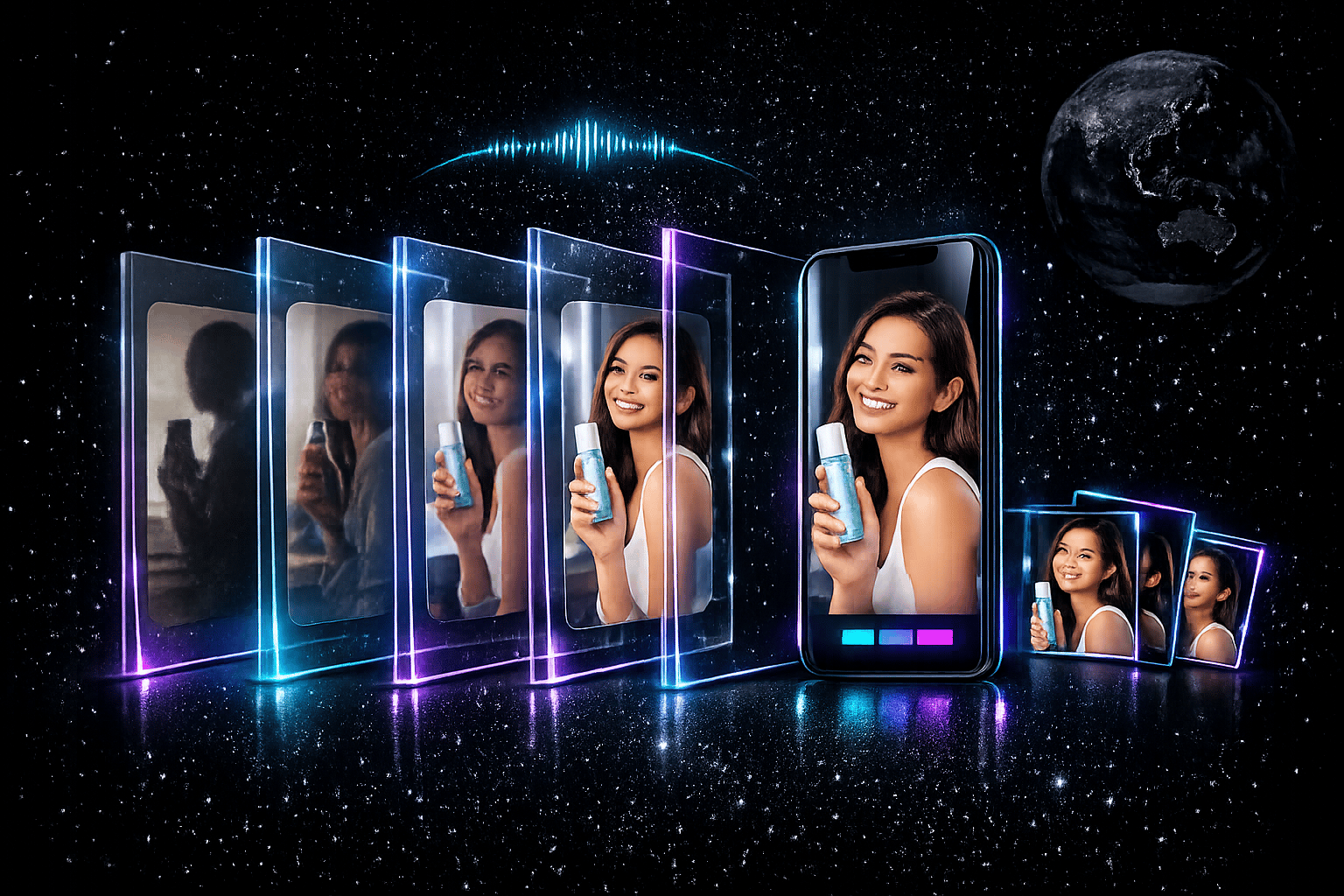
Hook: Editing raw user-generated content (UGC) for Meta ads doesn't have to take weeks or cost thousands. AI tools can transform raw clips into polished, high-performing ads in minutes.
Value Summary: UGC ads outperform traditional ads by building trust and delivering better engagement at lower costs. But raw UGC footage often needs refinement - like trimming dead air, adding captions, and creating scroll-stopping hooks. AI tools like Runway ML, Descript Overdub, and CapCut streamline this process, cutting editing time drastically and ensuring consistent results. Brands using these tools have reported up to a 340% boost in return on ad spend (ROAS) and significant cost savings.
Quick Overview:
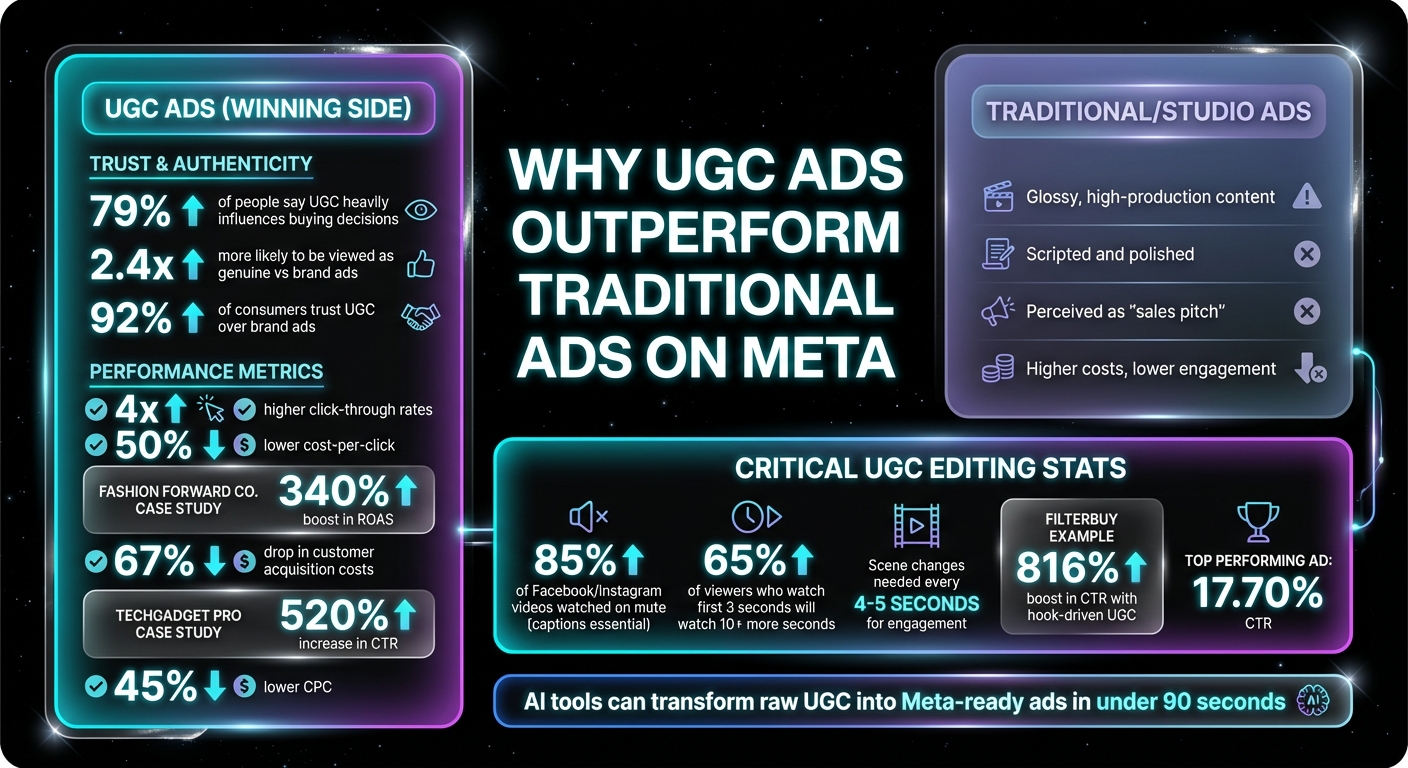
- Why UGC Works: 92% of consumers trust UGC over brand ads; UGC ads deliver 4x higher click-through rates and 50% lower CPC.
- Challenges with Raw UGC: Poor pacing, lack of captions, and unengaging hooks reduce ad performance.
- AI Solutions: Tools like Runway ML (visual cleanup), Descript Overdub (audio fixes), and CapCut (final edits) make editing faster and scalable.
- Real Results: Brands like Fashion Forward Co. and TechGadget Pro have seen ROAS improvements of 340%+ and cost reductions using AI-driven workflows.
Bridge: Let’s explore how AI tools simplify UGC production and help scale Meta campaigns by optimizing your AI budget allocation to avoid creative bottlenecks.
UGC vs Traditional Ads Performance Metrics Comparison
Why UGC Ads Outperform Polished Studio Content on Meta
Real People Build Real Trust
When scrolling through Instagram or Facebook, users can spot a sales pitch from a mile away. Those glossy, high-production studio ads? They scream "advertisement" with their perfect lighting, scripted lines, and overly enthusiastic actors. And what happens? People scroll right past them.
User-generated content (UGC), on the other hand, feels like a friend sharing a recommendation. It’s authentic, relatable, and rooted in real-life experiences. Research backs this up: 79% of people say UGC heavily influences their buying decisions, and consumers are 2.4 times more likely to view UGC as genuine compared to brand-created ads. Think about it - would you trust a friend's advice or a flashy commercial? That relatability builds trust, and trust drives results.
Better Engagement at Lower CPMs
That trust doesn’t just feel good - it delivers hard numbers. UGC ads outperform traditional content with 4x higher click-through rates and 50% lower cost-per-click. This means better return on ad spend (ROAS) and lower customer acquisition costs (CAC).
And here’s the kicker: lower engagement costs lead to reduced CPMs, making Meta’s algorithm favor your ads in auctions. Take Fashion Forward Co., for example. When CMO Sarah Chen switched from polished agency content to UGC-focused testing, the company saw a 340% boost in ROAS and a 67% drop in CAC. Similarly, TechGadget Pro’s Growth Director Mike Rodriguez cut their $50,000 monthly agency spend in favor of UGC-driven ads. The result? A 520% increase in CTR and 45% lower CPC.
These success stories highlight how UGC isn’t just about authenticity - it’s a cost-effective powerhouse that delivers results. And with AI tools, transforming raw UGC into high-performing Meta ads is easier than ever. This allows brands to scale winning creatives across their entire account efficiently.
Put the playbook to work
Apply this playbook to your page
Paste your website and the Lab will turn the strategy you are reading into a ready-to-test ads.
Free to try No prompt writing
The Real Problems With Raw UGC Footage
Many advertisers learn the hard way that raw user-generated content (UGC) often falls flat without proper editing. A 90-second clip might seem authentic, but if the hook doesn’t come early enough, it’s likely to lose viewers. Add in awkward pauses, clunky transitions, or poorly framed mobile shots, and the chances of success drop even further. With 85% of people watching Facebook and Instagram videos on mute, skipping captions means most viewers won’t even catch your message.
Raw Footage Needs Serious Refinement
Raw UGC often includes "dead air" - those dull intros, long silences, or static shots that add no value. On platforms like Meta, where attention spans are short, scenes need to change every 4–5 seconds to keep people engaged. Raw clips rarely meet this standard. To turn them into high-performing ads, you’ll need to:
- Cut out unnecessary or boring segments.
- Add B-roll footage to keep the visuals dynamic.
- Include captions for silent viewers.
- Rework the opening seconds to create a scroll-stopping hook.
Why is that first impression so crucial? Because 65% of viewers who stick around for the first three seconds will watch at least 10 more seconds. That’s why editing isn’t just a nice-to-have - it’s essential for performance.
Take Filterbuy, for example. In 2026, they revamped their approach by moving away from slow, passive ads to hook-driven UGC campaigns targeting homeowners aged 55+. By sharpening their creative briefs and quickly trimming out unengaging parts, they achieved an 816% boost in average click-through rates (CTR). Their top-performing ads hit a 17.70% CTR. This kind of success didn’t come from untouched footage - it came from strategic, performance-focused editing.
But even the best-edited clips can only go so far if you’re not producing enough fresh content.
Running Out of Creatives Stalls Growth
Even with polished edits, a lack of creative variety can stop your campaign from scaling. On Meta, scaling isn’t just about increasing your budget - it’s about keeping your audience engaged with new content. Repeatedly showing the same ad leads to creative fatigue, where performance dips as cost-per-acquisition (CPA) rises and click-through rates fall. Waiting for an editor or agency to deliver new assets - often a two-week process - can leave you stuck, wasting money on stale ads while competitors push fresh ideas.
To avoid this, high-performing brands typically need 8 to 20 new ad variations every month. Without that steady flow of creatives, you risk burning your budget on ads that no longer resonate, while competitors continuously test new angles to capture attention.
These challenges - editing inefficiencies and creative bottlenecks - highlight the growing need for AI to step in and transform UGC into scalable, high-performing ad content.
How AI Speeds Up UGC Production
AI cuts through the bottlenecks that often slow down user-generated content (UGC) production. In traditional workflows, editors spend hours reviewing footage, making subjective calls, and dealing with feedback loops that can drag on for days. AI flips the script by analyzing raw clips, identifying high-performing elements based on data, and producing polished ads - all in the time it takes for a quick coffee break. This speed transforms the editing process into something far more efficient.
Edit and Optimize in Minutes, Not Days
Creative fatigue and lengthy production timelines are common challenges, but AI offers a faster alternative. Forget detailed briefings and endless revisions - AI can analyze, trim, adjust, and format footage for platforms like Meta in under 90 seconds. To put that into perspective, while a manual team might churn out 10 ads in two weeks, AI can deliver over 100 performance-ready ads in a single day. This level of output allows you to test multiple hooks and creative angles simultaneously, helping Meta's algorithm quickly identify which ads resonate most with audiences.
Eliminate Quality Inconsistency
Speed is only part of the equation - consistent quality is just as critical for scaling campaigns. AI ensures this by leveraging performance-tested templates, so every ad meets the same high standard. This consistency ensures that variations in ad performance are driven by creative decisions, not uneven editing. The results speak for themselves: AI-generated ads have been shown to outperform human-made ads by an average of 340%, thanks to their focus on what truly drives clicks and conversions.
AI Tools That Turn UGC Into Meta-Ready Videos
Once you see how AI can speed up production, the next step is figuring out which tools can actually handle the job. Three standout tools tackle different parts of the editing process: cleaning up video, fixing audio, and adding finishing touches. Each one solves a common problem in UGC (user-generated content) production. When used together, they can make the entire workflow faster and smoother. Let’s break down how each tool fits into the process.
Runway ML
Runway ML is a game-changer for cleaning up raw UGC footage. It handles tasks like background removal, video enhancement, and quick edits, all through an easy-to-use interface. UGC is often filmed in less-than-ideal settings - think cluttered living rooms or noisy parking lots - where distracting visuals can hurt ad performance. Traditional editing tools like Adobe Premiere require a lot of technical knowledge, but Runway ML skips the complicated steps. What might take 30 minutes in typical software can be done in just 3–5 minutes here. Since Meta’s algorithm tends to favor clean, focused content, this step is essential. Start your editing process with Runway ML to stabilize shaky clips and isolate the product in the frame. Once the visuals are polished, it’s time to address audio issues.
Descript Overdub

Descript Overdub is your go-to for fixing audio problems and handling transcription. It simplifies audio editing by letting you adjust the transcript directly - any changes you make to the text are instantly reflected in the audio using AI voice synthesis. This is especially helpful for fixing common UGC issues, like background noise, awkward pauses, or filler words that interrupt the flow. If re-recording voiceovers isn’t an option, Descript even lets you clone a creator’s voice to make adjustments or test different messaging approaches. That said, it works best with relatively clean audio; recordings with heavy noise might still need some manual tweaking. Once the audio is cleaned up, you can move on to refining the video’s pacing and style.
CapCut AI Features

CapCut is perfect for adding the finishing touches to your UGC videos. It’s beginner-friendly and packed with features like text overlays, transitions, and automatic pacing adjustments. After fixing the technical and audio aspects, CapCut helps you polish the video with engaging captions, smooth transitions, and optimized pacing. The platform can automatically detect scene changes and recommend transitions, saving you time when editing multiple shots. It also supports various aspect ratios - like 9:16 for Stories and Reels or 16:9 for YouTube - ensuring your content is ready for any platform. Plus, its auto-caption feature can boost viewer engagement by making your video more accessible. Use CapCut to add these creative elements after cleaning up the footage and audio, so the final product is polished and ready for Meta.
The ideal workflow is simple: start with Runway ML for visual cleanup, move to Descript Overdub for audio fixes, and finish with CapCut for creative enhancements. This order works because the first two tools prepare the raw footage, allowing CapCut to shine during the final stage. Reversing the order could mean redoing creative edits later, which wastes time. By following this sequence, you can produce a Meta-ready video in just 30–40 minutes - a fraction of the time traditional editing would take. This streamlined approach not only saves time but also allows advertisers to quickly test and scale their campaigns, a must in today’s fast-paced marketing world.
Pairing UGC Videos With Static Ads From ADEN's Lab
Once your UGC (user-generated content) videos are polished, consider pairing them with static ads instead of producing more videos. Videos are great for grabbing attention and building trust, but static ads let you test multiple messaging angles quickly. This approach increases your testing options without adding to production challenges, making your ad campaigns more efficient and varied.
AI video editing tools can only do so much with limited footage, and creating UGC videos takes time. Even with AI, you're restricted by how much raw content your creators can provide. Static ads solve this issue by allowing you to test different hooks, benefits, and objections almost instantly. With ADEN's Lab, for example, you can simply input your product link, and in just 90 seconds, the platform analyzes your page for key benefits, customer feedback, and social proof. It then generates Meta-ready static ads - no need for prompts or detailed design instructions.
This method leverages your existing content to its fullest. Use your videos to capture attention and establish credibility, then follow up with static ads to address specific objections or emphasize clear advantages. For instance, if a potential customer watches an unboxing video but doesn’t buy, a retargeting static ad can directly address their hesitation by reinforcing the product’s benefits or tackling common concerns.
In March 2025, Fashion Forward Co. successfully used this strategy to overcome creative fatigue and production bottlenecks. Their CMO, Sarah Chen, shared that ADEN's Lab generated over 200 ad variations in just one day. In contrast, their previous agency took three weeks to produce only 10 ads. The AI-generated ads outperformed the human-created ones by 340%, resulting in $2.3 million in additional revenue and a 67% drop in customer acquisition costs. Similarly, TechGadget Pro’s Growth Director, Mike Rodriguez, reduced agency spending from $50,000 per month to just $500 by using AI tools. This shift led to a 520% increase in click-through rates.
The real advantage here isn’t just speed or cost savings - it’s the sheer volume of possibilities. At $9 for 10 ads, you can test a wide range of creative ideas without overwhelming your team. By providing Meta’s algorithm with a diverse set of assets, you enable faster learning and scaling, all while amplifying the impact of your UGC content without overloading your creative resources by automating Meta ad production.
How to Scale UGC Campaigns Without Burning Out Creatives
After exploring how AI can enhance production, the next step in scaling campaigns is smarter testing and proactive ad rotation and scheduling. The challenge isn’t just about running out of fresh content - it’s about keeping the flow of effective ads steady without overwhelming your creative team. The solution? High-volume testing and preemptive ad rotation, supported by automation tools that ensure fresh ads are always in play. Let’s break this down into two core strategies: testing more creatives and rotating ads before they lose their impact.
Test More Creatives to Find More Winners
When scaling Meta ad spend from $10K to $50K daily, you’ll need 50–100 new UGC variants weekly. This high volume is critical to maintaining steady ROAS as you increase budgets. Meta’s algorithm thrives on fresh, high-performing creatives, and testing only a few ads will eventually leave the system starving for new data.
Here’s the reality: most ads won’t perform well, but that’s expected. The goal is to uncover the 5–10 winners that drive results. Testing 10 to 20 creatives per campaign can increase ROAS by 20%–30% compared to relying on just one or two ads. Winning creatives often show a CTR above 1.5%–2%, achieve a ROAS of 2.5x or more, and meet your target CPA within 24–48 hours of launch. Track these metrics in Ads Manager, and quickly pause underperformers to focus on the winners.
Since UGC creators can’t realistically produce 50 videos a week, mixing UGC content with static ads is a practical alternative. For example, use your UGC videos to create attention-grabbing hooks, then pair them with static ads from services like ADEN’s Lab. This tool lets you upload a product link and receive 10 Meta-ready ads in 90 seconds for just $9. By testing a variety of messaging angles, objections, and benefits, you can keep your campaigns fresh while your UGC creators focus on what they do best.
Rotate Ads Before Performance Drops
Identifying winning creatives is just the first step - keeping their performance steady is the real challenge. Creative fatigue can damage campaign results faster than poor targeting. When the same ad runs for three to five days, CPMs can increase by 30%–50%, and ROAS can plummet by half. This happens because Meta initially serves ads to high-intent users, but as that audience saturates, you end up paying more to reach new viewers.
Proactively rotating ads prevents this decline. Instead of waiting for performance to drop, rotate your winning ads into fresh campaigns every 48–72 hours. Here’s a simple workflow to follow:
- Days 1–2: Launch 20 UGC videos.
- Day 3: Pause any ad with a CTR below 1% and allocate about 20% of your budget to the winners.
- Days 4–5: Move those winners into new ad sets targeting fresh audiences.
- Day 6: Introduce 20 new variants - whether it’s updated UGC edits or static ads from ADEN’s Lab - and repeat the process weekly.
This rotation strategy has helped e-commerce brands maintain a 3x ROAS while scaling campaigns to over $100,000 per month.
One common mistake advertisers make is overcommitting to a single winning ad. For instance, an ad might hit 4x ROAS, prompting a surge in budget allocation, only for its performance to collapse within a week. This can waste 40%–60% of your spend on a fatigued creative. The key is to treat every winning ad as temporary. Rotate it regularly, test its variations, and always have fresh creatives ready to replace it when performance dips. Automation tools can handle much of this workload, ensuring your team stays focused and Meta’s algorithm continues to deliver results efficiently.
Conclusion
Scaling UGC campaigns often hits a roadblock when it comes to production. The challenge? Inconsistent creator output and delays in editing mean that by the time content is ready, it can already feel outdated. Enter AI tools like Runway ML, Descript, and CapCut, which shrink editing time from days to mere minutes.
The next step in this streamlined process involves pairing these AI-enhanced UGC videos with a high volume of static ads. Static ads are quick to produce and allow for testing multiple messaging angles at scale, driving conversions further down the funnel. Together, this creates a steady flow of fresh content that keeps Meta's algorithm engaged - without overloading your team.
The real game-changer? Tools like ADEN's LAB. For just $9, you can drop in a product link and churn out 10 Meta-ready static ads in just 90 seconds. This speed allows brands to test various benefits, address objections, and refine messaging quickly. Brands using this hybrid approach have reported maintaining a 3x ROAS while scaling beyond $100,000 in monthly ad spend.
Meta rewards advertisers who consistently refresh their creative assets to lower costs and improve performance. The best performers are those who test new ideas quickly, retire underperforming ads, and feed the algorithm with a constant stream of fresh content. Waiting weeks for ad delivery? That’s a surefire way to fall behind.
FAQs
What’s the fastest workflow to turn raw UGC into a Meta-ready ad?
The quickest way to transform raw user-generated content (UGC) into an ad ready for Meta is by leveraging an AI-powered tool that generates high-performing ads instantly. All you need to do is upload your product link or footage. The AI takes care of the rest - analyzing the content, pulling out key elements, and creating multiple ad variations on its own. This process removes the need for tedious manual edits and lengthy production timelines, allowing you to launch campaigns faster and scale with ease.
How can I tell if an ad is getting fatigued on Meta?
When an ad's cost per result doubles compared to its earlier performance, its click-through rate (CTR) declines, or its frequency (the number of times the same audience sees the ad) climbs sharply, it’s a sign the ad might be losing its effectiveness. A high frequency often signals overexposure, which can lead to poor results and unnecessary spending.
When should I use static ads from ADEN’s Lab instead of making more UGC videos?
Static ads from ADEN’s Lab are a quick and effective solution when you need high-performing creatives but don’t have fresh video content on hand. They’re perfect for situations like testing out new products, tackling creative fatigue, or launching campaigns at short notice. These ads are instantly generated from a website link, making them ready to deploy in no time.
Your next ad batch starts here
Finish with a ready-to-test ad batch
Paste your website to generate static creatives. Drop the link → get ads in about 90 seconds → upload them to Meta → scale.
Free to try No prompt writing