AI Tools for Scaling Meta Ads: What to Automate First at $10K, $30K, $100K Per Month
Try the workflow instead of comparing it
See what an AI ad generator makes from your product
Paste your product page and get a complete Meta ad batch—creative concepts, images, headlines, and copy—without another tool stack.
Free to try No prompt writing

Scaling Meta ads becomes complex as your budget grows. Here's a quick breakdown of what to automate at key spending levels:
- $10K/month: Focus on automating ad creation to avoid creative fatigue. Use tools like ADEN'S LAB to quickly generate dozens of ad variations without relying on designers.
- $30K/month: Automate budget allocation and targeting. Rule-based systems can reallocate spend to top-performing ads and pause underperformers in real time.
- $100K/month: Automate the entire campaign workflow. This includes hourly budget adjustments, audience expansion, and constant ad production to replace fatigued creatives.
Automation ensures your campaigns stay efficient, reduces wasted spend, and keeps performance high as your ad spend scales. Below, we’ll dive into the specific tools and strategies for each level.
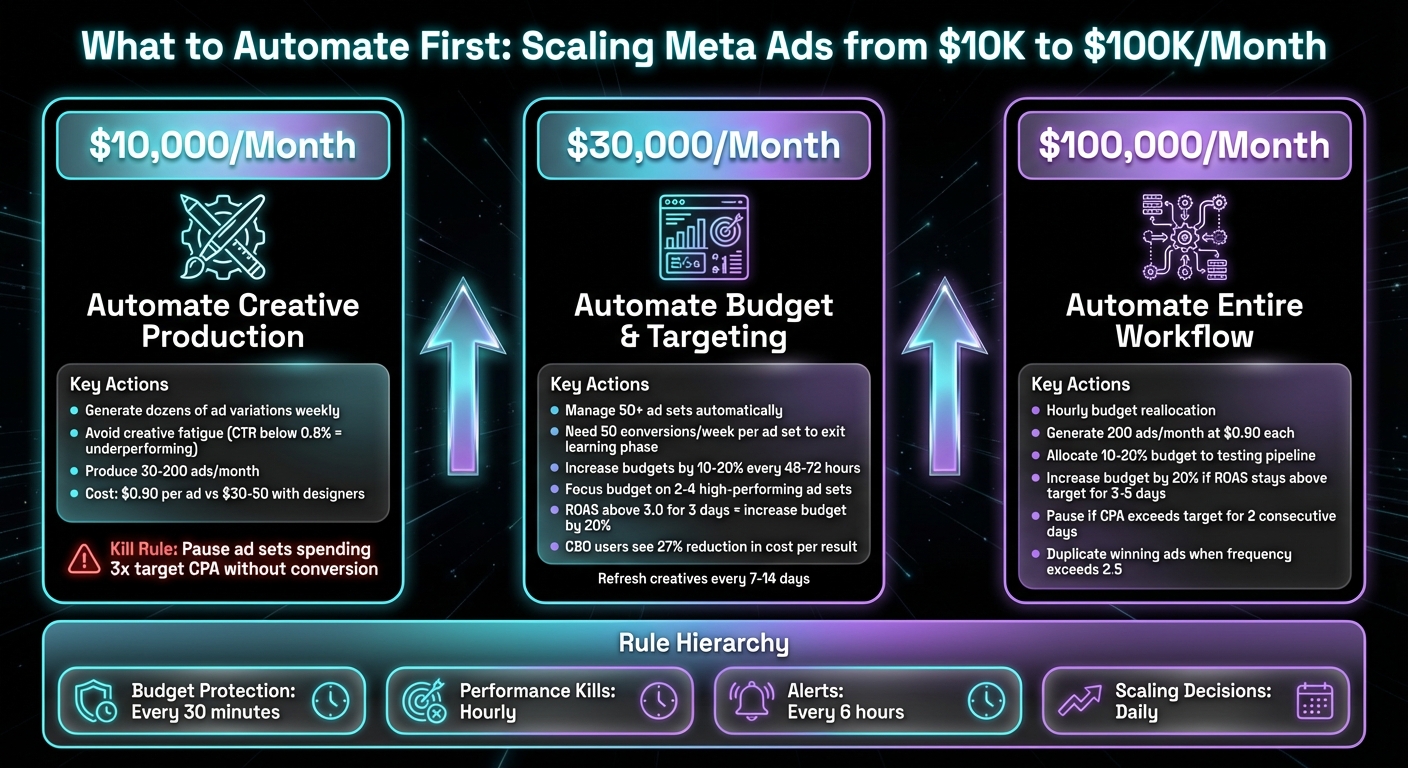
Meta Ads Automation Strategy by Budget Level: $10K, $30K, $100K Monthly Spend
Scaling to Six Figures a Day: The Ultimate Meta Ads Playbook
Put the playbook to work
Apply this playbook to your page
Paste your website and the Lab will turn the strategy you are reading into a ready-to-test ads.
Free to try No prompt writing
At $10K/Month: Automate Creative Production First
When you're spending $10,000 a month on ads, your biggest hurdle isn’t managing the budget or refining your targeting. It’s keeping up with the demand for fresh creative content. Many advertisers hit a wall when their creative supply runs dry, even while their budget remains untouched. This creative bottleneck can derail an otherwise promising campaign.
Creative Fatigue Kills Performance Fast
Reusing the same ad over and over leads to diminishing returns. Click-through rates (CTR) drop, cost-per-acquisition (CPA) climbs, and return on ad spend (ROAS) takes a hit. Why? Audiences get bored. If your CTR dips below 0.8% after 1,000 impressions, that ad is already underperforming. At that point, you’re essentially throwing money at impressions that won’t convert.
The problem is that many advertisers can’t produce new ads fast enough. A single designer might need three to five days to create one ad. Add in revisions, and your campaign slows to a crawl. This delay makes it impossible to keep up with the fast-paced demands of digital advertising.
How to Generate Ads Without Designers
This is where automation steps in to save the day. Instead of relying on creative teams or agencies, you need a tool that can churn out ads in minutes. That’s exactly what ADEN'S LAB offers. By simply entering your product or landing page link, the platform generates high-performing, static Meta ads tailored for Facebook and Instagram. No lengthy setup, no endless back-and-forth - just ready-to-launch, eye-catching ads.
At a $10K monthly spend, you should aim to test dozens of ad variations every week. With ADEN'S LAB, you can produce 30, 50, or even 200 ads per month, depending on your plan. This ensures you’ll always have fresh creatives ready to go, without the hefty designer fees of $30–$50 per ad. By keeping your creative pipeline full, you can avoid costly campaign pauses and maximize your ad spend.
Mistakes That Waste Money at $10K
Even with rapid creative production, there are common pitfalls that can eat into your budget. One major mistake is testing too few ad variants. Launching just two or three ads a week limits your chances of finding a high-performing winner. Meta’s algorithm thrives on variety, and a steady stream of fresh ads keeps your audience engaged.
Another trap is spending too much time perfecting a single ad. Some advertisers waste an entire week tweaking one creative, only to find out it doesn’t perform once it’s live. Automation allows you to launch ads quickly, test multiple options, and cut underperformers before they drain your budget.
To stay efficient, set up a rule to pause any ad set that spends three times your target CPA without generating a conversion. At a $10K spend, every dollar matters. Streamlining creative production and avoiding these missteps will help you get the most out of your budget.
At $30K/Month: Add Budget and Targeting Automation
When your monthly ad spend hits $30K, manually managing budgets and targeting becomes a logistical nightmare. At this scale, you’re juggling dozens of ad sets, each with its own performance trends. Checking in a couple of times a day simply doesn’t cut it. Meta’s auction updates multiple times an hour, which means a budget decision that worked at 9 a.m. could be completely off by lunchtime.
The core challenge? Manual adjustments just don’t hold up at this level. Monitoring over 50 ad sets and making timely decisions is beyond human capability. That’s where automation steps in - not to replace your strategy, but to execute it faster and more consistently than you ever could. The scale at $30K demands not only quicker reactions but smarter, automated systems to manage budgets and refine targeting.
Why Budget Management Becomes Crucial at $30K
At this spending level, budget allocation can make or break your campaigns. Poor allocation means you’re either wasting money on underperforming ads or underfunding your top performers. The difference between a profitable campaign and one that bleeds cash often comes down to how quickly you can cut the losers and scale the winners.
Meta’s algorithm needs about 50 conversions per ad set per week to stabilize performance and exit the learning phase. If you spread your $30K budget too thin across 20 ad sets, none of them will gather enough data to optimize properly. This leaves you stuck in "Learning Limited" mode, which can increase customer acquisition costs by 10% or more. To avoid this, focus your budget on 2–4 high-performing ad sets, ensuring each one gets enough spend to optimize effectively.
Be cautious with budget changes, though. Doubling an ad set’s budget overnight resets its learning phase and can destabilize performance. A safer approach is to increase budgets incrementally - by 10–20% every 48–72 hours.
Tools to Automate Budget and Targeting
At $30K per month, you need tools that execute your strategy without constant micromanagement. Use ADEN'S LAB for a steady stream of fresh creatives, while advanced automation tools handle real-time budget adjustments.
Set up rule-based automations. For example:
- Automatically increase an ad set’s budget by 20% if it maintains a ROAS above 3.0 for three consecutive days.
- Pause any ad set spending more than twice your target CPA without generating a conversion.
These rules can run every 30 minutes, allowing you to catch performance issues before they drain your budget. By automating budget shifts, you’ll concentrate spend on the top-performing ad sets, helping them move out of the "Learning Limited" phase.
When it comes to targeting, broad audiences paired with strong creative signals now outperform narrow interest-based targeting in 2025–2026. Meta’s algorithm analyzes your ad content - images, text, messaging - to find the right audience, making creative quality more important than ever. Use Advantage+ Campaign Budget Optimization (CBO) to let Meta’s AI shift funds in real time to the best-performing ad sets. Advertisers using CBO report a 27% reduction in cost per result compared to manual budgeting.
Avoid These Common Mistakes
At this level of spend, narrow audience targeting is one of the biggest pitfalls. Hyper-specific interest stacks limit Meta’s ability to find conversions, especially when you’re feeding high-quality creatives from ADEN'S LAB.
Another common mistake is setting overly strict automation rules. For example, pausing an ad set after just $25 in spend without conversions can cut short a promising test. Allow new tests enough room - at least 2–3 times your target CPA - before making a call.
Lastly, many advertisers don’t refresh their creatives often enough. Even the best-performing ads start to fatigue after 7–14 days. If you’re not testing new creatives weekly, you’ll see higher CPMs and lower CTRs. While automation can optimize budgets, it can’t fix outdated creative. Keep your creative pipeline running at full speed and let automation handle the rest.
At $100K/Month: Automate Entire Campaigns
When you're spending $100K per month on ads, you're no longer just managing individual campaigns - you’re running an entire advertising ecosystem. The sheer scale of ad sets, combined with the constant shifts in auction dynamics, makes full automation a necessity. At this level, everything from creative production to real-time budget adjustments needs to operate on autopilot.
Building on earlier strategies, automation becomes the backbone of your operations. One key focus is combating creative fatigue through a constant refresh of ad creatives. This isn’t about tweaking a few ads here and there - it’s about launching dozens, if not hundreds, of new creative iterations at once. This level of output is far beyond what a single designer or manual process can handle. Your role shifts to designing systems that run with minimal input, ensuring your campaigns remain effective and scalable.
Why Creative Volume Is Critical at Scale
When ad spend increases, creative fatigue sets in faster. An ad that performs well on a smaller budget can quickly lose its edge when pushed to a larger audience. As people see the same ad repeatedly, click-through rates drop, and costs per impression rise. To maintain performance, you need a steady stream of fresh creatives - far more than just a handful each week.
This is where tools like ADEN'S LAB shine. Their platform can generate hundreds of Meta ads every month without manual intervention. All you need to do is provide your product or landing page link, and the system produces high-quality, algorithm-optimized ads in minutes. For instance, the Apex Mode plan ($179/month) delivers 200 ads at just $0.90 each. This volume doesn’t just help you test more effectively - it also ensures fatigued creatives are replaced quickly, keeping your campaigns dynamic and responsive.
A good rule of thumb? Allocate 10–20% of your total budget to a dedicated testing pipeline. This allows you to launch and evaluate new creatives before scaling the best performers to high-budget campaigns. This approach keeps your campaigns fresh and ensures Meta’s algorithm always has new material to work with.
Campaign Management Tools for High-Spend Campaigns
At $100K monthly spend, campaign management tools that handle the entire workflow - from audience expansion to bidding adjustments - are non-negotiable. Advanced automation platforms, especially those integrated with ADEN'S LAB’s creative engine, can manage every aspect of your campaigns without constant manual oversight.
Here are a few strategies to maximize performance:
- Budget Scaling: Set rules to increase budgets by 20% if ROAS stays above your target for 3–5 days. This gradual scaling helps maintain Meta’s algorithm learning phase.
- Audience Expansion: Duplicate winning ads into fresh audience segments or lookalike audiences when current segments show signs of saturation. Tools with direct Meta API access can handle these updates in real time.
- Automated Kill Switches: If an ad set’s CPA exceeds your target for two consecutive days, automation can pause it immediately. This prevents wasted spend.
- Dynamic Budget Reallocation: Configure rules to shift budgets hourly. For example, move funds from underperformers (ROAS below 2.5x) to top performers (ROAS above 4x). This ensures your resources are always focused where they’ll deliver the best returns.
Common Pitfalls at $100K+ Spend
Even with advanced tools and strategies, there are some mistakes that can derail high-budget campaigns.
One major error is relying too heavily on outdated data. Auction dynamics and audience behaviors change constantly, so yesterday’s winning strategy might not work today. Without frequent updates to your creatives and targeting, performance can decline rapidly.
Another common issue is underestimating creative fatigue. Even your best-performing ads will burn out under heavy spend. At $100K monthly spend, this happens faster and with greater impact. Without a system like ADEN'S LAB to generate fresh creative variations at scale, even the best budget optimizations won’t save your campaigns.
Lastly, many advertisers fail to test new audience segments aggressively. Saturation happens quickly at high spend levels, and sticking with the same audience leads to diminishing returns. While automation can handle execution, its success depends on feeding it a constant supply of fresh creative inputs and audience insights to keep campaigns profitable as you scale.
How to Build a Scalable Meta Ads System

Scaling a Meta Ads system from $10,000 to $100,000 per month isn’t about piling on tools - it’s about layering automation strategically. You need to start with creative production, then move to budget management, and finally automate entire workflows. Each step builds on the previous one, and skipping ahead can lead to inefficiencies that drain your budget.
When spending $10,000 per month, your first priority is automating creative production. Tools like ADEN'S LAB make this easy. Just input your product link, and it generates a wide range of static Meta ads, ready to launch. This eliminates the bottleneck caused by waiting on designers and speeds up your testing process. Combine this with a reliable kill rule to pause underperforming ad sets. Together, these steps create the foundation of your scalable system.
Once your creative production is running smoothly, the next step is optimizing your budget and targeting. At around $30,000 per month, it’s time to introduce automation for these areas. Set rules to increase budgets by 10–20% every 24–48 hours when your ROAS (Return on Ad Spend) remains above target for at least three days. Use a 7-day window for scaling decisions and a 24-hour window for budget protection. This approach avoids triggering the algorithm’s "re-learning" mode while also keeping runaway spending in check. At this stage, focus on testing and scaling within the same campaigns - splitting campaigns should only happen when you’re spending at least $10,000 per week.
When you hit $100,000 per month, it’s time to automate the entire campaign workflow. Budget reallocation should happen hourly, shifting funds from underperforming ads to high performers in real time. Creative volume becomes a key factor here. ADEN'S LAB’s Apex Mode plan ($179/month) can generate 200 ads at just $0.90 each, ensuring you have enough fresh creatives to replace fatigued ones before they drag down performance. Set rules to duplicate winning ads into new audiences when the frequency exceeds 2.5, and pause underperforming ads before they waste your budget. These processes create a seamless system with a well-structured rule hierarchy.
To keep everything running smoothly at scale, establish clear rules for iterating at scale. For example:
- Budget Protection: Check every 30 minutes.
- Performance Kills: Execute hourly.
- Alerts: Trigger every 6 hours.
- Scaling Decisions: Adjust daily.
This setup avoids conflicts, like one rule scaling an ad while another pauses it. Review your rules weekly to identify frequent triggers and adjust thresholds as auction costs fluctuate. Automation handles the execution, but you remain in charge of strategy, creative decisions, and exploring new audiences. That balance is the key to making the system thrive.
FAQs
How can I tell if it’s creative fatigue or bad targeting?
Creative fatigue occurs when your audience is repeatedly exposed to the same ad, causing engagement to drop, costs to rise, and click-through rates (CTR) to decline. You might notice signs like increasing cost-per-click (CPC), reduced interaction, or even platform notifications such as “Creative fatigue.”
On the other hand, bad targeting arises from poorly defined audience segments. If your CTR is low and costs are high but your ads haven’t been overexposed, the issue is likely with your targeting. Dive into your metrics and pay attention to platform alerts for a clearer picture.
What’s the safest way to scale budgets without resetting learning?
To increase ad budgets without disrupting the learning phase, make gradual adjustments - around 10-20% every 24-48 hours. Rapid scaling can throw off the algorithm's learning process, which may hurt performance. Leveraging automated rules to manage these budget increases can streamline the process, ensuring changes are made consistently and efficiently. This approach mirrors manual adjustments but operates faster and with greater accuracy, helping to maintain steady campaign performance as you scale.
Which automation rules should I turn on first to avoid wasted spend?
Start by setting up automation rules to pause ads that aren't performing well. For example, you can target ads with low click-through rates (CTR), high cost per action (CPA), or low relevance scores. On the flip side, create rules to gradually increase ad budgets by 10-20% every 24-48 hours. This measured approach prevents sudden disruptions and keeps your campaigns running smoothly. These strategies help you manage costs efficiently while improving performance, allowing campaigns to grow without overspending.
Your next ad batch starts here
Finish with a ready-to-test ad batch
Paste your website to generate static creatives. Drop the link → get ads in about 90 seconds → upload them to Meta → scale.
Free to try No prompt writing