AI Tools for Audience and Messaging: Match Creatives to Buyer Intent
Try the workflow instead of comparing it
See what an AI ad generator makes from your product
Paste your product page and get a complete Meta ad batch—creative concepts, images, headlines, and copy—without another tool stack.
Free to try No prompt writing

Most Meta ads fail because they don't align with what buyers are thinking. Showing a product demo to someone who doesn’t even know they have a problem? That’s wasted money. The solution? Match your ads to the buyer’s intent - whether they’re in the awareness, consideration, or decision stage. This approach boosts click-through rates (CTR), lowers cost per acquisition (CPA), and improves campaign performance.
Here’s the problem: traditional ad production is too slow to keep up. AI tools, like ADEN's LAB, solve this by analyzing product data and generating ads tailored to each stage of intent - ready to launch in minutes. This ensures your message hits the right audience at the right time, saving time and ad spend.
Key takeaways:
- Awareness stage: Focus on emotional connections or educational content.
- Consideration stage: Highlight what sets your product apart (testimonials, comparisons).
- Decision stage: Use urgency and clear calls-to-action (discounts, free trials).
- AI tools like ADEN's LAB can instantly create intent-matched ads, keeping campaigns fresh and effective.
Full-Funnel Advertising, AI Agents, and Intent Data With Vibhor Kapoor of AdRoll
Put the playbook to work
Apply this playbook to your page
Paste your website and the Lab will turn the strategy you are reading into a ready-to-test ads.
Free to try No prompt writing
Why Buyer Intent Determines Meta Ad Performance
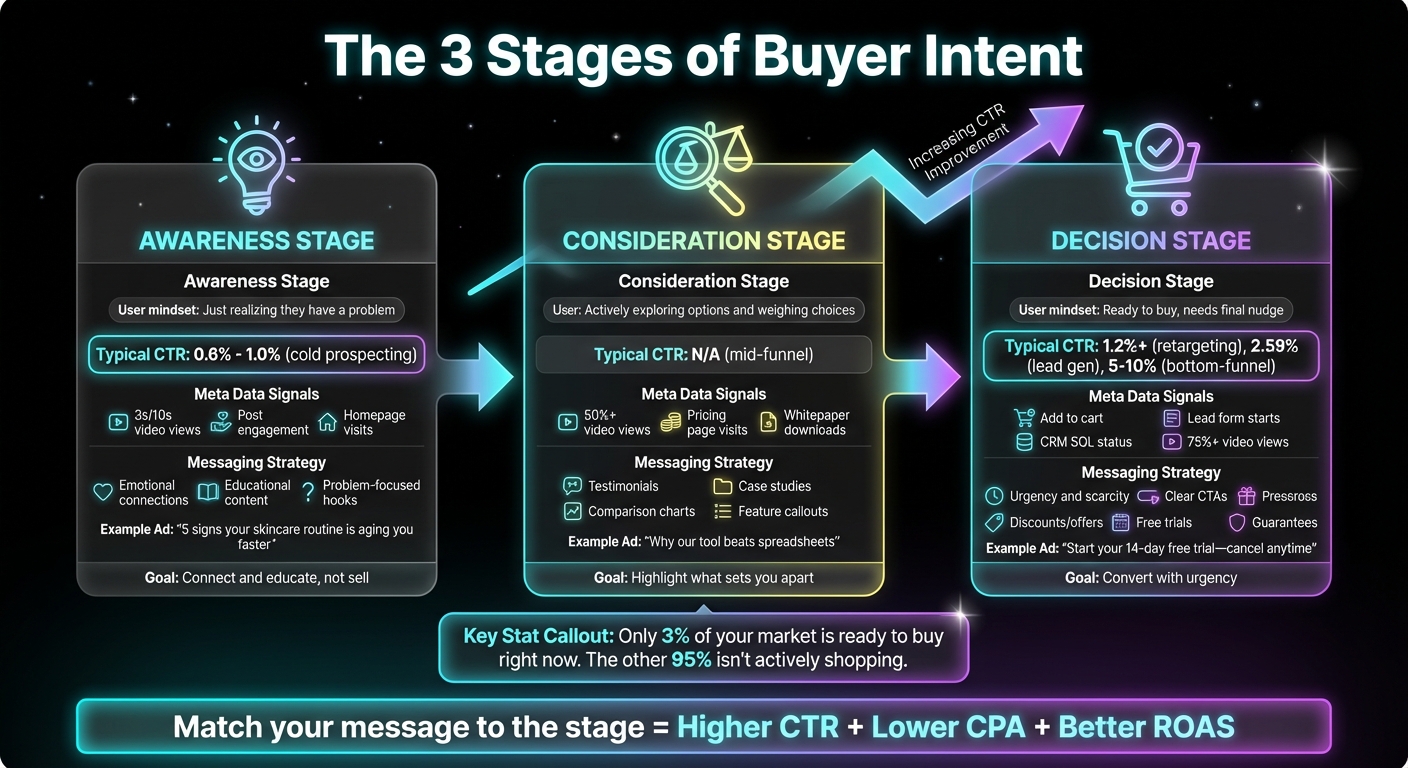
3 Stages of Buyer Intent for Meta Ads: Awareness, Consideration, Decision
Buyer intent reveals where someone is in their journey - whether they’re just becoming aware of a problem or ready to make a purchase. On Meta, understanding this can make or break your campaign. For instance, a jump in click-through rate (CTR) from 0.6% to 1.2% might not sound huge, but it’s often the difference between scaling profitably and draining your budget.
Meta’s algorithm thrives on engagement signals. When your message aligns with a user’s intent, you’ll see better clicks, conversions, and targeting. But if your ad doesn’t match where they are in their journey, they’ll scroll past, leaving Meta to show your ad to less relevant audiences. This mismatch can drive up CPMs and tank your performance.
"Structure is a value statement. It is how you (the media buyer) communicate your goals and priorities to the machine (Meta)." - Sam Tomlinson, Founder
The data tells the story. Retargeting campaigns - aimed at high-intent users who’ve already visited your site - can achieve CTRs of 1.2% or higher. Cold prospecting, targeting users unfamiliar with your brand, typically lands between 0.6% and 1.0%. Meanwhile, lead generation campaigns, which focus on capturing high-intent prospects, boast an impressive CTR of 2.59%. That’s 61% higher than standard traffic campaigns. The takeaway? Buyer intent directly impacts how users engage with your ads. Recognizing these patterns is key to understanding the stages of buyer intent.
The 3 Stages of Buyer Intent: Awareness, Consideration, and Decision
Each stage of buyer intent plays a unique role in shaping your Meta ad performance. Here’s how they break down:
Awareness: At this stage, people are just realizing they have a problem or need, but they’re not actively seeking a solution yet. Imagine someone casually scrolling through Instagram when your ad appears. Your goal here isn’t to sell - it’s to connect emotionally or educate. For example, instead of pitching a product, try something like, "5 signs your skincare routine is aging you faster."
Consideration: Now, they’re actively exploring options. They know they need a solution and are weighing their choices. This is the time to highlight what sets you apart. Use testimonials, comparisons, or specific feature callouts to show why your product or service is the right pick.
Decision: This is the final step. They’re ready to buy but might need a little nudge to seal the deal. Your messaging should focus on urgency and ease. Offers like limited-time discounts, free trials, or guarantees can make all the difference. For instance, "Start your 14-day free trial - cancel anytime" is a strong call-to-action for this stage.
Each stage calls for a tailored approach. Awareness-focused ads need to hook people by addressing a problem or desire, while decision-stage ads should have clear calls-to-action and direct offers. Using the same ad across all stages risks alienating potential customers - either by being too vague for high-intent buyers or too aggressive for those just learning about your brand.
What Happens When You Ignore Buyer Intent
Here’s a scenario I’ve seen far too often: A brand launches a campaign with a compelling offer - say, 20% off or a free trial - and blasts it to a cold, broad audience. The result? CTRs plummet, CPAs skyrocket, and the blame falls on Meta’s algorithm. But the real issue is that a decision-stage offer is being shown to people in the awareness stage - users who don’t even know what the product is, let alone why they’d want it.
"If you optimize for clicks, Meta is going to serve your ad to people who tend to click on ads – but probably not people who like to click on ads and buy." - Sam Tomlinson
Sam Tomlinson calls this "optimizing for bullshit". When you chase secondary metrics like clicks or video views without considering the buyer’s intent, Meta targets users who engage but rarely convert. The result? You pay for traffic that looks good on paper but doesn’t translate into revenue. I’ve seen accounts burn thousands in a week chasing cheap clicks that never lead to sales. This highlights the danger of prioritizing vanity metrics over meaningful conversions.
"The world's most brilliant piece of creative will fall flat if it's shown to an irrelevant or otherwise uninterested audience." - Sam Tomlinson
Even the best ad creative will fail if it’s shown to the wrong audience. High-performing accounts in 2026 typically allocate 80% of their budget to prospecting (demand creation) and 20% to retargeting (demand capture). This balance ensures you’re continuously filling the funnel while converting those already interested. Ignore buyer intent, and you risk losing that balance - and your campaigns will suffer as a result.
How to Segment Audiences by Intent Stage
Once you've defined buyer intent, the next step is breaking down your audience into meaningful segments.
Meta provides a treasure trove of data that tracks user interactions - everything from a quick video view to adding an item to a cart. Each action reveals where someone stands in their buying journey. The challenge lies in identifying the signals that matter and using them effectively.
Here’s why this matters: only about 3% of your market is ready to make a purchase right now. The remaining 95% isn’t actively shopping. If you treat everyone the same, you risk wasting your budget on people who aren’t ready and frustrating those who are. Proper segmentation ensures your message matches their mindset.
Using Meta Data to Identify Intent
Meta's algorithm has evolved to rely on user behavior signals rather than manual targeting. It learns from actions like video views, page visits, and more to identify high-intent users. The key is feeding the algorithm the right data.
Custom Audiences are a powerful tool here. For instance, a user who watches 50% of your product video is more engaged than someone who skips after three seconds. Similarly, a visitor to your pricing page is closer to buying than someone who just browses your blog.
"The Meta ad 'signals' you provide - data points about user behavior, preferences, and intent - are now paramount. These signals help the algorithm identify the right audiences." - Piyush Gupta, Founder, EasyInsights
Since privacy changes like iOS 14 have made browser tracking less reliable, first-party data has become essential. Meta’s Conversions API (CAPI) allows you to send conversion data directly from your server, bypassing ad blockers and browser restrictions. This streamlines targeting and reduces wasted ad spend.
By combining CAPI with CRM data, you can build audiences that reflect real customer journeys. For example, create a Custom Audience of users who became Marketing Qualified Leads (MQLs) in the past 30 days and then build a Lookalike Audience to find similar high-intent prospects. Focus on value-based Lookalikes - target users who resemble your highest-spending customers rather than all your customers. This approach prioritizes quality over quantity. To maintain this quality at scale, many teams automate their ad production to keep creative fresh without increasing manual overhead.
You can also refine retargeting by segmenting based on activity recency (e.g., 0–3 days, 4–7 days, 8–14 days). Someone who interacted recently may need gentle reminders, while older interactions might require more urgency.
| Intent Stage | Meta Data Signal | Recommended Action |
|---|---|---|
| Awareness | Video views (3s/10s), Engagement | Educational content, Brand storytelling |
| Consideration | Pricing page visits, 50%+ Video views | Case studies, Comparison charts, Testimonials |
| Decision | Add to Cart, Lead form start, CRM "SQL" status | Limited-time offers, Urgency, Social proof |
Now, let’s dive into the specific behaviors that signal intent.
Buyer Behaviors That Signal Intent
Different user actions signal varying levels of intent. Some behaviors scream "I'm ready to buy", while others suggest curiosity. Recognizing these differences helps you avoid overspending on low-intent traffic.
High-intent signals - like adding items to a cart, visiting the pricing page, or starting a lead form - indicate users in the decision stage. These individuals are actively considering a purchase and need a clear nudge. Ads targeting these users should emphasize urgency, social proof, or special offers. For example, retarget cart abandoners with a message like: "Still deciding? Here's 10% off to help you out."
Mid-intent signals - such as watching over 50% of a video or engaging with your posts - point to users in the consideration stage. They’re weighing their options and evaluating whether your product meets their needs. Use testimonials, case studies, or feature comparisons to help them choose you.
Low-intent signals - like brief video views or homepage visits - indicate users in the awareness stage. These people are just starting to learn about your brand. Instead of pushing for a sale, focus on sparking their curiosity. A message like "Why most skincare routines fail (and how to fix it)" works better than "Buy now and save 20%."
"High-intent users are much closer to making a purchase or signing up, which makes them far more valuable to your business than cold, unaware audiences." - Brij B Bhardwaj, Founder, Doe's Infotech
Video watch time is an underrated signal. Meta allows you to retarget users based on how much of your video they watched. For example, someone who watched 75% is far more engaged than someone who only watched 10%. Use this data to create tiered audiences: 75%+ watchers get decision-stage messaging, 25%-75% watchers get consideration-stage content, and under 25% viewers receive awareness-stage hooks.
For e-commerce, focus on purchase frequency and cart adds. For lead generation, track MQL/SQL progression and deal closures. These behaviors directly impact revenue, unlike vanity metrics like link clicks or impressions.
Finally, optimize for real outcomes. Set your campaign objective to "Conversions" or "Sales", not "Traffic" or "Engagement." When you optimize for clicks, Meta shows your ad to users who click often - but don’t necessarily buy. Optimizing for conversions ensures your ads reach people who are more likely to complete purchases or sign up, resulting in a much better ROI.
How AI Matches Messaging to Buyer Intent
Once you've segmented your audience by intent, the next step is crafting messaging that truly connects. This is where AI comes in, processing data at speeds no human team could match.
AI looks at behavioral patterns from millions of interactions to figure out what messaging works best at each stage of intent. It tracks responses to different hooks, angles, and calls-to-action, then uses those insights to create new, targeted campaigns. The result? Messaging that feels tailored to each audience segment - without the need for endless manual adjustments.
Instead of spending weeks brainstorming and fine-tuning, AI can generate multiple ad variations in minutes. By pulling data from your product pages and customer reviews, it creates ads designed to align with buyer psychology. Let’s dive into how AI tailors messaging to different stages of buyer intent.
How AI Creates Personalized Messaging at Scale
AI uses specific data points from user behavior - like visits to pricing pages or engagement with videos - to craft messaging that aligns with intent. Here's how it works:
- High-Intent Users: For those visiting pricing pages or adding items to their cart, AI generates simple, frictionless calls-to-action like "Get 10% off today" or "Book your demo now."
- Mid-Intent Users: For users downloading whitepapers or watching product videos, it creates content like case studies or comparison charts to address their questions.
- Low-Intent Users: For casual browsers, it focuses on educational hooks that spark curiosity, like blog posts or beginner guides, rather than pushing for a sale.
This approach relies on AI's ability to recognize patterns. By comparing current user behavior with past customer data, AI can spot purchase signals that might otherwise go unnoticed. In fact, AI and machine learning can boost the accuracy of identifying purchase intent from just 5% to over 90%. Nearly 70% of marketers say predictive lead generation has significantly improved their ability to target high-intent leads.
Take the example of Australian retailer Myer. In October 2025, they used AI to analyze spending behavior beyond their stores. By applying a luxury spend propensity model, they discovered that targeting the top 10% of their customer base could capture 88% of potential luxury buyers. This strategy delivered a 2x increase in sales compared to their previous methods.
AI also excels at testing multiple angles simultaneously. Instead of relying on a single creative and hoping it works, AI generates dozens of variations, each testing a different hook, benefit, or objection. Platforms like Meta quickly learn which messages resonate with different segments, helping you avoid wasting budget on underperforming ads. This agility is a game-changer for combating creative fatigue - a common challenge in scaling Meta campaigns.
Why Static Ads Still Win on Meta
Even with the rise of video and interactive formats, static ads remain the most scalable and efficient option on Meta. They're quick to produce, easy to test, and work seamlessly with Meta's algorithm.
AI-generated static ads allow for rapid testing of various messaging angles - one ad might highlight a benefit, another address an objection, and a third showcase social proof - all within the same campaign. Meta's algorithm uses these variations to optimize delivery, ensuring the right message reaches the right audience. This isn't just about tweaking visuals; it's about experimenting with different structures and framing to find what works.
Speed is critical here. Static ads can be created in as little as 90 seconds, giving you the ability to launch, cut underperformers, and iterate on winners faster than competitors relying on traditional video or agency-led processes. When creative fatigue inevitably sets in, you need fresh ads immediately - not weeks later.
Tools like Aden's Lab are designed for this purpose. Simply input your product or landing page link, and the platform generates static Meta ads optimized for conversions in minutes. The AI scans your product pages and customer reviews to pinpoint the language and pain points that will resonate most with your audience. It then crafts ads designed to trigger specific emotional responses based on buyer intent.
In 2025, Fashion Forward Co. used Aden's Lab to produce over 200 ad variations in a single day - a task that previously took their agency three weeks to complete for just 10 ads. According to CMO Sarah Chen, these AI-generated ads led to a 340% increase in ROAS and $2.3M in additional revenue, all while slashing their customer acquisition cost by 67%.
"ADEN'S LAB created 200+ ad variations in one day. Our previous agency took 3 weeks for 10 ads. The AI-created ads outperformed our human-created ones by 340%." - Sarah Chen, CMO, Fashion Forward Co.
Static ads also offer unmatched clarity. They're clean, bold, and designed to communicate a single, clear message without unnecessary distractions. Matching the right creative to the right intent is key, and static ads deliver this with speed and precision. The goal isn't to dazzle with flashy production value - it's to deliver the right message to the right person at the right time.
How ADEN's LAB Generates Intent-Aligned Creatives
One of the biggest challenges for advertisers is turning buyer intent data into effective ads. ADEN's LAB solves this problem by creating Meta ads tailored to intent stages - all in just 90 seconds, starting with a single URL.
Here’s how it works: paste the URL of your product or landing page, and ADEN's LAB scans it for images, reviews, headlines, pricing, and calls-to-action. Using this information, the AI generates static ads for every stage of intent. It automatically transforms pain points into awareness hooks, feature comparisons into consideration ads, and discounts or guarantees into decision-stage motivators. Best of all, there’s no need for manual setup.
For instance, if you input a fitness tracker page, the AI might create an awareness ad with a headline like, "Tired of forgetting your progress?" It could also generate a comparison ad for consideration and a decision-stage ad offering "20% off + free shipping - ends tonight!" Each creative is optimized for Meta’s algorithm and ready to launch.
This process eliminates time-consuming tasks like audience research, Meta ad copy, image editing, and A/B testing. What typically takes days - or even weeks - for a team to accomplish is done in minutes. ADEN's LAB achieves this by using insights from billions in ad spend and buyer psychology, ensuring each headline and layout connects emotionally with the audience at the right stage of intent.
Drop a Link, Get Ads: How ADEN's LAB Works
The workflow couldn’t be simpler: paste your product or landing page URL, and ADEN's LAB generates multiple static ad creatives aligned with the awareness, consideration, and decision stages. There’s no setup, no learning curve, and no need for creative meetings.
The AI builds ads that speak to buyers at every stage. Awareness ads focus on broad visuals and educational hooks, consideration ads highlight comparisons or case studies, and decision ads emphasize urgency with discounts or guarantees.
Take TechGadget Pro as an example. In February 2025, they shifted from spending $50,000 per month on a creative agency to just $500 per month on ADEN's LAB. Within the first week, the platform created over 100 variations. Growth Director Mike Rodriguez reported a 520% increase in CTR, $1.8M in additional revenue, and a 45% reduction in CPC.
"We went from spending $50k/month on creative agencies to $500/month on ADEN'S LAB. The AI understands our tech audience better than any human designer ever could."
– Mike Rodriguez, Growth Director, TechGadget Pro
By removing the back-and-forth of creative revisions, ADEN's LAB simplifies the entire process. The AI extracts intent signals directly from your landing page and produces Meta-ready ads, allowing you to refresh campaigns frequently without delays. With instant, tailored creatives, you can test multiple messaging angles quickly, keeping your campaigns performing at their peak.
Testing Creatives Across Intent Stages
ADEN's LAB doesn’t just save time - it lays the groundwork for effective testing across buyer intent stages. Frequent creative updates are crucial for avoiding ad fatigue on Meta, where performance can drop without fresh content. ADEN's LAB addresses this by generating 10 to 20 intent-specific ad variants per link, enabling you to test diverse hooks for each stage simultaneously.
This approach allows you to segment your Meta ad sets by intent stage and continuously rotate new creatives to maintain performance. Instead of testing one idea at a time and waiting weeks for results, you can launch dozens of variations - highlighting benefits, addressing objections, showcasing social proof, and demonstrating use cases. Meta’s algorithm identifies the top performers in just 24 to 48 hours, making it easier to scale campaigns efficiently.
In March 2025, Wellness Plus used ADEN's LAB to create over 150 ad variations targeting emotional triggers across intent stages. Founder Dr. Amanda Foster reported a 280% increase in ROAS, $3.1M in additional revenue, and a 72% reduction in CAC compared to their previous $10,000-per-month agency.
"The AI-created health and wellness ads are incredibly persuasive. They understand the emotional triggers that drive our customers to buy better than our $10k/month agency ever did."
– Dr. Amanda Foster, Founder, Wellness Plus
The real power of ADEN's LAB lies in its data-driven iteration. Instead of guessing which intent stage will perform best, you can test live and quickly eliminate underperforming creatives. Campaigns using intent-matched ads often see 35% to 50% higher CTR and double the ROAS compared to mismatched ones. Bottom-funnel decision ads frequently achieve 5% to 10% CTR, while awareness ads deliver lower-cost traffic. By automating this segmentation, ADEN's LAB ensures you always have fresh, high-performing creatives without the delays of manual production.
Mistakes That Break Intent-Creative Alignment
Matching your messaging to buyer intent is critical, but it’s just as important to avoid going too broad or too narrow with your language. Even if you’ve nailed the intent stages, execution missteps can derail your campaigns. Two common pitfalls are creating messaging that’s either too vague to resonate or too specific to scale - and ignoring creative fatigue until your performance takes a nosedive.
Striking the Right Balance in Messaging
When your messaging is too vague, it loses relevance. Phrases like "Improve your business" or "Get better results" don’t connect with specific pain points, leaving Meta’s algorithm unsure of your target audience. This leads to low engagement - CTR can drop below 1%, and your cost per click goes up as Meta deprioritizes ads that don’t resonate. For awareness campaigns, this kind of generic messaging misses the mark entirely. And for decision-stage users, it fails to drive urgency.
On the flip side, being overly specific can shrink your audience too much. For instance, crafting ads that only target enterprise CTOs might exclude mid-market leaders who face similar challenges. This approach often results in campaigns delivering 20% to 30% lower ROAS compared to those with a broader reach. The solution? Use intent-specific messaging frameworks that balance clarity and scale. For awareness, focus on problem-driven hooks like "Struggling with low leads?" For consideration, emphasize comparisons like "Why our tool beats spreadsheets." And for decision-stage users, create urgency with calls to action like "Start your free trial today - no credit card required." Testing three to five variations per intent stage using systematic testing for Meta ads can help you find the sweet spot where your messaging connects with a wide yet relevant audience.
Catching Creative Fatigue Before It Hurts
Creative fatigue happens when your audience sees the same ads too often and starts to tune them out. The impact can be dramatic - CTR might drop by 50% (e.g., from 2% to 1%), ROAS could fall below 2x, and ad frequency may spike to 7–10, signaling overexposure. Campaigns suffering from fatigue can lose up to $50,000 a week, especially if it sets in after just two weeks. Worse, stale ads can push decision-ready buyers back into the awareness stage, driving acquisition costs up by 2–3x.
To avoid this, daily monitoring is crucial. Use Meta Ads Manager to set alerts for a 20% drop in CTR or when ad frequency exceeds 5. Segment your audiences by intent - retarget decision-stage buyers and use cold traffic for awareness - to identify which groups are burning out. Rotate at least 10 creatives per ad set weekly and pause any ads delivering under 50% ROAS. Automated rules can save you over $1,000 a day by catching fatigue before it spirals out of control.
Platforms like ADEN's LAB make refreshing creatives easy. By dropping a single link, you can generate 20 or more static Meta ad variants for each intent stage in minutes. This allows you to quickly replace fatigued ads without waiting weeks for new designs. Regularly updating your creatives keeps ad frequency low and performance high, letting Meta’s algorithm do the heavy lifting to find winners while you stay ahead of audience burnout. By monitoring key metrics and rotating fresh creatives often, you’ll keep your campaigns agile and ready to scale.
Matching Intent to Creatives Drives Better ROI
Aligning your ad creatives with buyer intent isn’t just a nice-to-have - it’s a budget saver. Campaigns often lose 20% to 30% of their spend by mismatching messaging with where the audience is in their buying journey. For example, awareness-stage ads shown to decision-ready buyers - or vice versa - can tank performance. The solution? Serve the right message at the right stage. For cold audiences, use problem-focused hooks. During consideration, highlight benefit comparisons. And when buyers are ready to act, urgency-driven offers seal the deal. When this alignment clicks, click-through rates (CTR) can double or even triple, and return on ad spend (ROAS) improves as Meta’s algorithm hones in on the right audience. This approach not only saves money but also sets the stage for faster, smarter optimization.
Traditional workflows often slow down testing, leaving you trailing behind competitors who iterate faster. This is where tools like ADEN's LAB make a game-changing difference. With just a link, you can generate dozens of intent-aligned static Meta ads in minutes - no prompts, no revisions, no delays. This speed lets you test hooks across all stages of the buyer’s journey - awareness, consideration, and decision - all at the same time. Meta’s algorithm identifies what works best, keeping you ahead of creative fatigue and ensuring your campaigns stay fresh.
The impact is clear. Take Fashion Forward Co. and TechGadget Pro, for example. Both companies saw major improvements in ROAS, revenue, and acquisition costs by scaling up intent-matched creative production. These results show how reducing wasted ad spend and speeding up creative refreshes can lead to measurable gains.
When your ads match where buyers are in their journey, you avoid the pitfalls of high bounce rates and poor engagement that drain budgets. Plus, generating fresh creatives daily instead of monthly helps you dodge the performance dips caused by stale ads. Campaigns using AI for intent alignment often see 2x to 4x ROAS improvements, as they continuously supply Meta’s algorithm with relevant, high-performing content.
Matching intent with creatives isn’t just about sustaining performance - it’s about scaling it. Manual processes can’t keep up with the speed needed to test, iterate, and outpace fatigue. By automating creative production with ADEN's LAB, every ad becomes a strategic tool, perfectly aligned with your buyer’s journey and built to deliver results.
FAQs
How do I know which intent stage my audience is in?
To understand where your audience stands in their intent journey, pay close attention to their behavior and how they engage with your content.
- Low intent: These individuals may not even realize they have a problem or need a solution. They’re best served with educational content that introduces challenges and potential answers.
- Medium intent: At this stage, people are actively researching and comparing options. Their behavior reflects a desire to explore possibilities and weigh their choices.
- High intent: These are decision-makers. They’re engaging with things like demos, free trials, or other decision-oriented resources, showing they’re ready to take action.
Look for clues like repeat visits, time spent on specific pages, or a focus on content designed for decision-making. These insights will help you customize your communication to meet them where they are.
What Meta signals should I use to build intent-based audiences?
To create intent-based audiences on Meta, focus on actions like Add to Cart, Page Views (or ViewContent), and Purchases. These behaviors reflect different levels of interest, ranging from casual browsing to strong intent to buy. By using Facebook Pixel data, you can track these actions and build custom or lookalike audiences. Targeting users based on these signals helps fine-tune your campaigns, making it easier to connect with people who are more likely to convert.
How many new creatives do I need each week to avoid ad fatigue?
To keep your Meta ads performing well and avoid ad fatigue, it's smart to update your creatives every 10–14 days. Some marketers even suggest rolling out fresh creatives daily during the workweek. Regularly introducing new visuals and messaging helps maintain audience interest and keeps your campaigns running strong.
Your next ad batch starts here
Finish with a ready-to-test ad batch
Paste your website to generate static creatives. Drop the link → get ads in about 90 seconds → upload them to Meta → scale.
Free to try No prompt writing