The Ultimate Guide to AI Meta Ads (2026)
Turn the strategy into creatives
Create Meta ads for your product
Paste your product page. ADEN'S LAB turns the offer, audience, and positioning into complete ready-to-use Meta static ads.
Free to try No prompt writing

Meta ads in 2026 are all about AI systems like Andromeda and GEM driving performance. The focus has shifted from manual targeting to AI analyzing your ad visuals and messaging to find the right audience. Here's what you need to know to succeed:
- AI prioritizes ad visuals and messaging. Creative quality and variety are now more important than audience targeting.
- Broad targeting beats segmentation. Narrow audience settings limit AI performance, while broader settings let the system optimize effectively.
- Creative fatigue is real. Ads lose effectiveness as they saturate audiences, so frequent updates are essential.
- Speed matters. Faster ad production means quicker testing and better results. Using AI tools for Meta ads can generate dozens of ad variations in seconds.
- Simplify campaign structures. Fewer campaigns with broad targeting give AI more data to optimize.
Meta's AI thrives on diverse, high-quality ad inputs. Focus on producing a steady stream of ads, avoid manual micromanagement, and let the AI do the heavy lifting for better results.
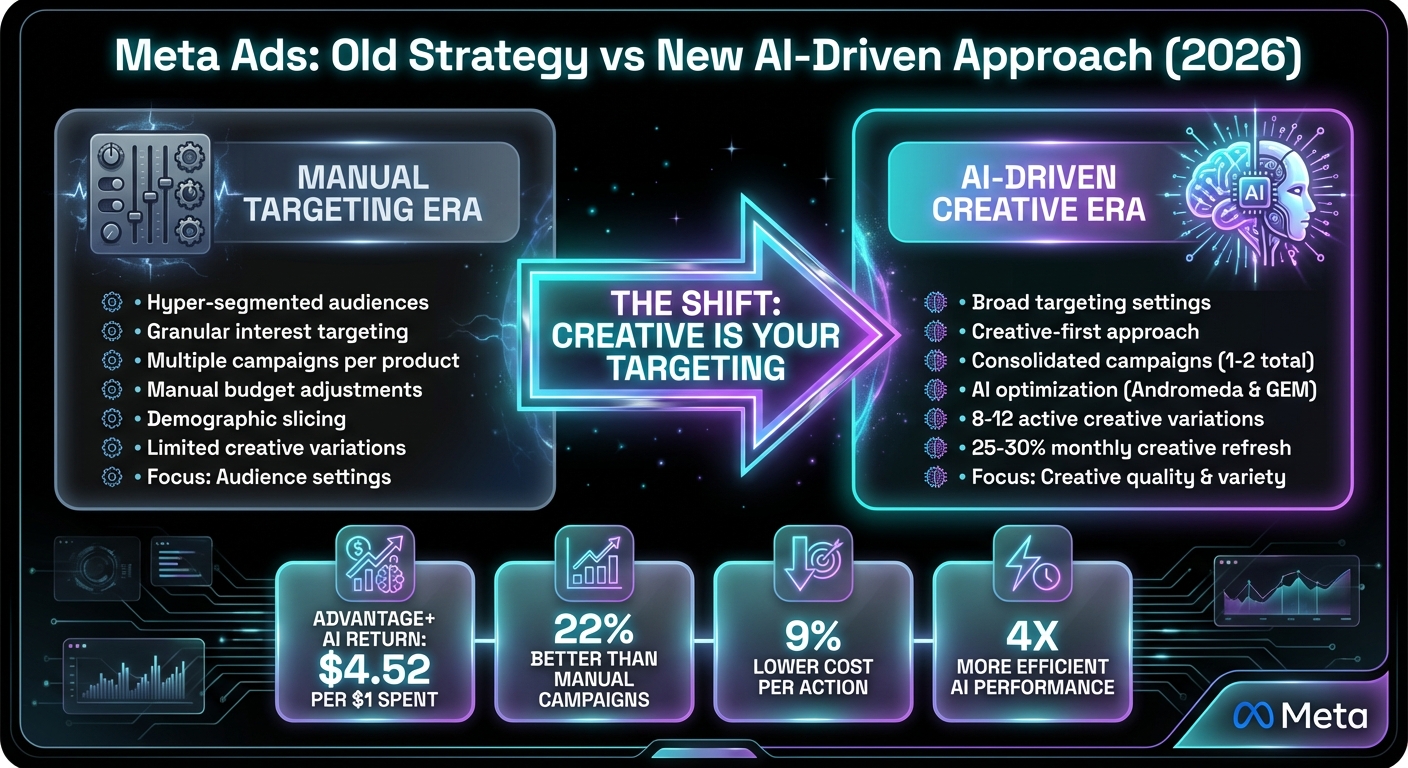
Old vs New Meta Ads Strategy: Manual Targeting vs AI-Driven Creative Approach 2026
If You Don’t Understand This, Meta Ads Won’t Work in 2026
Put the playbook to work
Apply this playbook to your page
Paste your website and the Lab will turn the strategy you are reading into a ready-to-test ads.
Free to try No prompt writing
Why Meta Ads Feel Harder Now
Running Meta ad campaigns feels more unpredictable these days. Ads that once delivered steady returns can suddenly underperform, even after adjusting targeting, budgets, or audiences. But blaming the platform itself misses the bigger picture: Meta’s system now rewards a completely different approach.
The change stems from Meta’s shift to AI-driven systems, which have replaced many manual controls. These AI systems are notoriously opaque. You can’t directly see how they work or intervene when performance dips. And when things go wrong, pinpointing the exact issue is nearly impossible.
This isn’t a glitch - it’s the system’s new design. Many advertisers are still stuck using outdated tactics like granular interest targeting or constant budget adjustments. But Meta’s algorithm now prioritizes your creative as the main targeting signal. If your ad creative doesn’t give the AI enough data to work with, the system struggles to find the right audience, and performance suffers. To understand these challenges, it’s crucial to look at how Meta’s AI operates today.
How Meta's System Changed (And Why It Still Works)
Before Apple’s iOS 14 update, Meta relied on precise user tracking to build lookalike audiences and target ads. But Apple’s privacy changes disrupted this, forcing Meta to develop new systems like Andromeda and GEM. These tools now focus on analyzing ad creative and user behavior to predict conversions.
Here’s how it works: Andromeda reviews your ad creative - everything from images to headlines - to determine which users might engage with it. Essentially, it “reads” your ad like a person would, identifying themes and emotions. GEM then fine-tunes delivery based on how users interact with the ad. For example, advertisers using Meta’s Advantage+ automation report an average return of $4.52 for every $1 spent - a 22% improvement over manual campaigns - with a 9% lower cost per action on average. But these results depend on feeding the AI a steady stream of diverse, high-quality creative. A limited number of ad variations leaves the algorithm starved for data.
"Meta Ads is no longer an open, manual optimization environment. Performance now depends on understanding how the system evaluates inputs and learns over time." – Akvile DeFazio, President, AKvertise
Another major shift lies in how accounts are structured. The old strategy of hyper-segmentation - where each audience had its own ad set, and every product had its own campaign - splintered the available data. Today, the AI performs best with broad campaigns that consolidate signals across the funnel. Many top-performing accounts now run just one or two campaigns, allowing Andromeda and GEM to optimize more effectively. This streamlined approach isn’t cutting corners - it’s about giving the AI the data volume it needs. However, even with simplified structures, success depends on producing a wide variety of creative assets quickly.
Why Creative Production Is Now the Biggest Problem
With AI handling much of the targeting, the quality of your creative has become the most critical factor in ad performance. If your creative acts as the new “targeting,” then the real challenge isn’t your budget or strategy - it’s how quickly you can produce ads. Many advertisers still rely on slow, manual workflows, creating only a handful of ads at a time. By the time these ads launch, market conditions may have already shifted.
Meta’s AI thrives on variety. If your campaign relies on just a few static images or a single messaging angle, the system can’t adapt to different user contexts. This lack of diversity leads to what’s called a “monotony tax” - higher CPMs and reduced reach because the AI struggles to match your ads with the right users. Without a diverse range of creative assets, your campaigns are likely to underperform.
The numbers tell the story. In December 2025, the agency Spinta Digital worked with Truzon Solar on a campaign where creative production took 25 days, and only a few ads were tested each month. The campaign stalled at a 1.9x ROAS. After adopting AI tools to automate ad production, the timeline shrank to 4 days, allowing for more creative testing. This shift boosted ROAS to 3.8x and cut the cost per lead from ₹360 to ₹190.
This isn’t an isolated case - it’s becoming the norm. Without fast and varied creative production, even the best advertising strategies can fall flat. In today’s fast-moving environment, an ad that’s good enough but launched quickly often outperforms a perfect ad that arrives too late.
How Meta's AI Actually Decides Which Ads Scale
Meta's AI has completely changed how ads are scaled, moving away from manual targeting and AI-driven budget allocation. Instead, the system evaluates your creative first and then targets users most likely to engage based on that creative. This is a big shift from how things used to work.
At the heart of this system are two engines: Andromeda and GEM. Andromeda acts as the gatekeeper, analyzing your ad's visuals, copy, and format to determine who should see it. Once the ad is shown, GEM takes over, learning from user interactions and predicting what content should appear next in their feed. Together, these engines are four times more efficient at improving performance compared to older systems.
The real game-changer? Creative diversity. If your creative library lacks variety, the AI has less to learn from, which can drive up CPMs. The system thrives on engagement data, not manual audience settings. Here’s a closer look at how Andromeda and GEM work.
How Andromeda and GEM Learn From Your Ads
Andromeda doesn’t just skim through your ad - it analyzes it like a person might, identifying themes, emotions, and messaging. For instance, if your ad promotes "better sleep", Andromeda will find users who’ve interacted with similar content. Essentially, your creative sets the direction for targeting.
"Andromeda decides which ads make it onto the shelf, while GEM learns what shoppers buy and shapes what gets featured next." – Akvile DeFazio, President, AKvertise
GEM takes it a step further by refining ad delivery based on user behavior. It tracks actions like scrolling, clicking, or visiting a product page and uses these patterns to predict what users are likely to do next. GEM even pulls in data from organic Instagram interactions, giving it a fuller understanding of user intent. Updates to GEM in late 2025 led to a 3.5% increase in ad clicks on Facebook and a 1% rise in conversions on Instagram.
The more formats and styles you use - like static images, carousels, and short videos - the better these systems perform. High-performing campaigns typically include 8–12 active creative variations and refresh 25–30% of their creative library monthly.
Why Audience Targeting Matters Less Than Creative
Manual audience targeting, like choosing specific interests or creating lookalike audiences, can actually hurt your campaign. Hyper-segmenting your audience limits the data available to the AI, slowing optimization and reducing performance.
Broad targeting, on the other hand, gives the AI more room to identify patterns. Instead of narrowing your audience to "women aged 25–34 interested in yoga", you let the AI analyze your creative and match it to users based on their behavior. This works because the system can detect intent far more accurately than manual settings. Advertisers using Meta's Advantage+ automation - which emphasizes broad targeting and creative-first strategies - report an average return of $4.52 for every $1 spent, a 22% improvement over manually managed campaigns.
The key takeaway? Creative is your targeting now. If your ad features a customer testimonial solving a specific problem, the AI will find users with similar challenges. Bold visuals? The system matches them to users who engage with similar content. By offering varied creative angles - different value propositions, formats, and messaging - you give the AI more chances to connect with high-intent users.
Frequent manual adjustments can also disrupt performance. Each time you tweak budgets, pause ad sets, or change targeting, you reset the AI’s learning phase, which now spans 2–4 weeks under the Andromeda system. To avoid this, stick to a "no-touch" window of at least one week or 50–75 conversions before making changes. Instead of fiddling with settings, focus on introducing fresh creative to keep the system learning and scaling effectively. This creative-first approach lays the groundwork for scaling your campaigns - a topic that will be explored further in the next section.
How to Build a Creative System That Actually Scales
In AI-driven Meta campaigns, creative is at the heart of success. But relying on the "perfect" ad, launching it, and scrambling to create a replacement when it burns out? That’s not a system; it’s a bottleneck. A scalable creative system works as a continuous cycle - consistent production, quality checks, and metrics to catch issues before performance dips. The goal isn’t flawless execution; it’s producing a steady stream of creative with clear direction. Here’s how to turn your creative process into a scalable, data-driven engine.
How AI Analyzes Creative Performance
AI doesn’t just declare a winning ad - it digs into why it works. Using multimodal AI tagging, it identifies elements like visual styles, objects, audio tones, and hook lines. These tags are then tied to bottom-line metrics like ROAS (Return on Ad Spend) and cost per acquisition, revealing meaningful patterns.
This creates a feedback loop that speeds up creative testing. Instead of waiting weeks for data, you can spot trends within 24 to 48 hours by tracking early indicators like click-through rates (CTR) and cost per click (CPC). For instance, if testimonial-based ads consistently outperform product-only visuals, you know to double down on testimonial variations right away.
AI also tracks creative fatigue. Using asset clustering, it notices when similar concepts start to oversaturate your audience. For example, if frequency hits 4.0 or CTR drops by more than 20% over two weeks, the system flags the asset for replacement. This proactive monitoring keeps your campaigns fresh without constant manual oversight.
Why Static Ads Still Win in 2026
Even with AI breaking down performance data, the format of your creative remains a key factor in scaling efficiently. Static image ads continue to be one of the most effective tools for rapid testing and scaling. They’re quicker and cheaper to produce, making it easier for Meta’s AI to match the right creative with the right audience at a lower cost. Successful accounts often test 8–12 creative variations per campaign, leveraging static ads to stay in step with the algorithm’s demands.
Static ads also offer flexibility. By creating multiple aspect ratios - 1:1 for Feed, 4:5 for Stories, and 9:16 for Reels - you ensure your ads are ready for any placement. In comparison, video ads require more time, higher costs, and longer iteration cycles. If a static ad underperforms, it can be quickly reworked, while a video misstep is costlier to fix.
Meta’s algorithm prioritizes engagement over production value. In fact, lo-fi, user-generated-style static ads often outperform polished brand content because they feel more authentic to users. Meta’s Andromeda system rewards ads that align with user behavior rather than focusing on high-end aesthetics.
Why High Output Beats Perfect Execution
Chasing the "perfect" ad is a losing game. High output keeps you ahead of the performance drop-off that happens when one “winning” ad becomes oversaturated. Once an ad reaches a frequency of 4.0 or higher, CTR declines, and costs spike. A diverse ad set ensures you always have backup options ready to go.
Meta’s algorithm thrives on creative variety. Testing different value propositions, hooks, and formats increases the likelihood of hitting profitable audience matches. That’s why top-performing accounts refresh 25–30% of their creative library each month. It’s not about perfection - it’s about speed and volume.
AI tools can launch 50 ad variations in 60 seconds, a task that would take a human marketer hours. This pace allows for constant testing, learning, and adapting, leaving competitors stuck waiting for lengthy revisions. Scaling isn’t about a single ad - it’s about building a system that can produce fresh creative faster than it fatigues. That’s the edge that separates accounts that grow from those that stall.
What Not to Do With AI Meta Ads
Many advertisers are throwing money away on Meta ads because they’re clinging to outdated strategies. Meta’s system has evolved, but some still operate as if it hasn’t. If you’re making these mistakes, it’s time to rethink your approach.
The Biggest Mistakes When Using AI for Ads
One major misstep is confusing engagement with actual performance. During the learning phase, Meta’s AI might favor ads with high click-through rates or hook rates, but that doesn’t always mean they’re cost-effective. For example, a 5% click-through rate doesn’t mean much if your cost per acquisition (CPA) is sky-high.
Then there’s the "winning creative" trap. You might find an ad that works well initially and decide to scale it aggressively, only to watch its performance nosedive. Why? Audience fatigue sets in, and CPAs spike as ad frequency climbs past 4.0. Relying on a single “winner” for too long can backfire.
Another mistake is running too few creative variations, often called an "asset diet." When you limit the number of creatives, you force the AI into less-than-ideal placements, which drives up costs per thousand impressions (CPMs). This so-called "monotony tax" can quickly eat into your budget.
Finally, manual optimization is a huge time sink. AI can do in seconds what might take you hours. If you’re still manually tweaking bids in 2026, you’re wasting time while your competitors are scaling ahead.
If any of these sound familiar, it’s time to rethink your workflow. Here’s what you need to stop doing as we move into 2026.
What to Stop Doing in 2026
- Stop detailed audience segmentation. Hyper-segmentation, like manual interest targeting and demographic slicing, is outdated. Meta’s Advantage+ system delivers a $4.52 return for every $1 spent - 22% better than manual campaigns. The algorithm now relies on creative elements like visuals, hooks, and language rather than dropdown-selected interests. Over-segmenting also fragments your data, making it harder for systems like Andromeda and GEM to learn effectively.
- Stop making constant manual edits. Every manual adjustment resets the learning phase, creating instability. Instead, give the system at least a week or 50–75 conversions to learn before making changes. As Akvile DeFazio, President of AKvertise, advises:
"Patience is a competitive advantage given the current state of the system".
- Stop testing endless variations. Rather than obsessing over micro-optimizations, focus on testing entirely new creative angles and messages. The algorithm is more concerned with whether your creative resonates in the moment than with small tweaks.
- Stop relying solely on Meta’s reporting. Meta’s AI operates like a “black box,” meaning it’s hard to pinpoint why a campaign succeeds or fails without external tracking. Use the Meta Conversions API (CAPI) to feed better data signals to the AI and independently verify campaign performance.
The takeaway here is simple: the tactics that worked a few years ago aren’t just outdated - they’re actively draining your budget. Let the AI do what it’s designed to do, and focus on building systems that support it.
The Simple System That Works for Meta Ads in 2026
The most effective Meta ad strategy in 2026 is surprisingly straightforward. Many advertisers tend to overcomplicate their campaigns, but the formula for success boils down to three essentials: fewer campaigns, broader targeting, and consistently producing creative assets quickly.
The Account Structure That Delivers Results
Since creating high-performing ads is the biggest hurdle, structuring your account in a simple and efficient way is critical. Focus your budget on a single campaign with one objective and broad targeting. This method prevents your ads from competing against each other in Meta’s auction system, which can unnecessarily increase costs. Use Ad Set Budget Optimization (ABO) to allocate spending across three categories of ads: proven performers, variations of those performers, and experimental concepts.
Here’s a breakdown that works well:
- 60% of your budget: Allocate to ads that have already been proven to perform well.
- 30% of your budget: Use for refined variations of those proven ads.
- 10% of your budget: experiment with entirely new creative ideas.
This 60-30-10 approach helps you find the right balance between scaling successful ads and testing fresh concepts. Instead of relying on manual demographic filters, let AI-driven creative signals guide your targeting.
To avoid audience fatigue, aim to keep 8–12 active creative variations per campaign and refresh about 25–30% of your ad library every month. Watch for signs like ad frequency hitting 4.0 or a 20% drop in click-through rates - these indicate it’s time to replace older assets with new ones from your creative pipeline.
How Aden's Lab Tackles Creative Production Challenges
Once you’ve nailed your campaign structure, the next challenge is producing enough high-quality ads quickly. For most advertisers, the real bottleneck isn’t strategy - it’s the time and effort required to generate creative assets. That’s where Aden's Lab comes in.
Aden's Lab eliminates production delays entirely. Simply provide your product or landing page link, and in just 90 seconds, you’ll get ready-to-use static Meta ads designed for conversions. There’s no need for prompts, instructions, or special setup.
Unlike traditional design tools that require expertise, Aden's Lab acts as a creative engine. Whether you need 50 ad variations today or 200 next month, it scales to meet your needs. At just $0.90 per ad on the Apex Mode plan, it’s a cost-effective alternative to traditional design workflows.
Static ads dominate the Meta landscape in 2026 because they’re ideal for quick testing and delivering clear, concise messages. With Aden's Lab, you can continuously launch fresh ads before performance drops, eliminating creative fatigue. This streamlined approach sets the foundation for scaling your campaigns effectively, as discussed in the next section.
Why Simplicity Beats Complexity
Keeping your campaigns simple doesn’t just make them easier to manage - it also helps Meta’s AI perform better. Complex setups with multiple campaigns and narrow targeting spread your data too thin. When this happens, Meta’s AI (like Andromeda and GEM) has less information to analyze, which slows down its ability to identify winning strategies.
Consolidating your campaigns into broader setups gives Meta’s AI more data to work with, allowing it to deliver better results. For example, Meta’s Advantage+ system achieves a $4.52 return for every $1 spent - 22% higher than manually managed campaigns. Additionally, the latest AI models are four times more effective at driving performance improvements compared to older versions.
Speed is another critical factor. Take Truzon Solar, for instance. In December 2025, they cut their creative production time from 25 days to just 4 days using an AI-powered ad system. The results were dramatic: their return on ad spend (ROAS) jumped from 1.9x to 3.8x, and their cost per lead dropped from ₹360 to ₹190. The key wasn’t a change in strategy - it was the ability to execute faster.
How to Win With AI Meta Ads in 2026
Winning on Meta in 2026 boils down to three key strategies: boost your creative output, keep your campaign structure simple, and let AI handle the heavy lifting. The brands that thrive are the ones pushing out 50 ad variations while their competitors are stuck in endless design revisions.
Here’s how you can stay ahead in the ever-changing Meta landscape. Simplify your campaigns by consolidating them as outlined earlier. This allows Meta's AI to gather data quickly, learn efficiently, and optimize performance. Pair this with creative velocity - a steady flow of fresh ad assets. When your ad frequency hits 4.0 or your click-through rate (CTR) drops by 20%, it’s time to swap in new creatives immediately.
Still relying on manual ad design? That’s already putting you at a disadvantage. Automation is the answer to cutting delays. For instance, Aden's Lab can generate static Meta ads in just 90 seconds. All you need to do is drop in your product link - no prompts, no setup, no waiting. At only $0.90 per ad with the Apex Mode plan, you can produce hundreds of variations each month, keeping your creative pipeline full without overspending on designers or agencies.
The transition to AI-powered systems isn’t optional anymore - it’s a necessity. Meta’s Advantage+ campaigns, for example, deliver $4.52 in return for every $1 spent, outperforming manual campaigns by 22%. On average, AI automation can lower your cost per action by 9%. The real edge here lies in speed and scale. The quicker you test, the sooner you’ll find winning ads. With a robust rotation of creative assets, you can scale effectively without running into ad fatigue.
Don’t overthink it. Simplicity is the key to success. Provide Meta’s AI with a variety of creative assets, stick to a streamlined structure, and move quickly. That’s the winning formula.
FAQs
How do AI systems like Andromeda and GEM enhance Meta ad performance?
AI tools like Andromeda and GEM are transforming Meta ad campaigns by automating crucial elements of campaign management. These systems analyze data to pinpoint top-performing audiences, run simultaneous tests on various ad creatives, and adjust placements in real time. This takes the trial-and-error out of the process, ensuring your ads connect with the right audience at the right moment.
What’s more, these tools don’t just stop at initial optimization - they keep learning. By analyzing engagement data over time, they fine-tune targeting and creative strategies, making your campaigns more efficient and scalable while improving overall results.
Why is having diverse ad creatives more effective than focusing on audience targeting in Meta ads?
By 2026, creative diversity has taken center stage, overshadowing traditional audience targeting methods. Why? Because Meta’s AI now takes care of much of the audience selection process automatically. Instead of manually narrowing down who should see your ads, Meta’s algorithms analyze creative signals - like engagement metrics, user sentiment, and visual components - to identify which ads resonate best with different groups.
This means your ad creatives essentially become the new way to connect with the right audience. By offering a mix of ad formats, messaging, and styles, you provide the AI with richer data to refine its delivery. This approach not only optimizes campaign performance but also helps scale your efforts more efficiently. For example, static ads perform especially well in this setup. Their clear and consistent signals make it easier for the AI to interpret, reducing creative fatigue and boosting overall campaign efficiency.
In this new landscape, achieving success on Meta isn’t about painstakingly defining your audience - it’s about equipping the AI with a diverse range of high-quality creatives to do the heavy lifting for you.
What mistakes should I avoid when using AI for Meta ads?
One frequent misstep when using AI for Meta ads is relying too much on broad targeting without fine-tuning your audience signals. This approach often results in wasted ad spend and underwhelming campaign results. To make the most of AI, ensure your pixel and conversion tracking are properly configured - these tools provide the essential data AI needs to optimize your campaigns effectively.
Another issue is overcomplicating the creative process. Many advertisers get bogged down by trying to manually produce a high volume of content, which can slow down their ability to scale campaigns. Instead, AI-driven tools can help you quickly and consistently generate high-quality static ads, saving both time and effort. Plus, failing to update creative assets regularly can lead to ad fatigue, so it’s key to keep your content engaging and fresh.
Finally, don’t assume AI can fully grasp nuanced messaging on its own. Without enough input or data, even advanced AI systems will struggle. Focus on simplicity and speed in your workflows. Modern AI tools are built to streamline content creation and testing, enabling you to scale your campaigns more efficiently and effectively.
Your next ad batch starts here
Finish with a ready-to-test ad batch
Paste your website to generate static creatives. Drop the link → get ads in about 90 seconds → upload them to Meta → scale.
Free to try No prompt writing