AI Creative Testing: How to Generate 50 Meta Ads in Minutes That Actually Win
Turn the strategy into creatives
Create Meta ads for your product
Paste your product page. ADEN'S LAB turns the offer, audience, and positioning into complete ready-to-use Meta static ads.
Free to try No prompt writing
AI creative testing is transforming Meta advertising by enabling marketers to produce 50+ ad variations in minutes. Instead of spending days or weeks creating ads manually, AI tools like ADEN's LAB analyze your product, apply proven strategies, and generate tailored ads ready for testing.
Key Takeaways:
- Why it matters: With Meta's algorithm relying more on ad creatives post-iOS 14.5, quality and variety in ads directly impact performance and cost per acquisition (CPA).
- How it works: AI generates ad variations using hooks, visuals, and copy styles optimized for Meta platforms, saving time and reducing costs.
- Testing strategy: Use Ad Set Budget Optimization (ABO) for controlled testing and Campaign Budget Optimization (CBO) for scaling winners.
- Phased approach: Start with discovery (testing broad concepts), validate top performers, and scale with refined variations.
- Maintaining performance: AI helps combat creative fatigue by quickly producing new variations when ads lose effectiveness.
By automating ad creation and testing, AI tools like ADEN's LAB empower marketers to lower CPA, improve performance, and scale campaigns efficiently. Whether you're managing small or large budgets, AI simplifies the process while keeping your campaigns competitive.
The Foundations Of Meta Ads Creative Testing You HAVE To Get Right
Put the playbook to work
Apply this playbook to your page
Paste your website and the Lab will turn the strategy you are reading into a ready-to-test ads.
Free to try No prompt writing
Core Principles of Meta Creative Testing
To succeed with creative testing on Meta, you need a structured and methodical approach. This involves using proven frameworks, carefully planned budgets, and controlled variable testing. Mastering these principles can mean the difference between overspending and consistently lowering your CPA while scaling profitably. Below, we’ll dive into the strategies and data-driven techniques that top marketers rely on.
Meta Campaign Structures: CBO vs. ABO
Budget allocation plays a crucial role in scaling successful ads, and Meta provides two main methods for optimizing budgets - each with its own impact on your testing strategy.
Campaign Budget Optimization (CBO) puts Meta’s algorithm in charge. You set a single campaign-level budget, and Meta automatically allocates spending across ad sets based on performance. This allows the algorithm to focus on the best-performing combinations, speeding up learning and helping identify winners faster. However, this approach can sometimes skew results by funneling most of the budget toward a few variations, leaving others under-tested.
Ad Set Budget Optimization (ABO), on the other hand, gives you manual control. You assign specific budgets to individual ad sets, enabling a more balanced allocation for each creative variation. This makes ABO ideal for controlled experiments where precision is critical - like testing whether a video ad outperforms a static image. The downside? This method often takes longer to generate actionable insights compared to the more dynamic CBO approach.
A smart strategy combines both methods: start with ABO to gather clean, reliable data, then transition to CBO to efficiently scale the top performers. This hybrid approach gives you the best of both worlds - accurate testing and effective scaling.
Creative Testing Types and Variables
Meta creative testing operates across different levels, each designed to address specific goals.
Concept-level testing focuses on entirely different creative directions. For example, one ad might emphasize the problem your product solves, another might highlight its benefits, and a third could lean on social proof. These distinct angles often target different audience motivations and require separate ad sets for proper evaluation.
A/B testing hones in on a single variable, keeping everything else constant. For instance, you could test two different hooks for your video’s opening or compare two call-to-action (CTA) phrases. By isolating one variable at a time, A/B testing provides clear insights into what drives performance.
Multivariate testing takes things further by testing multiple variables simultaneously - like hooks, visuals, and CTAs - to uncover the best combinations. This approach can reveal interactions between elements that simpler tests might miss.
Key variables that influence Meta ad performance include:
- Hooks: These are the attention-grabbers that open your ad, such as a bold claim, a question, or a relatable pain point.
- Visual Formats: Options like static images, videos, carousels, and slideshows each have unique strengths for engagement and clarity.
- Copy Length and Style: Short, punchy copy often works for impulse buys, while longer copy builds trust for higher-ticket items. Tone can range from conversational to urgent or authoritative.
- Calls-to-Action (CTAs): Phrases like "Shop Now", "Learn More", or "Get Started" directly impact click-through rates.
- Social Proof: Elements like testimonials, star ratings, or user statistics help build trust and credibility.
Data-Driven Testing Methods
Testing creative variations only works when backed by solid data. Data-driven testing helps eliminate guesswork, replacing it with measurable results. A key part of this process is achieving statistical significance - ensuring that performance differences are real and not just random noise.
To get reliable results, each variation needs enough budget and time to reach statistical significance. Rushing the process or underfunding tests can lead to misleading conclusions, so patience and proper resource allocation are critical.
In the early stages of testing, focus on engagement metrics like click-through rate (CTR) and cost per click (CPC) to identify which creatives grab attention. As you collect more data, shift attention to conversion metrics such as cost per acquisition (CPA) and conversion rate, which measure how well the creative aligns with your landing page experience. For e-commerce campaigns, metrics like return on ad spend (ROAS) become especially important, though the ideal targets will depend on your specific business model.
Structured testing often reveals valuable trends. For example, you might discover that user-generated content consistently outperforms polished studio visuals, offering both cost savings and better results. Similarly, focusing on clear product benefits rather than a list of features can lead to more effective messaging.
Creative testing isn’t a one-and-done process - it’s ongoing. As your best-performing ads start to lose effectiveness due to audience fatigue, continuous testing ensures you always have fresh, high-performing creatives ready to take their place. This approach helps maintain steady performance as you scale your ad spend.
AI Workflow to Generate 50 Meta Ads in Minutes
Creating ads manually can be a slow and costly process. Designers often take days to produce just a handful of variations, and agencies charge hefty fees for their services. But with AI workflows, you can generate dozens - or even hundreds - of ad variations in just minutes. This rapid production opens the door to a whole new level of testing, where 50 variations created in mere minutes can completely change your strategy.
Here’s how AI simplifies the creative process from start to finish.
Step-by-Step AI Workflow for Ad Creation
AI-powered workflows for Meta ad creation take your product details and turn them into ready-to-use ads. Here’s how it works:
-
Start with your product details.
Provide your product information either by entering it manually or through a URL. The system analyzes this data to understand your product and identify potential target audiences. -
Set creative guidelines.
Define the ad formats, angles you want to explore, and variables to test. Include brand guidelines to ensure the final ads align with your identity. -
Generate creative concepts.
Using principles of buyer psychology, the AI creates multiple ad concepts, each tailored to appeal to different audience motivations. -
Review and tweak.
The AI delivers complete ad assets formatted for Meta placements. You can review, refine, or request new variations to ensure everything matches your brand voice. -
Export ready-to-use files.
Once finalized, the ads are exported with the correct dimensions, file sizes, and aspect ratios, ready for immediate upload to Meta Ads Manager.
This process eliminates the need for multiple rounds of briefings, designs, and revisions. What used to take weeks now takes minutes, allowing you to iterate quickly, lower your CPA, and stay ahead of competitors.
How ADEN's LAB Produces High-Volume Ads
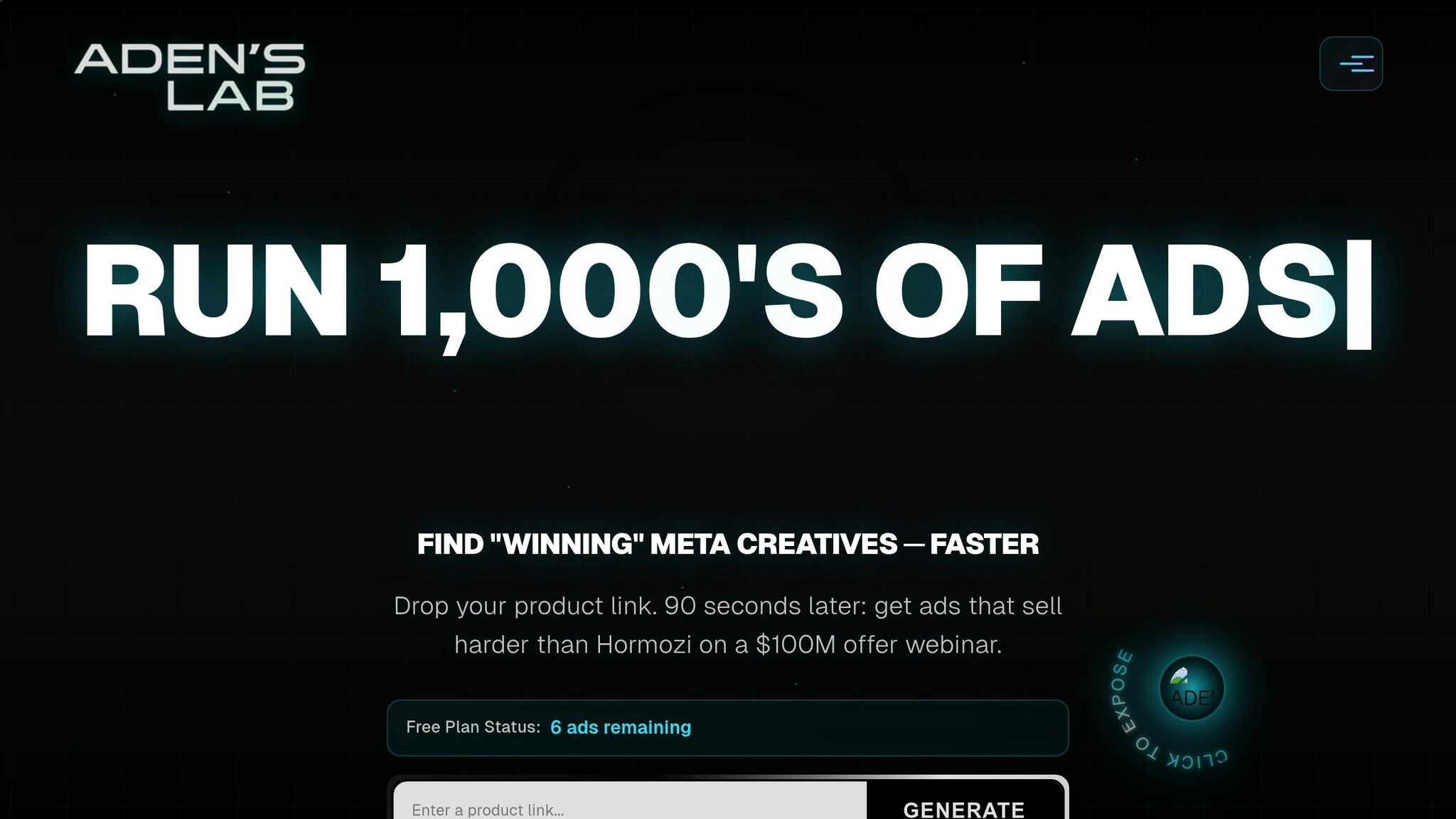
ADEN's LAB takes this workflow to the next level by scaling ad production for high-volume testing.
The platform automates the entire creative pipeline, enabling marketers to produce hundreds of Meta ads daily without needing to grow their creative teams or budgets. In seconds, it delivers attention-grabbing ads designed to drive conversions.
What’s more, ADEN's LAB significantly reduces costs, making high-volume testing possible even for smaller businesses. All ads come with full commercial rights, so you own the content and can use it across all your marketing channels without limitations.
Using AI with CBO and ABO Campaigns
AI-generated ads integrate seamlessly into both Campaign Budget Optimization (CBO) and Ad Set Budget Optimization (ABO) structures:
- For ABO campaigns: Use AI to create 10–20 unique ad variations. Assign each variation to its own ad set with equal budgets. After a few days, you’ll have clear data on which ads perform best, helping you refine your strategy.
- For CBO campaigns: Load 20–50 variations into a single campaign. Meta’s algorithm will automatically identify the top-performing ads, giving you a data-driven way to optimize results.
A hybrid approach often works best. Start with ABO to test a variety of creative concepts. Once you identify the winning ideas, use CBO to scale those concepts by generating additional variations.
AI also helps combat creative fatigue. When your top-performing ads lose their effectiveness due to audience saturation, you can quickly generate fresh variations to keep your campaigns running smoothly. This ability to refresh your ads on demand is crucial for maintaining consistent performance as you scale your ad spend.
Another advantage? AI makes it easy to run highly segmented campaigns. For instance, you can create one set of ads that emphasizes luxury for high-income audiences, another that highlights affordability for budget-conscious buyers, and a third that focuses on convenience for busy professionals. What used to be a logistical challenge is now a straightforward and routine part of your strategy.
sbb-itb-628c49f
Testing Frameworks and Matrices for Meta Ads
Generating dozens of ads in minutes sounds impressive, but without a solid testing framework, it's just noise. A well-structured approach ensures your AI-generated ads turn into actionable insights, helping you uncover what works, eliminate what doesn’t, and scale your campaigns effectively. This process involves breaking testing into distinct phases that guide your ads from concept to scalable winners.
Phased Testing Framework for Meta Ads
Testing Meta ads effectively can be divided into three phases: discovery, validation, and scaling. Each phase has specific goals, budgets, and criteria to guide decision-making.
Discovery Phase: Identifying Promising Concepts
The discovery phase is all about casting a wide net to pinpoint creative ideas with potential. The aim here isn’t immediate success but finding concepts worth refining. This phase typically runs for 3–5 days with smaller budgets, using an ad set budget of $20–$50 per day. By testing 20–50 ad variations, you can explore multiple angles, hooks, and formats.
Key metrics to watch include click-through rate (CTR) and cost per click (CPC). Ads with a CTR above 2% for cold audiences or a CPC below your target are worth advancing to the next phase. Conversion data is less critical at this stage, as sample sizes are too small to draw meaningful conclusions.
Validation Phase: Confirming Winning Ads
Once you’ve identified promising ads, move them into the validation phase. This step runs for 5–7 days with a daily budget of $100–$200 per ad set, allowing you to gather enough data to evaluate performance based on conversions.
The focus here shifts to cost per acquisition (CPA) and return on ad spend (ROAS). An ad with a strong CTR might still fall short in driving conversions, so this phase ensures only the best-performing ads move forward. Ads that meet your CPA targets and show consistent results are your true winners.
Scaling Phase: Growing Profitable Campaigns
The scaling phase is where you maximize returns from your validated winners. Transition to a campaign budget optimization (CBO) structure, grouping your winning ads into a single campaign with a daily budget ranging from $500 to $5,000+, depending on your business size. Meta's algorithm will allocate the budget to your best-performing ads automatically.
Leverage AI to create 10–20 refined versions of each winning ad, tweaking elements like background colors, copy, or calls-to-action. Monitor performance closely - if an ad starts underperforming compared to its validation results, pause it and test new variations. With AI, you can generate replacement ads in minutes, keeping your campaigns fresh and effective.
Testing Matrices for Creative Experiments
Once the phases are in place, using structured matrices helps you dissect creative variables systematically. These matrices allow you to test multiple elements simultaneously, revealing what really drives performance.
Angle × Format Matrix
This matrix pairs different marketing angles with various ad formats. Start by identifying 3–5 key angles for your product. For example, a fitness supplement might focus on weight loss, muscle building, energy boosts, overall health, or convenience. Combine these angles with 3–4 ad formats like static images, carousels, short videos, or user-generated content. This approach generates 15–20 unique combinations, each of which can be tested during the discovery phase to identify patterns - like which angle works best with a specific format.
Hook × Offer × CTA Matrix
This matrix zeroes in on three critical ad components: hook, offer, and call-to-action (CTA). Select 3–4 hooks (e.g., problem-focused, benefit-driven, curiosity-inducing, or social proof). Pair each with 2–3 offers, such as discounts, value-adds (like free shipping), or urgency-driven deals. Finally, test 2–3 CTAs, such as "Shop Now", "Learn More", or "Start Saving Today." This setup can yield 18–36 variations, helping you pinpoint combinations that resonate most with your audience.
Concept × Funnel Stage Matrix
Different creative concepts perform better at specific stages of the customer journey. For awareness, focus on educational content or lifestyle imagery. During consideration, highlight product features, comparisons, or testimonials. For conversions, emphasize urgency, guarantees, and clear value propositions. Use AI to generate 5–7 concepts per funnel stage and test them across cold, engaged, and retargeting audiences. This ensures your creative aligns with the goals of each stage in the funnel.
Moving from Testing to Scaling
Transitioning from testing to scaling is often tricky. Some advertisers scale too quickly on unproven ads, while others linger too long in testing. To avoid this, shortlist your winners after validation by ranking them based on CPA and ROAS. Ads with sufficient conversions and consistent performance are your true winners.
When scaling, don’t just duplicate ads. Instead, use AI to create 5–10 variations of each winner, refreshing the creative while keeping the core concept intact. Group these variations under a CBO campaign and let Meta’s algorithm optimize the budget. Start with a daily budget 2–3× higher than your validation spend, and increase it gradually (by 20–30% every few days). If CPA rises significantly, pause budget increases and refresh the creative.
Maintaining Performance at Scale
Even the best ads experience creative fatigue over time. To combat this, set performance thresholds - if an ad’s CPA rises significantly above its validation baseline, pause it and generate 3–5 new variations using AI. High-spending campaigns ($5,000+ per day) may need creative refreshes every 7–14 days, while lower-spending campaigns can often run for 3–4 weeks. Tools like ADEN's LAB make this process seamless, producing replacement ads in under two minutes.
Another key to scaling success is audience expansion. Once your winning ads perform consistently, test them with new audience segments. Tailor variations to different demographics, interests, or regions - what works for one group may need slight adjustments for another.
Improving Performance and Reducing CPA with AI
AI has transformed the way advertisers approach creative testing. By streamlining workflows, it reduces costs per acquisition (CPA), boosts return on ad spend (ROAS), and helps maintain campaign profitability. Traditional methods of identifying winning ads, tweaking concepts, and refreshing fatigued creatives take time. AI simplifies this process by creating a continuous feedback loop that keeps campaigns optimized.
Key Metrics for Meta Ad Performance
Each phase of ad testing relies on specific metrics to evaluate performance effectively. These metrics guide decisions and ensure ads progress smoothly through the funnel.
- Discovery Phase: At this stage, engagement and click-based metrics are the focus. Click-through rate (CTR) helps determine if an ad concept resonates with your audience, while cost per click (CPC) indicates cost-effectiveness. Meta’s algorithm uses these early signals to assess ad potential, automatically scaling high performers and throttling underperformers. Since conversion data is often unreliable in this phase due to limited samples, engagement metrics take precedence.
- Validation Phase: Here, the emphasis shifts to conversion metrics. CPA becomes the main indicator of whether an ad can drive profitable actions, while ROAS provides a clearer picture of scalability. Conversion rate also plays a role, showing how well the ad’s messaging aligns with the landing page and offer.
- Scaling Phase: Efficiency and fatigue indicators become critical. Metrics like CPA and ROAS remain important, but signs of creative fatigue - such as rising CPC or CPA combined with falling CTR - signal the need for updates. Creative elements account for 47% of an ad’s effectiveness, far outweighing factors like reach (22%) and brand (15%). This underscores the importance of refining creative elements rather than focusing solely on targeting or budget adjustments.
These metrics are essential for guiding the iterative process of ad optimization.
Iterating Creatives Based on Performance Data
AI simplifies the process of analyzing performance and generating fresh ad variations. Instead of waiting on designers to create new concepts, AI allows for quick updates to keep campaigns engaging and avoid fatigue.
Start by pinpointing the elements driving success in your top-performing ads. For example, if a specific hook consistently performs well, AI can help create multiple variations that retain this element while experimenting with different visuals, offers, or calls-to-action. Similarly, if a particular product angle proves cost-effective, you can expand it into various formats like static images, carousels, or short videos.
Rather than starting from scratch, AI ensures consistency across your creative output while introducing fresh elements to maintain audience interest.
A B2B SaaS company, for instance, saw a 23% lift in CTR, an 18% increase in conversions, and a 9% drop in CPA by featuring their founder prominently in their ads. Using AI, they created multiple variations - changing backgrounds, captions, and calls-to-action - while keeping the founder as the focal point. This preserved the ad’s core strengths while refreshing its presentation.
How ADEN's LAB Improves Ad Efficiency
ADEN's LAB takes the iterative process to the next level, drastically reducing the time needed to refresh ads. The platform can detect performance dips and deploy new creatives in under two minutes. Unlike traditional workflows that require coordination between teams, ADEN's LAB compresses the process, enabling immediate responses to performance changes.
With the ability to generate hundreds of ads daily, the platform ensures a constant supply of fresh creatives. When an ad starts underperforming, new variations can be launched quickly, keeping CPA stable and minimizing downtime. ADEN's LAB also cuts production costs by up to 100x compared to traditional teams, allowing for faster iterations and more concept testing without exceeding your budget.
Consistency is another key advantage. Once you identify a winning ad, ADEN's LAB creates variations that maintain the core elements - such as brand style, messaging tone, and visual hierarchy - while introducing fresh components. This approach avoids the "random testing" problem, where new ads deviate too far from proven successes.
The platform also accelerates testing cycles. While traditional methods often require extended data collection periods, ADEN's LAB enables brands to run multiple testing cycles in a short time, compounding performance improvements.
For high-growth brands, ADEN's LAB acts as a scalable engine that keeps up with increased ad spend. Its speed, cost efficiency, and consistency ensure you always have a pipeline of high-performing creatives, helping reduce CPA and maintain profitability as you scale.
Conclusion: Scaling Growth with AI Creative Testing
The traditional methods of creative testing just can't keep up with the fast-paced demands of Meta advertising today. AI-powered testing eliminates the slow, manual processes and limited capacity that often stall growth.
Imagine moving from creating a few ads per week to producing hundreds of ads every single day. This shift changes the game for brands, allowing you to test multiple creative angles at once, pinpoint what works faster, and scale campaigns more effectively. The ability to produce at this scale gives you a clear edge - faster, data-driven decisions that fuel growth.
Speed is everything here. Rolling out new ad variations in under two minutes keeps your campaigns sharp and optimized, without the need for constant manual adjustments. This quick turnaround often leads to lower CPA and higher ROAS, especially when scaling efforts are in full swing.
AI also dramatically reduces production costs - by as much as 100× - giving you more room in your budget for testing and media spend while maintaining high-quality output. Once you’ve identified what works - whether it’s a specific hook, visual style, or product focus - ADEN's LAB ensures those winning elements stay intact while refreshing other components. This keeps your ads performing well without falling into creative fatigue, all while aligning with the phased testing strategies we've covered.
For brands managing large ad budgets, ADEN's LAB acts as a creative powerhouse, capable of generating 1,000+ ads daily. This scalability ensures you always have fresh creative to match increased spending, keeping performance steady as you grow.
AI creative testing isn’t just about churning out more ads; it’s about creating a smarter, more systematic way to grow. Each testing cycle reveals deeper audience insights, making future campaigns even stronger. Brands leveraging AI-powered testing consistently outpace competitors by operating at a speed and efficiency that traditional workflows simply can’t match.
With ADEN's LAB, creative production becomes a competitive advantage. It equips performance marketers with the tools to test boldly, scale confidently, and maintain profitability - no matter how big the budget gets. AI creative testing transforms growth into a repeatable, scalable process that drives results.
FAQs
How can AI creative testing lower the cost per acquisition (CPA) for Meta ads?
AI-powered creative testing helps reduce CPA by pinpointing the top-performing ad creatives quickly. This means you can allocate your budget to the ads that deliver results while sidelining those that don’t, ensuring your ad spend works harder and delivers better outcomes for less.
With AI, you can test multiple ad variations at the same time, identify trends in audience preferences, and make faster, data-backed decisions compared to traditional methods. This approach not only saves time but also cuts down on wasted ad spend, boosting your campaign’s profitability in the process.
What’s the difference between Campaign Budget Optimization (CBO) and Ad Set Budget Optimization (ABO) when using AI to create Meta ads?
The difference between Campaign Budget Optimization (CBO) and Ad Set Budget Optimization (ABO) lies in how budgets are managed across ad sets.
CBO takes a hands-off approach by automatically distributing your campaign's total budget based on performance. This means the system prioritizes ad sets that are delivering better results in real time. It’s especially useful for dynamic campaigns where efficiency and quick adjustments are key.
In contrast, ABO puts the control in your hands. You manually assign budgets to each ad set, making it a great choice for testing specific variables. However, this method demands more attention, as it doesn’t adapt as quickly to changes in performance.
Both methods can work well with AI tools for creative testing. CBO shines when you need to scale and optimize ad variations quickly, while ABO is better suited for detailed, granular testing.
How does ADEN's LAB use AI to prevent creative fatigue in Meta ad campaigns?
AI-driven platforms like ADEN's LAB take the hassle out of battling creative fatigue by swiftly producing a diverse range of ad variations. This means marketers can update ads more often, ensuring content stays fresh and continues to resonate with audiences.
By automating the creation and testing of ad creatives, AI makes it easy to replace underperforming ads while scaling the ones that work best. The result? Consistently engaged audiences and a gradual reduction in cost-per-acquisition (CPA) over time.
Your next ad batch starts here
Finish with a ready-to-test ad batch
Paste your website to generate static creatives. Drop the link → get ads in about 90 seconds → upload them to Meta → scale.
Free to try No prompt writing