Dynamic Ads vs Static Ads for Retargeting on Meta
Build the ads while the examples are fresh
Turn your product page into static ad creatives
Paste your product URL and generate scroll-stopping images, headlines, and primary text—ready for your next Meta creative test.
Free to try No prompt writing

Dynamic ads and static ads serve different purposes in Meta retargeting campaigns. Dynamic ads personalize content by showing users the exact products they’ve interacted with, making them highly effective for driving conversions, especially for businesses with large product catalogs. Static ads, on the other hand, deliver the same message to all viewers, offering simplicity, speed, and full control over the design - ideal for brand awareness, flash sales, or small product ranges.
Key Takeaways:
-
Dynamic Ads:
- Automatically display products users viewed or added to their cart.
- Require a product catalog, Meta Pixel, and Conversions API.
- Offer high personalization, scaling easily for large inventories.
- Best for high-intent audiences like cart abandoners or product viewers.
-
Static Ads:
- Use a single creative for all viewers.
- Quick and easy to set up - no catalog or advanced tracking needed.
- Ideal for time-sensitive promotions, storytelling, or small catalogs.
- Provide full creative control but lack personalization.
Quick Comparison
| Factor | Dynamic Ads | Static Ads |
|---|---|---|
| Setup Complexity | High - requires catalog and tracking setup | Low - upload creative and launch |
| Personalization | High - tailored to user behavior | None - same message for all |
| Best Use Case | Retargeting large catalogs, cart abandoners | Flash sales, brand awareness, small catalogs |
| Creative Control | Limited to templates | Full design flexibility |
| Scalability | Handles thousands of SKUs easily | Requires manual updates for changes |
| Cost to Produce | Higher due to technical setup | Lower - simple creative assets |
Dynamic ads excel in driving conversions through personalization, while static ads are better for campaigns requiring quick deployment and consistent messaging. The best approach often combines both formats, using static ads for broad messaging and dynamic ads for personalized follow-ups.
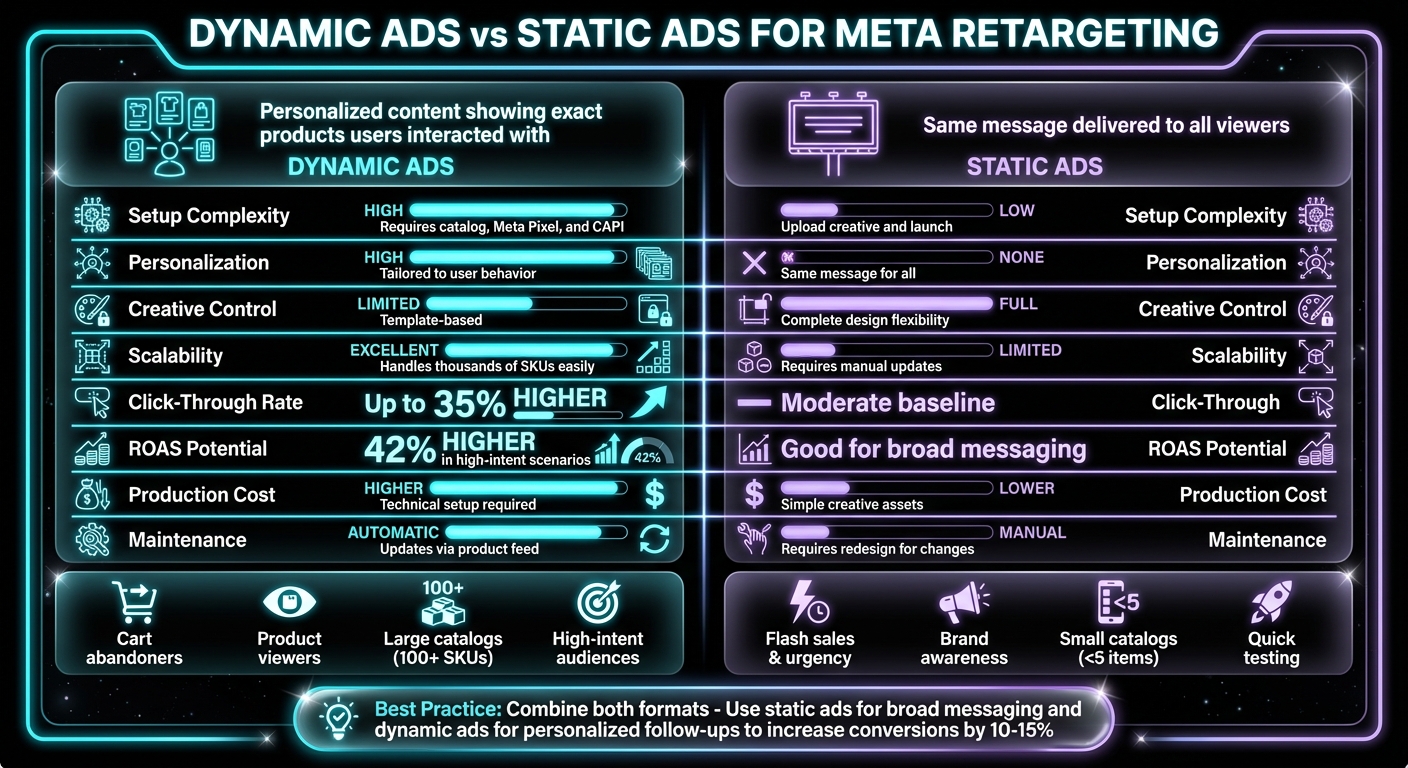
Dynamic Ads vs Static Ads Comparison for Meta Retargeting
Dynamic vs Static Ads: What's the Difference?
Put the playbook to work
Apply this playbook to your page
Paste your website and the Lab will turn the strategy you are reading into a ready-to-test ads.
Free to try No prompt writing
What Are Dynamic Ads for Retargeting?
Dynamic ads, officially known as Advantage+ catalog ads by Meta, are automated ad templates designed to show users products they’ve already interacted with on your website. Imagine someone browses a pair of running shoes but doesn’t make a purchase - these ads will display that exact pair of shoes in their social media feed. If they abandon a laptop in their cart, the ad reminds them about it. The goal? Serve ads that feel highly personalized.
"Instead of having to create an individual ad for each product or item in your inventory, dynamic ads allow you to create an ad template that automatically uses images and details from your catalogue." - Meta
This personalization is powered by three key components: your product catalog (a detailed inventory feed), the Meta Pixel (which tracks user behavior on your site), and an ad template (a layout that Meta automatically fills with product details). When a user interacts with a product, the Meta Pixel logs the Product ID, matches it to your catalog, and generates an ad featuring that specific item, complete with its image, price, and description. This system aligns perfectly with retargeting’s main goal: showing users what they’ve already expressed interest in.
How Dynamic Ads Work
To set up dynamic ads, you’ll need three critical elements: a product catalog, the Meta Pixel, and an ad template. Here’s how it all comes together:
- Product Catalog: This is the backbone of your system - a data file containing details about every product you sell, such as titles, prices, images, availability, and unique Product IDs. It acts as your inventory’s "source of truth."
- Meta Pixel and Conversions API (CAPI): These tools track user actions on your site. For example, when someone views a product, adds it to their cart, or makes a purchase, the Pixel logs the Product ID. Meanwhile, CAPI provides server-side tracking, ensuring accurate data even when browser restrictions block the Pixel.
- Ad Template: Once the Pixel captures a user’s interaction with a product, Meta matches the Product ID to your catalog, pulls the relevant details, and inserts them into a pre-designed ad template. This process happens automatically, allowing you to scale your campaigns without manually creating thousands of ads.
| Component | Role in Retargeting |
|---|---|
| Meta Pixel | Tracks user behavior, like viewed or carted items |
| Product Catalog | Stores product details, including images and pricing |
| Ad Template | Framework for displaying personalized product ads |
| Conversions API | Ensures accurate tracking by sending server-side signals |
This seamless system ensures that ads are tailored to each user’s browsing history, creating a highly personalized experience in real time.
Why Dynamic Ads Perform Well
The success of dynamic ads boils down to relevance. These ads show people the exact products they’ve already considered, removing the need for them to search again or remember what they wanted. This level of personalization can increase click-through rates by up to 300%.
Dynamic ads also scale effortlessly. Whether you have 10 or 10,000 products, you only need one ad template. Meta handles the rest, automatically pulling the right product for each user. For example, a fashion retailer reported a 25% increase in sales by using dynamic ads to target shoppers who abandoned items in their carts.
Another major benefit is automation. Since the ads update in real time, they reflect current inventory and pricing without manual intervention. Once you set the rules - like targeting cart abandoners - Meta’s system runs continuously.
Where Dynamic Ads Fall Short
Despite their advantages, dynamic ads come with challenges, starting with setup complexity. You need a well-organized product catalog, a properly installed Pixel, and ideally CAPI. If your catalog has errors - like incorrect prices, broken image links, or missing Product IDs - your ads won’t function properly. Poorly formatted data or Pixel issues can delay campaigns for weeks.
Another drawback is creative fatigue. Since dynamic ads rely on the same template, they can start to feel repetitive. While the product image and details change, the overall design remains static. Without regular updates to the template, users may begin to ignore the ads, reducing their effectiveness.
Finally, dynamic ads depend heavily on accurate data. If your catalog isn’t updated in real time, you risk showing ads for out-of-stock items. This not only wastes your ad spend but also frustrates potential customers. Keeping your feed accurate is essential to avoid these pitfalls.
Next, we’ll explore how static ads work and the unique advantages they bring to the table.
What Are Static Ads for Retargeting?
Static ads rely on a single creative - a fixed image, video, or message - that's shown to every viewer in your retargeting audience. It doesn’t matter if someone just visited your homepage, browsed a product, or left items in their cart - the ad remains the same. The "static" part refers to the unchanging content, not the format. These ads can take many forms: still images, videos, carousels, or slideshows. Think of them like digital billboards: one clear message for everyone.
The appeal of static ads lies in their simplicity. You don’t need a product catalog, advanced tracking tools, or complex integrations. All it takes is creating one ad, uploading it to Meta's Ads Manager, and letting it run. This makes static ads especially manageable for small teams or businesses without technical resources.
Another advantage is complete creative control. Every design element - text, colors, and visuals - is entirely up to you. Unlike automated dynamic ads, where algorithms decide what to display, static ads allow you to maintain a consistent brand identity across all impressions.
However, static ads lack personalization. Everyone sees the same message, whether they abandoned their cart or just visited your homepage. For businesses with large product catalogs or intricate customer journeys, this approach can feel generic. But for goals like raising brand awareness, promoting seasonal sales, or showcasing a small product line, static ads can be a smart option.
How Static Ads Work
Static ads are as straightforward to launch as they sound. You create the ad - whether it’s an image, video, or carousel - and upload it to Meta’s Ads Manager. Then, you define your retargeting audience. This could include people who visited your site in the last 30 days or engaged with your Instagram profile. Once the campaign is live, everyone in that audience sees the same creative.
Unlike dynamic ads, static ads don’t track specific products someone viewed. Instead, they target broader actions like site visits, page engagement, or video views. This makes them ideal for storytelling rather than product-specific reminders.
For example, if you’re introducing a new product line, you could create a static video ad showcasing the collection and run it to everyone who visited your site recently. The goal here isn’t to remind viewers of a specific item but to spark interest and encourage them to explore further. This approach works particularly well for smaller product ranges.
Static ads are also great for time-sensitive campaigns. Whether it’s a flash sale or a holiday promotion, a bold, clear message like "30% Off Ends Tonight" can create urgency without relying on personalized content. This ensures everyone gets the same, unmistakable offer.
Why Static Ads Work
One of the biggest strengths of static ads is their speed. You can go from concept to live campaign in less than an hour, with no need to sync product catalogs or troubleshoot technical setups. This makes them perfect for testing new ideas, reacting to trends, or jumping on timely opportunities.
They’re also cost-effective. Static ads are less expensive to produce and can run for weeks without needing updates - though it’s important to monitor for creative fatigue. This makes them particularly appealing for small businesses or brands just starting out.
Reliability is another plus. Because static ads don’t rely on external data feeds, you don’t have to worry about errors disrupting your campaign. What you design is exactly what viewers will see.
Static ads also allow for precise A/B testing. You can manually test different headlines, images, and calls-to-action to see what resonates most with your audience. This level of control is harder to achieve with dynamic ads, where algorithms handle much of the decision-making.
Lastly, static ads are excellent for maintaining brand consistency. Whether you’re launching a new brand or reinforcing a specific message, static ads ensure that every viewer sees the same story. This consistency is crucial when your goal is to build trust and recognition at the top of the retargeting funnel.
Where Static Ads Fall Short
The main drawback of static ads is their lack of personalization. Since everyone sees the same creative, this approach may not work well for brands with extensive product catalogs or diverse offerings. Without the ability to show users the exact items they’ve shown interest in, static ads may struggle to re-engage high-intent shoppers effectively.
Another issue is creative fatigue. Showing the same ad repeatedly can lead to declining engagement over time. To counter this, it’s recommended to refresh static creatives every two weeks, which can be challenging for smaller teams.
Static ads also require manual updates. If your pricing changes, a product sells out, or you need to tweak an offer, you’ll have to redesign and re-upload the ad. This is in contrast to dynamic ads, which update automatically through product feeds.
For brands with hundreds or thousands of products, static ads simply don’t scale efficiently. Creating individual static ads for each item would be impractical. In such cases, dynamic ads are often the better choice for retargeting.
That said, static ads aren’t inherently flawed - they’re just a different tool suited to specific scenarios. For campaigns focusing on smaller product lines, brand building, or time-sensitive promotions, the speed, control, and simplicity of static ads make them a great choice.
Dynamic vs Static Ads: The Main Differences
When it comes to dynamic ads vs. static ads, the key distinction lies in personalization vs. control. Dynamic ads use real-time data from your product catalog to show users the exact items they interacted with - whether it's the sneakers they abandoned in their cart or the furniture they browsed. On the other hand, static ads present the same creative to every viewer, regardless of their behavior on your site.
How They Work
Static ads are straightforward: you create a single creative and deploy it as-is. Dynamic ads, however, rely on an integrated system that includes tools like Meta Pixel, CAPI, and a product catalog. But here's the catch - if your product feed breaks or tracking events misfire, dynamic ads can fall apart, while static ads remain unaffected. This technical difference has major implications for performance and upkeep.
Maintenance and Updates
The way these formats handle updates is another big difference. With static ads, every change requires manual effort - you'll need to update the creative yourself. Dynamic ads, by contrast, automatically pull updates from your product feed. While this saves time, it also means the accuracy of your catalog is critical. Feed errors can lead to ads showing out-of-stock or mispriced products, which can hurt your campaign's effectiveness.
Personalization vs. Creative Control
Dynamic ads excel in personalization, often outperforming static ads when it comes to conversions. Showing a user the exact product they viewed is far more compelling than a generic message. However, this personalization comes at the cost of creative control. Static ads allow you to fine-tune every detail - colors, text, layout - to align perfectly with your brand. Dynamic ads, on the other hand, rely on preset templates, limiting your ability to customize.
Performance Comparison Table
| Factor | Static Ads | Dynamic Ads |
|---|---|---|
| Setup Complexity | Low - upload creative and launch | High - requires tracking pixel, CAPI, and product catalog |
| Personalization Level | None - same message for everyone | High - automatically shows products users interacted with |
| Creative Control | Full control over design | Limited to preset templates |
| Click-Through Rate (CTR) | Moderate baseline | Up to 35% higher due to personalization |
| ROAS Potential | Good for broad messaging | 42% higher in high-intent retargeting scenarios |
| Maintenance | Manual updates for changes | Automatic updates via product feed |
| Scalability | Limited - manual effort per ad | Easily handles thousands of SKUs |
| Best For | Brand building or small catalogs | E-commerce retargeting for large inventories |
| Technical Requirements | Basic creative assets | Advanced tracking and data feed integration |
| Cost to Produce | Lower production cost | Higher technical and setup investment |
Real-World Example
In early 2026, a furniture brand tested both formats in a retargeting campaign. Their static ad offered a 10% discount to all site visitors, while the dynamic ad highlighted specific sofas users had viewed. The results? The dynamic ad drove 27% more conversions and achieved a 42% higher ROAS. This aligns with broader trends I've seen after managing over $100M in Meta ads.
When to Use Each Format
Dynamic ads shine when personalization is key - like retargeting high-intent shoppers or managing large inventories. But static ads have their place, too. They're faster to test, easier to iterate, and give you full creative control. If you're experimenting with a new creative angle, running a flash sale, or focusing on brand awareness, static ads are often the better choice.
Ultimately, the decision depends on your goals. Want to turn interest into action? Dynamic ads are your go-to. Need to test creative ideas quickly or maintain tight control over your messaging? Static ads are the way to go. Each format has its strengths, and understanding when to use them can make all the difference in your campaign's success.
When Dynamic Ads Make Sense
Dynamic ads shine in scenarios where personalization can seal the deal. Imagine a user browsing several sofas on your site but leaving without making a purchase. A generic ad won’t cut it. However, showing them the exact sofas they viewed? That’s where dynamic ads truly deliver.
One of the most effective use cases is cart abandonment. When someone adds a product to their cart but doesn’t complete the purchase, dynamic ads can step in and remind them - sometimes with a little extra nudge like free shipping. Campaigns targeting cart abandoners with dynamic ads often achieve conversion rates 3–5 times higher than cold prospecting efforts. Why? The intent to buy is already there; these ads just help close the loop.
Dynamic ads are also a game-changer for businesses with large product catalogs. Manually creating static ads for hundreds or thousands of products isn’t practical. A single dynamic ad template can automatically showcase hundreds of SKUs. For example, a fashion brand I worked with had over 800 products. Using dynamic ads, they retargeted shoppers with personalized creatives, leading to a 25% increase in sales by displaying items users had browsed.
Another strength of dynamic ads is their ability to engage users who browse multiple items. Carousel formats, for instance, can show previously viewed products alongside similar recommendations, keeping the content relevant. One retailer reported a 35% jump in click-through rates simply because their ads aligned with what users had already expressed interest in.
Dynamic ads are perfect for high-intent audiences. They’re not designed for building broad awareness but for converting warm prospects who are already poised to make a purchase. In the next section, we’ll look at situations where static ads might be the better choice for your retargeting strategy.
When Static Ads Make Sense
Static ads work best when delivering a consistent message is more important than tailoring it to individual users. Take a flash sale, for instance. If the sale ends in 48 hours, you don’t want an algorithm deciding which products to highlight. Instead, everyone should see the same clear message, like: "20% off everything - ends Sunday." With static ads, you can ensure that message is delivered exactly as intended, without relying on complicated data feeds or technical setups.
This straightforward approach is ideal not just for flash sales but also for seasonal campaigns. One example comes from a Black Friday campaign where a brand used static ads to spotlight a single hero product - a limited-edition item they wanted to emphasize. The ad highlighted the product, the discount, and a clear deadline. This focused strategy delivered strong results without the unpredictability often associated with dynamic formats.
Static ads also play a key role when launching new products or building brand awareness. Introducing a product to the market requires complete control over how it’s presented - from the visuals to the tone of the copy. Since dynamic ads prioritize personalization, they can sometimes compromise this consistency. As Connor Lane from HexClad aptly said:
"You can't media buy yourself out of a bad creative situation".
A well-crafted static ad builds momentum over time. On the flip side, if the creative is weak, no budget can save it.
Another advantage of static ads is their quick deployment. Without the need for complex integrations, you can design and launch them fast. Plus, because static ads are lighter and load faster, they often perform better in areas with slower internet speeds.
However, static ads do come with a downside: creative fatigue. To maintain performance during heavy ad spending, you’ll need to refresh your creatives every 7–10 days. Tools like ADEN’s LAB simplify this process. Just drop a link, get fresh ads, and launch them on Meta - all in under 90 seconds. This eliminates the delays typically caused by traditional design and revision cycles.
While dynamic ads excel at personalization, static ads provide unmatched control and speed, making them a powerful choice for focused campaigns.
What Actually Happens When You Test Both
When testing static and dynamic ad formats side by side, the results vary significantly based on what you're retargeting and how your product catalog is set up. Take this example: in a 2026 experiment, a furniture brand compared a static ad offering a flat 10% discount with a dynamic campaign that showcased the specific products users had previously browsed. The dynamic campaign outperformed the static one, delivering 27% more conversions and a 42% higher ROAS. That kind of performance can make the difference between merely breaking even and achieving profitable growth.
Dynamic ads thrive on personalization, making them highly effective when user intent is strong. Think about scenarios like cart abandonment or targeting users who have viewed specific products - personalized reminders often drive better results in these cases. On the other hand, static ads shine in situations where clarity and urgency are key, such as flash sales or sitewide discounts. Their straightforward messaging can cut through the noise when time is of the essence.
Here's another consideration: Meta's algorithm tends to allocate budgets quickly to the ad that performs well early on, even before the results have fully stabilized. This means that simply mixing static and dynamic ads in the same ad set won't give you a fair comparison. Instead, using Meta's A/B testing tool or running separate campaigns with equal budgets is a better approach. Ultimately, each ad type has its strengths, and the right choice depends on the specific goals of your campaign.
Use Case Comparison Table
| Scenario | Best Ad Type | Setup Time | Fatigue Resistance | Cost Efficiency | Conversion Impact |
|---|---|---|---|---|---|
| Cart Abandonment | Dynamic | High (Catalog Required) | High | High | Very High |
| Product Viewers | Dynamic | High (Catalog Required) | High | Moderate | High |
| Large Catalogs (100+ SKUs) | Dynamic | Moderate | Very High | High | High |
| Small Catalogs (<5 Items) | Static | Low | Low | High | Moderate |
| Flash Sales / Urgency | Static | Low | Moderate | High | High |
| Brand Awareness | Static | Low | Low | Moderate | Low (Direct) |
Using Both Ad Types Together
The most effective retargeting strategies assign specific roles to each ad format: static ads focus on brand messaging and broad offers, while dynamic ads personalize content for users showing clear buying intent. By aligning each format with a particular stage of your sales funnel, you can deliver more targeted and efficient messaging.
Static ads are great for introducing your brand, addressing common concerns, or promoting limited-time offers to all visitors from the past 30 days. Once users show stronger intent - like adding items to their cart or browsing specific products - dynamic ads step in. These ads remind users of what they left behind, keeping the message relevant and avoiding wasted impressions. To ensure a smooth transition between the two, maintain visual consistency. Stick to the same colors, fonts, and tone across both formats to create a cohesive brand experience.
Budget management plays a major role in this strategy. Campaign Budget Optimization (CBO) can help by allowing Meta's algorithm to allocate spending dynamically between your static and dynamic ad sets based on performance. To avoid overexposure, exclude recent buyers and limit ad frequency to 5–7 impressions per person within seven days. When testing these formats, run them as separate campaigns with equal budgets. This helps prevent Meta's system from favoring one format too early, giving you a fair comparison of their performance.
Here’s a smart tip: use static ads to test creative concepts quickly. For instance, if a static ad highlighting "better fit than competitors" outperforms one focused on durability, you can apply that winning message to your dynamic ad templates. This method not only saves time but also avoids the complexity of building dynamic campaigns from scratch while you're still figuring out what resonates.
The real strength of combining both formats lies in their complementary nature. Static ads give you full creative control for pivotal moments like flash sales or product launches - scenarios where dynamic templates might fall short. Meanwhile, dynamic ads efficiently handle repetitive tasks, like showcasing a wide range of products, without needing manual updates. Together, they form a scalable retargeting system that can boost conversions by 10–15% compared to relying on just one format.
If you're struggling with creative fatigue or slow production cycles, services like Aden's Lab can simplify things. Just provide a link, and they’ll generate fresh static ads ready to launch on Meta. This ensures your static creative stays relevant and impactful, even when resources are tight.
Why Static Ads Scale Better Than Most People Think
Static ads often surprise marketers with their ability to scale effectively, even as budgets grow. While they might seem less personalized compared to dynamic ads, static ads can outperform their dynamic counterparts in unexpected ways.
The key advantage lies in speed and control. Static ads allow you to test different messaging angles and validate creative concepts in just a few days, rather than weeks. Unlike dynamic ads, which depend on feed integrations and catalog updates, static ads skip these delays. You simply upload the creative and launch immediately. As Connor Lane from HexClad aptly said:
"You can't media buy yourself out of a bad creative situation".
This speed enables quick iterations, helping you avoid wasting money on ideas that don’t perform well. It’s a streamlined approach that’s crucial when rapid adjustments are needed in a campaign.
Another standout benefit is automation, which eliminates the usual production bottlenecks. Tools like Aden's Lab let you generate dozens of Meta ad variations in minutes - no back-and-forth with designers required. In fact, with automation, you can create over 100 variations instantly. This gives Meta’s algorithm plenty of material to experiment with, ensuring it can quickly identify the best audience segments. The combination of speed and automation also ensures your creative stays consistent, which is critical for maintaining a strong brand image.
Static ads also offer complete creative control. Unlike dynamic ads, which depend on potentially glitchy feed integrations, static ads maintain your brand’s visual consistency without compromise.
Finally, there’s the advantage of cost efficiency. By focusing on simple, core concepts rather than over-polished designs, teams can produce static ads for as little as $320 each. Automation can drive costs even lower - sometimes under $1 per ad - compared to the $50 or more typically charged by designers for a single creative. This low-cost, high-speed production process not only accelerates testing but also allows brands to scale their ad output significantly. Companies generating 200+ ads monthly are leaving competitors in the dust, especially those still stuck in slower, manual design cycles.
How to Choose Your Retargeting Approach
When it comes to retargeting, it’s not about picking one ad format over another - it’s about understanding what each does best and using them strategically. After managing over $100M in Meta ads, I’ve learned that aligning your ad format with your campaign stage is the real game-changer.
Dynamic ads excel at delivering personalized experiences on a large scale. They’re perfect for businesses with extensive product catalogs, especially when you want to showcase the exact items users viewed or left in their carts. On the other hand, static ads give you full control over your messaging and are great for quick testing. The key is knowing when to prioritize automation and when to take a more hands-on approach.
If your product catalog is small (fewer than five items), static ads or manual carousels often work better. They keep things simple and avoid the unnecessary complexity of dynamic setups. For larger catalogs, like those found in e-commerce stores with dozens or even hundreds of SKUs, dynamic ads are a must. They help you stay relevant without the headache of constant manual updates.
Another critical factor is how quickly you can produce new creative. Traditional design processes can slow you down, but automation lets you test and scale ideas almost instantly. For example, tools like ADEN's LAB can generate dozens of high-performing static Meta ads from just a single product link. Drop in the link, get your ads, and launch them on Meta - it’s that fast.
Finally, consider where your audience is in the funnel. For warmed-up audiences, decide whether you need the scalability of dynamic ads or the precision of manual creative control. Small product ranges often benefit from static ads’ simplicity, while larger inventories demand the efficiency of dynamic campaigns. In many cases, the smartest move is to combine both formats, tailoring them to different stages of your funnel.
FAQs
What are the main advantages of using dynamic ads for retargeting on Meta?
Dynamic ads work wonders for retargeting because they automatically create a personalized experience for each user. These ads use data from users' past interactions - like the products they browsed, added to their cart, or nearly purchased - to deliver content that feels tailored to their interests. This level of precision boosts engagement and drives conversions since users are more likely to respond to ads that resonate with their preferences.
Another big win with dynamic ads is their automation. By pulling directly from your product catalog, these ads ensure that updates like inventory changes, price adjustments, or new product launches are reflected instantly. No more worrying about manually updating ads or accidentally promoting outdated products. For businesses managing large catalogs or scaling retargeting campaigns, dynamic ads make it easier to serve personalized content while optimizing your return on ad spend (ROAS).
How do static ads ensure a consistent brand message without personalization?
Static ads deliver a steady brand message by presenting the same visuals and text to every viewer. This consistent approach helps build recognition and strengthens your brand identity over time. By sticking to a fixed design and tone, static ads eliminate the potential pitfalls of inconsistent messaging that can sometimes arise with highly personalized campaigns.
Although they don't cater to individual preferences, static ads are a dependable way to maintain a clear and unified presence, ensuring you stay in control of how your brand is represented.
When should a business use static ads instead of dynamic ads for retargeting?
Static ads work well when your main goal is boosting brand awareness, keeping your message consistent, or promoting a specific offer. Because these ads display the same creative to everyone, they’re straightforward to produce and ensure a unified presentation of your brand. This makes them a solid choice for campaigns focused on showcasing a single product or reinforcing your overall brand image without the need for personalization.
That said, static ads aren’t ideal for retargeting campaigns that rely on customized content or involve extensive product catalogs. For these scenarios, dynamic ads are a better option. They automatically adjust to feature products or messages tailored to a user’s behavior, making them more effective in driving engagement. Stick with static ads when your focus is on simplicity, consistency, or delivering a universal message to your audience.
Your next ad batch starts here
Finish with a ready-to-test ad batch
Paste your website to generate static creatives. Drop the link → get ads in about 90 seconds → upload them to Meta → scale.
Free to try No prompt writing