How to Create High-Converting Facebook Ads with AI (Step-by-Step Blueprint)
Turn the strategy into creatives
Create Meta ads for your product
Paste your product page. ADEN'S LAB turns the offer, audience, and positioning into complete ready-to-use Meta static ads.
Free to try No prompt writing
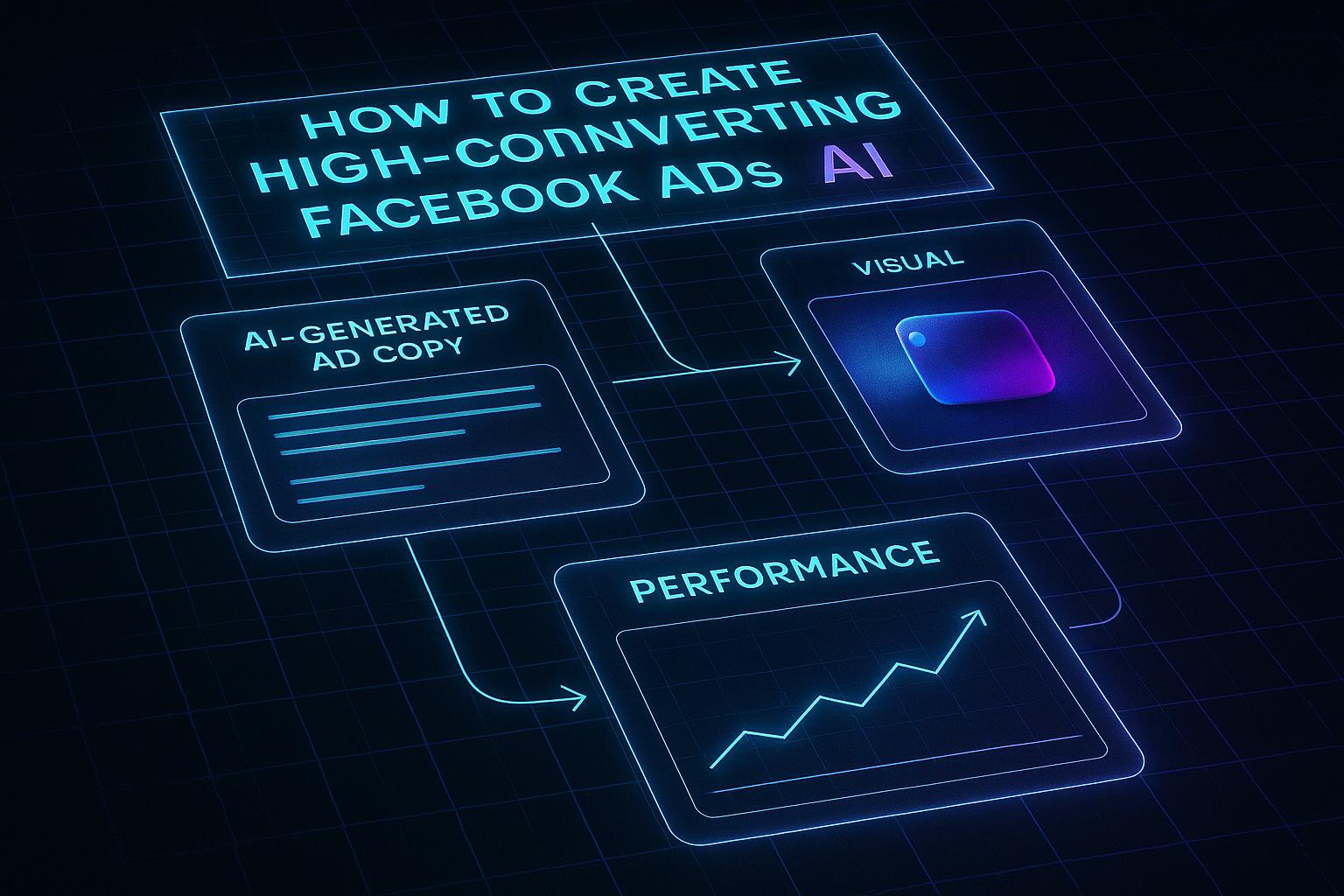
Want to boost your Facebook ad performance without spending hours on design and copywriting? AI tools like ADEN'S LAB make it possible to create multiple ad variations in seconds, helping you test faster and scale smarter.
Here’s the process in four easy steps:
- Prepare your inputs: Organize product details, audience insights, and brand assets.
- Use AI tools: Platforms like ADEN'S LAB generate ad creatives tailored for Facebook and Instagram.
- Write effective ad copy: Focus on clear, benefit-driven messaging for different placements.
- Launch and optimize: Test variations, analyze results, and refine based on performance.
This guide walks you through everything you need to know - from setting up AI-generated ads to improving conversions using data-driven insights. Whether you’re running a small e-commerce store or managing large campaigns, this approach saves time, reduces costs, and delivers better results.
The ULTIMATE Guide to using AI to make Facebook Ads (Full Step-by-Step Walkthrough)
Put the playbook to work
Apply this playbook to your page
Paste your website and the Lab will turn the strategy you are reading into a ready-to-test ads.
Free to try No prompt writing
Step 1: Prepare Your Inputs for AI Ad Creation
Creating effective AI-generated ads starts with the quality of your inputs. Spending 15-20 minutes organizing your product details, audience insights, and brand assets before diving into ADEN'S LAB can make all the difference between ads that perform and those that miss the mark.
Providing just a product link won’t cut it. The key is offering context, constraints, and clarity. The more specific you are, the more precise and impactful your ad variations will be.
Define Your Offer and Audience
Begin by summarizing your offer in a single, clear sentence. Include key product details, pricing (in USD), and major benefits. For example: "Organic sleep gummies, $29.99 for a 30-day supply, with a 60-day money-back guarantee."
Highlight any discounts, promotions, or guarantees that reduce hesitation. These elements directly shape ad copy and creative strategies.
Next, craft a detailed customer profile. Move beyond basic demographics like "women aged 25-45" and explore psychographics - what motivates your audience, their frustrations, and what would drive them to act.
For instance, if you’re marketing productivity software, your audience might include freelancers struggling to track billable hours across multiple clients. They could be losing $500-$1,000 monthly due to poor time management. They’ve tried spreadsheets and generic apps but need something tailored to their workflow. They value simplicity and tools that integrate seamlessly into their routine.
Pinpoint their pain points, goals, and objections. For example:
- Pain points: Wasting time on manual tracking, missing billable hours, feeling disorganized.
- Goals: Increase earnings by 20%, reduce admin work, gain peace of mind.
- Objections: Concerns about learning curves, skepticism after trying other tools, worries about monthly costs.
These insights will directly shape persuasive and relatable ad messaging.
Gather Required Inputs for AI Tools
For ADEN'S LAB to create high-quality ads, you’ll need to prepare specific assets. Start with your product URL, which should lead to a fast-loading landing page with clear product images and persuasive copy. The AI will analyze this page to extract key details and visuals.
If you have brand guidelines, gather them too. This includes:
- Logo files (preferably PNG with transparent backgrounds)
- Brand colors (hex codes like #FF5733)
-
Fonts and visual style preferences
Consistency across ads builds trust and recognition.
Collect customer testimonials that highlight measurable results. Look for specifics like: "I lost 12 lbs in 6 weeks without changing my diet" or "Cut my email response time from 3 hours to 15 minutes." These real-world results make for powerful ad hooks.
Prepare high-resolution product images from various angles. Include lifestyle shots that show the product in use. For instance, if you’re selling fitness equipment, feature people using it in home gyms. If it’s software, include screenshots showcasing key features.
Finally, define your desired outcomes. Are you aiming for purchases, leads, app installs, or video views? Specify your target cost per acquisition. For example, if you’re currently paying $45 per customer but want to lower it to $30, include that goal. Clear objectives will help evaluate the success of your AI-generated ads.
Create a Clear Creative Brief
Turn your organized inputs into a structured creative brief to guide the AI. Be explicit and detailed in your instructions.
Start with your campaign objective in one sentence. For example: "Generate Facebook carousel ads promoting our noise-canceling headphones to remote workers, emphasizing focus and productivity benefits, with a goal of $35 cost per purchase."
List your key selling points in order of priority. Focus on the top three benefits. For instance:
- Blocks 99% of background noise for distraction-free work
- 30-hour battery life lasts a full work week
- Comfortable for all-day wear with memory foam ear cups
Specify your ad format preferences - single image ads, carousels, video ads, or a mix. Include any restrictions, such as avoiding certain words due to Meta’s policies or steering clear of competitor comparisons.
Define the tone and voice of your ads. Should they feel urgent ("Limited stock - order now!") or educational ("Here’s how noise affects productivity")? Professional or casual? Write 2-3 example sentences in your desired tone to set clear expectations.
Include call-to-action (CTA) preferences like "Shop Now", "Learn More", or "Get Started." Different CTAs resonate with audiences at different stages of the buyer journey. For instance, "Shop Now" works well for ready-to-buy customers, while "Learn More" suits those still exploring.
Lastly, outline any compliance requirements. If you’re in a regulated industry like healthcare or finance, list what claims you can’t make. Document any audience-specific details, like age groups or geographic locations.
Step 2: Generate Facebook Ads with ADEN'S LAB
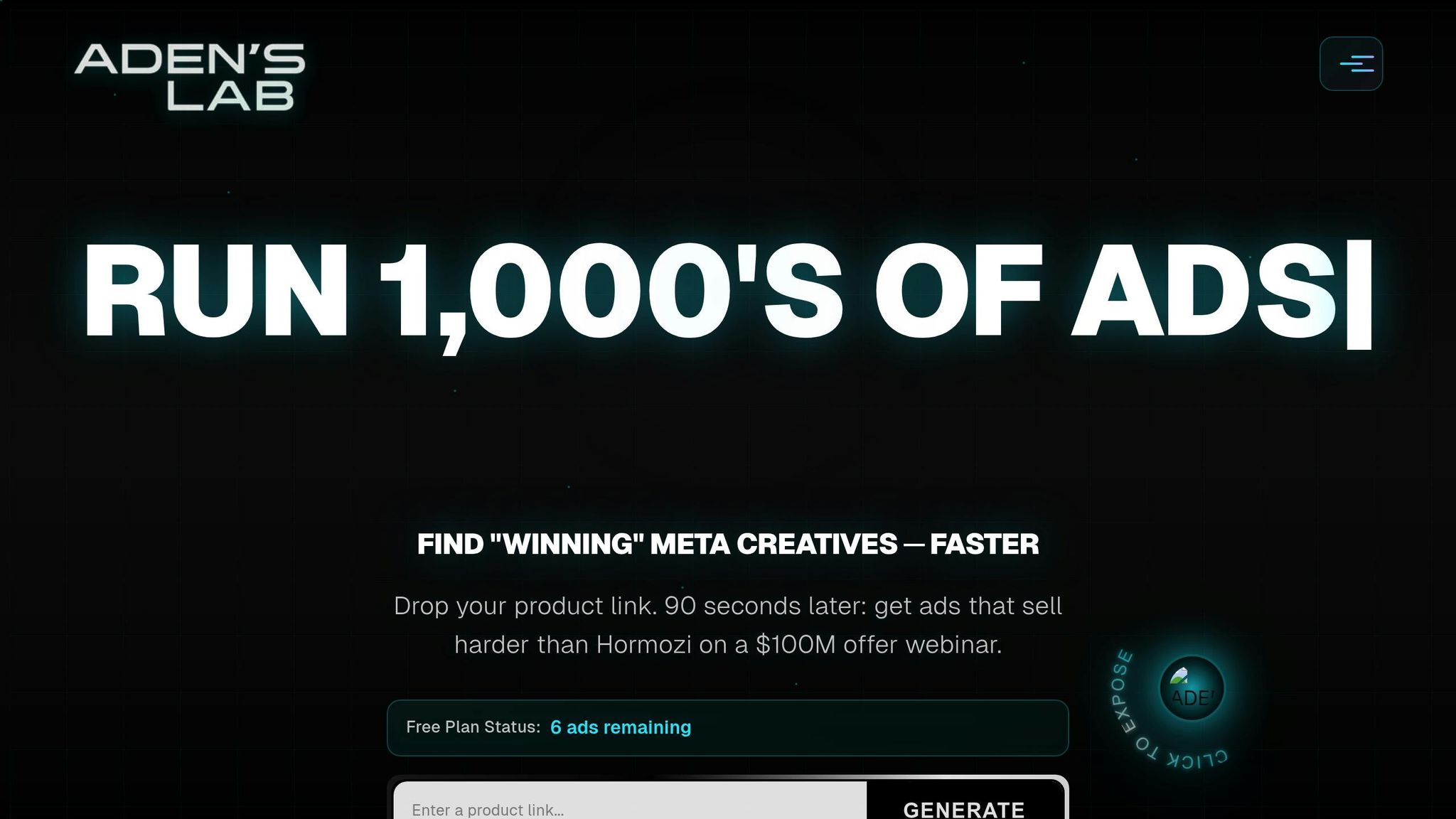
Now that your inputs are organized and your creative brief is prepared, it’s time to turn those details into high-performing ads. ADEN'S LAB takes your product page, analyzes it using proven conversion strategies, and generates multiple ad variations tailored to Meta's requirements. You’ll get ad assets designed for different placements, audiences, and psychological triggers - all without needing design tools or manual copywriting. This process makes testing and improving your ad performance quick and efficient.
Set Up Your ADEN'S LAB Account
Start by heading to adenslab.com to create your account. The free plan lets you generate up to six ads, giving you a chance to explore the platform before upgrading.
Once logged in, locate the product URL field on your dashboard and paste the link to your landing page. ADEN'S LAB will scan your page in seconds, pulling out product details, key features, and visual elements.
Next, upload your brand assets. Add your logo, specify your brand colors using hex codes (like #4A90E2 or #FF6B35), and upload your brand fonts. This ensures your ads stay consistent with your existing marketing materials.
You’ll also choose a brand style to match your product and audience. Options include modern and minimal, bold and vibrant, or elegant and sophisticated. For instance, a sleek style might suit tech products aimed at young professionals, while a more refined look could work for luxury skincare. Feel free to experiment with different styles to see what resonates.
Then, set your campaign objective. Whether your goal is purchases, lead generation, or awareness, options like "conversions" or "lead generation" will guide the AI in prioritizing the right calls to action and emotional triggers.
Finally, add any specific instructions in the creative brief field. For example: "Highlight the 60-day money-back guarantee. Target busy parents. Use a friendly but urgent tone." Once you’re ready, click "Generate Ads" and let the platform do its thing. In just about 90 seconds, your first batch of ads will be ready for review.
Generate Different Facebook Ad Formats
Once your account is set up, ADEN'S LAB creates ads optimized for all major Meta placements, ensuring your campaigns perform seamlessly across formats.
- Feed image ads: These appear in Facebook and Instagram feeds, either in square or vertical layouts. ADEN'S LAB generates variations with different headlines, benefit highlights, and CTAs. One version might spotlight a product feature, while another emphasizes its key benefit.
- Carousel ads: Perfect for showcasing multiple products or features, these ads use a series of cards. Each card includes its own image, headline, and description, guiding viewers through your product story step by step.
- Stories and Reels ads: Designed for vertical, full-screen placements, these ads feature bold text, quick pacing, and eye-catching hooks. The platform adjusts dimensions to the 9:16 aspect ratio and ensures text stays within safe zones.
- Animated video-style ads: These dynamic ads use text animations, zoom effects, and transitions to highlight product features or before-and-after results.
Each format comes with multiple variations, giving you a library of ad options to test. ADEN'S LAB ensures every ad meets Meta’s technical requirements, from dimensions to text-to-image ratios, so you can skip the hassle of reformatting or dealing with rejected ads.
You can download your ads individually or as complete kits organized by format. These kits include creative files, suggested ad copy, audience targeting tips, and notes on the psychological triggers used in each variation.
Apply Buyer Psychology for Better Conversions
ADEN'S LAB doesn’t just create visually appealing ads - it incorporates buyer psychology to drive engagement and conversions. The platform uses strategies like:
- Urgency and scarcity: Copy that emphasizes deadlines or limited availability.
- Social proof: Customer testimonials and review scores to build trust.
- Curiosity gaps: Hooks that encourage clicks and engagement.
- Authority signals: Credentials, endorsements, or certifications to establish trust.
- Reciprocity triggers: Offers that provide upfront value.
- Pattern interrupts: Unexpected visuals or questions to grab attention.
To keep your messaging clear, ADEN'S LAB uses benefit stacking, leading with your primary value proposition and following up with supporting features. This prevents your core message from getting lost in the details.
Each ad includes annotations explaining the psychological triggers it uses, helping you refine your strategy over time. The platform creates ads for every stage of the buyer journey - whether it’s grabbing the attention of cold audiences with curiosity hooks, reassuring warm prospects with guarantees and testimonials, or retargeting visitors with timely offers. You can even specify which psychological angles to focus on in your creative brief, like adding more trust signals for sensitive products or emphasizing urgency for quick purchases.
Step 3: Write High-Converting AI Ad Copy
Now that your ad visuals are ready, it’s time to focus on crafting ad copy that gets results. Great ad copy speaks directly to your audience - addressing their challenges, desires, and concerns. While ADEN'S LAB can generate this copy for you, understanding its structure helps you provide better inputs. Let’s break down the key elements of Facebook ad copy, how to structure effective prompts, and how to tailor your messaging for various placements in Meta’s ecosystem.
Core Elements of Effective Facebook Ad Copy
Facebook ads are made up of several key components, each with a specific role. Knowing these elements helps you guide the AI to create ads that resonate and convert.
- Primary text: This is the first block of text above your ad creative. Since Facebook truncates text after 125 characters with a "See more" link, you need to hook your audience right away. Use this space to call out your audience, highlight a benefit, or ask a question. Example: "Tired of waking up with back pain?"
- Headlines: Headlines appear just below your image or video and are limited to 40 characters. This is where you sum up your value proposition in a concise and impactful way. Examples: "Sleep Better Tonight" or "60-Day Money-Back Guarantee."
- Descriptions: These are 30-character snippets below the headline that provide supporting details. Use them to reinforce your offer, add urgency, or highlight a secondary benefit. Examples: "Free shipping on all orders" or "Limited stock available."
- Call-to-action buttons: These guide your audience on what to do next. Facebook provides preset options like "Shop Now", "Learn More", "Sign Up", or "Get Quote." Choose the one that aligns with your campaign goal.
Your visuals and text should work hand-in-hand. Avoid cluttering your images with too much text - Meta suggests keeping text overlays under 20% of the image area to avoid delivery penalties.
ADEN'S LAB simplifies this process by generating multiple variations of each component. For example, one version might start with a question in the primary text and a benefit-driven headline, while another might lead with social proof and use an urgent call-to-action.
Structure AI Prompts for Copy Frameworks
To get the best results from AI, your prompts need to be clear and specific. The more detailed your instructions, the better the output.
-
Use proven copywriting frameworks. For example:
- Problem-Agitate-Solve (PAS): This approach highlights a pain point, stirs emotion, and offers a solution. Prompt example: "Generate PAS framework copy using ADEN'S LAB. Problem: back pain from poor mattress. Agitate: sleepless nights affecting work performance. Solve: memory foam mattress with 60-day trial."
- AIDA (Attention-Interest-Desire-Action): This structure grabs attention, builds interest, creates desire, and drives action. Prompt example: "Generate AIDA-based ad copy for noise-canceling headphones. Start with a hook for commuters. Highlight noise cancellation. Emphasize focus and productivity. Close with a limited-time 20% discount."
- Offer-led approach: This is direct and focuses on the value being offered. Prompt example: "Generate direct offer ad using ADEN'S LAB. Product: meal prep service. Offer: 50% off first week. Target: busy professionals. Tone: friendly and time-saving."
- Be specific about your audience. Instead of saying "target parents", try "target first-time parents aged 28-35 who value convenience and prioritize product safety."
- Define tone and constraints. For example, specify "conversational and warm" or "professional and authoritative." Add parameters like "Keep primary text under 125 characters for mobile optimization" or "Create three headline variations under 40 characters."
When using ADEN'S LAB, input these frameworks directly into the creative brief. The platform recognizes these structures and applies them across all ad variations. Once your prompts are ready, you can refine the copy to suit different Meta placements.
Adapt Copy for Different Placements
Meta’s ad placements vary in format and user behavior, so your copy needs to adapt accordingly.
- Feed placements: These offer the most space. Since users scroll quickly, your ad should blend in while still standing out. Use the first sentence to grab attention - identify your audience or highlight a benefit. Expand with supporting details, social proof, or your offer. Keep headlines direct and benefit-focused, while descriptions add urgency or extra details.
- Stories and Reels: These are full-screen, vertical formats designed for quick consumption. You have about two seconds to make an impression. Keep text overlays short - three to five words max - and position them in the center third of the screen to avoid safe zone issues. Use a single punchy sentence for the primary text at the bottom. CTAs like "Swipe Up" or "Tap to Shop" work best here. Let your visuals or videos carry most of the message.
- Reels ads: These benefit from casual, native-looking content. Avoid overly polished or sales-heavy language. Instead, use conversational phrases, questions, or statements that feel authentic.
- Right column and Marketplace placements: These have tighter space constraints. Right column ads only display your image and headline, so the headline must carry the entire message. Marketplace ads target active shoppers, so direct, offer-focused copy works best, like "30% Off All Sneakers" or "Free Shipping This Week."
ADEN'S LAB automatically tailors copy to fit these placement requirements. It also generates variations in copy length, allowing you to test concise messaging against more detailed explanations. Start with the options ADEN'S LAB provides, then refine based on performance metrics. Once your copy is optimized for each placement, you’re ready to launch and test your ads in Meta Ads Manager.
Step 4: Launch and Optimize AI-Generated Ads
Once your AI-generated ads are ready, it’s time to launch them and gather performance data. This is where planning meets execution. By setting up campaigns in Meta Ads Manager, testing your creative assets, and analyzing real-world results, you can make data-driven decisions to improve your return on ad spend.
Build Campaigns in Meta Ads Manager
With your creative assets and inputs ready, the next step is to bring them to life in Meta Ads Manager. A proper setup ensures your ads reach the right audience with the right budget.
Start by selecting a campaign objective that matches your goal. For instance:
- Choose "Sales" if you’re optimizing for purchases.
- Use "Leads" to grow your email list.
- Select "Engagement" or "Traffic" to boost brand awareness.
Next, set your budget. You can opt for a daily budget (spending a set amount per day) or a lifetime budget (spreading your spend over the campaign’s duration). For testing purposes, a daily budget of $20–$50 per ad set is a good starting point. Once you identify top-performing ads, shift more budget toward them.
Configure your audience targeting. For example, if your ads are aimed at professionals aged 28–45 interested in productivity tools, set up targeting to match. Use Meta’s detailed options to refine by location (e.g., U.S. regions), demographics (age, gender, education), and interests (like entrepreneurship or productivity apps). Aim for an audience size between 500,000 and 2 million to ensure effective delivery.
Set your ad placements. Meta offers automatic placements across Facebook, Instagram, Messenger, and the Audience Network. However, manual placements give more control during testing. For starters, focus on Facebook Feed, Instagram Feed, and Instagram Stories. If your ads include vertical videos, consider adding Facebook Reels and Instagram Reels.
Don’t forget to install the Meta Pixel on your website to track conversions like purchases or sign-ups. This tool helps Meta optimize ad delivery to users most likely to convert. Platforms like Shopify or WooCommerce make it easy to integrate the Pixel - just follow Meta’s setup guides.
Finally, upload your AI-generated creatives. Add your primary text, headline, description, and call-to-action button as generated. Upload images or videos, ensuring they meet Meta’s size requirements (images under 30 MB and videos under 4 GB). For multiple variations, create separate ads within the same ad set to compare performance.
Test AI-Generated Creatives
Now that your campaigns are live, the focus shifts to testing which creative elements perform best. A structured testing approach saves money and speeds up learning.
Test one creative element at a time while keeping other factors constant. For example, if you have five product images with identical copy, create five ads within one ad set. This way, you can pinpoint which image drives better results.
Maintain consistency across ad sets. Use identical targeting and budgets to ensure any performance differences are due to the creative, not other variables.
Enable creative rotation by selecting "Optimize Creative for Each Person" in Ads Manager. This feature lets Meta’s algorithm test different variations with users and prioritize the ones that perform best. Once an ad gets 500–1,000 impressions, the algorithm will favor high-performing creatives while still testing others.
Run tests for 3–5 days to account for weekday and weekend behavior. A daily budget of $50 should generate enough data ($150–$250 per ad set) to identify trends.
Keep an eye on frequency, which shows how often the average person sees your ad. If it exceeds 3.0 in the first week, it could signal ad fatigue. In that case, try expanding your audience or introducing fresh variations.
Track your tests in a simple spreadsheet. Record details such as the ad variation (e.g., "Image A + Headline 1"), date range, budget, impressions, clicks, conversions, cost per result, and any observations. Over time, this will reveal patterns and help refine your creative strategy.
Once you identify clear winners, use the results to fine-tune your campaigns.
Optimize Based on Performance Metrics
Analyzing performance metrics is key to turning experimental campaigns into profitable ones. Here’s how to interpret the numbers and adjust your strategy:
- Click-through rate (CTR): This measures how many people clicked your ad. For Facebook Feed ads, a CTR above 1.5% is a good sign, while Instagram Feed ads typically range from 1.0% to 2.0%. Formats like Stories and Reels often see higher CTRs, exceeding 3.0%. If your CTR is low, consider testing new visuals or rewriting your primary text with a stronger hook.
- Cost per acquisition (CPA): This is the cost to generate one conversion, like a purchase or sign-up. A sustainable CPA depends on your profit margins. For example, if you sell a $50 product with a $30 profit margin, a CPA of $15 might work. If your CPA is too high, identify whether the issue lies in low engagement (low CTR) or poor landing page performance.
- Return on ad spend (ROAS): This metric shows how much revenue you earn for every dollar spent on ads. For instance, a ROAS of 3.0 means $3 earned per $1 spent. Many e-commerce brands aim for a ROAS of 2.5–3.0 to stay profitable. If your ROAS is underperforming, focus on high-converting ads and pause those that lag behind.
Use Meta’s Breakdown tool to analyze performance by placement, device, or demographic. You might discover, for example, that your video ads perform well on Instagram Reels but struggle on Facebook Feed. Shift your budget toward the most effective placements.
When scaling successful campaigns, increase budgets gradually - by 20–30% every 2–3 days. For example, if an ad set performs well at $50/day, increase it to $65/day, then $85/day, while monitoring performance.
For underperforming ads, don’t rush to pause them. Ads often need over 1,000 impressions to find their audience. However, if an ad consistently underperforms - CTR below 0.5% or CPA far above your target after spending $100 - pause it and create new variations. Use insights from these tests to refine your next creative brief. If image-based ads outperform others, focus on similar visuals in future campaigns. And remember to revisit the psychological triggers from Step 2 to ensure your ads resonate with your audience effectively.
Conclusion
Creating high-converting Facebook ads with AI turns a daunting process into a repeatable, scalable system. By following the four steps in this guide, you’ve learned how to prepare inputs, generate ads using ADEN'S LAB, craft engaging copy, and refine your campaigns based on real-world performance data. This method transforms ad creation into a streamlined growth engine.
Pairing AI with your expertise is key. While ADEN'S LAB simplifies the heavy lifting of ad creation, your role is to guide the process, test strategically, and make decisions based on audience feedback. This blend of AI efficiency and human insight is what separates successful campaigns from wasted ad spend.
Why Choose ADEN'S LAB for Ad Creation?
Traditional ad creation often involves slow, resource-heavy workflows. ADEN'S LAB changes the game by generating attention-grabbing Meta ads in just 90 seconds. All it takes is a product link, and the platform produces multiple ad variations tailored for Facebook and Instagram. This speed allows you to test campaigns up to 10 times faster than manual methods.
The platform also integrates essential conversion triggers to maximize performance. With the ability to generate over 1,000 ads daily and full commercial rights included in paid plans, you have complete flexibility to modify and deploy your creatives across campaigns. This makes scaling your efforts both efficient and effective.
How to Take the Next Step in Your Ad Strategy
Now that you know the process, it’s time to put it into action. Start by signing up for ADEN'S LAB and creating your first batch of ads. Even the free plan allows you to produce up to six ads, giving you a no-risk opportunity to explore its features. Begin with a single product or offer to get comfortable with the workflow.
Run a small test campaign ($20–$50 per day) using three to five ad variations. After several days, analyze the data and focus on the top-performing ads. Use these insights to refine your next campaign.
As you find winning creatives, scale them by gradually increasing budgets by 20–30% every few days. Simultaneously, continue testing fresh variations to avoid ad fatigue and uncover new approaches that resonate with your audience.
Keep track of your results in a spreadsheet, noting metrics like CTR, CPA, and ROAS for each ad. Over time, you’ll build a resource of proven creative elements - whether it’s a specific image, headline, or psychological hook - that reliably converts. This database will give you an edge when launching future campaigns.
Success on Facebook isn’t just about having the biggest budget; it’s about testing faster, learning from the data, and evolving your strategy. With ADEN'S LAB handling creative production, you can focus your energy on optimizing and scaling what works best.
FAQs
How does ADEN'S LAB ensure AI-generated Facebook ads meet Meta's guidelines and technical requirements?
ADEN'S LAB leverages cutting-edge AI algorithms to ensure your ads seamlessly adhere to Meta's advertising policies and technical requirements. These algorithms are frequently updated to stay in sync with Meta's latest standards, covering everything from ad dimensions to text limits and content guidelines.
On top of that, ADEN'S LAB includes built-in safeguards to identify and adjust any elements that could potentially breach Meta's policies. This means you can focus on crafting impactful campaigns without worrying about compliance issues.
How can I use ADEN'S LAB to select the best psychological triggers for high-converting Facebook ads?
To make your Facebook ads hit the mark using ADEN'S LAB, start by tapping into your audience's emotions and motivations. Psychological triggers such as scarcity, social proof, and fear of missing out (FOMO) can be powerful tools to boost engagement and drive conversions when used thoughtfully.
ADEN'S LAB allows you to test different ad variations and messaging to see which triggers click with your audience. For instance, phrases like "Limited-time offer" can create urgency, while "Join thousands of satisfied customers" builds trust and credibility. The platform’s AI tools take it a step further by analyzing performance data, so you can fine-tune your strategy and get the most out of your campaigns.
How can I measure the success of my AI-generated Facebook ads and optimize them effectively?
To measure how well your AI-generated Facebook ads are performing, focus on critical metrics like click-through rate (CTR), conversion rate, cost per click (CPC), and return on ad spend (ROAS). These numbers give you a clear picture of how effectively your ad is engaging your audience and driving desired outcomes. You can monitor all of this in real time using Facebook Ads Manager.
When it comes to improving your results, pinpoint areas that aren’t performing as expected and tweak them. Here are a few strategies to try:
- Experiment with new hooks or visuals: Switch up headlines, images, or videos to find what grabs attention more effectively.
- Fine-tune your targeting: Adjust your audience - either narrowing it down or broadening it - based on what the data reveals.
- Reallocate your budget: Shift more funds toward campaigns that are delivering strong results to maximize your return.
By regularly reviewing these metrics and making thoughtful, incremental adjustments, you can boost your ad performance over time. Let the AI tool lend a hand by generating multiple variations and identifying which ones are worth scaling up.
Your next ad batch starts here
Finish with a ready-to-test ad batch
Paste your website to generate static creatives. Drop the link → get ads in about 90 seconds → upload them to Meta → scale.
Free to try No prompt writing