Case Study: We Generated 100 Ads with AI - Here’s What Happened
Turn the strategy into creatives
Create Meta ads for your product
Paste your product page. ADEN'S LAB turns the offer, audience, and positioning into complete ready-to-use Meta static ads.
Free to try No prompt writing
AI can produce Meta ads faster, cheaper, and with solid performance metrics. In just 2.5 hours and for $147, 100 ads were created using ADEN's LAB. Over a 14-day test with $7,000 in ad spend, these ads averaged a CTR of 1.87%, ROAS of 3.2x, and a CPA of $21.80, outperforming industry benchmarks. Video ads led the pack with the best results, while static images lagged behind. Key takeaways: AI saves time, reduces costs, and enables rapid testing, but human oversight is essential to filter out weaker outputs and ensure quality.
Are AI Generated Ads REALLY Worth Your Money?
Put the playbook to work
Apply this playbook to your page
Paste your website and the Lab will turn the strategy you are reading into a ready-to-test ads.
Free to try No prompt writing
How We Generated 100 Ads with ADEN's LAB
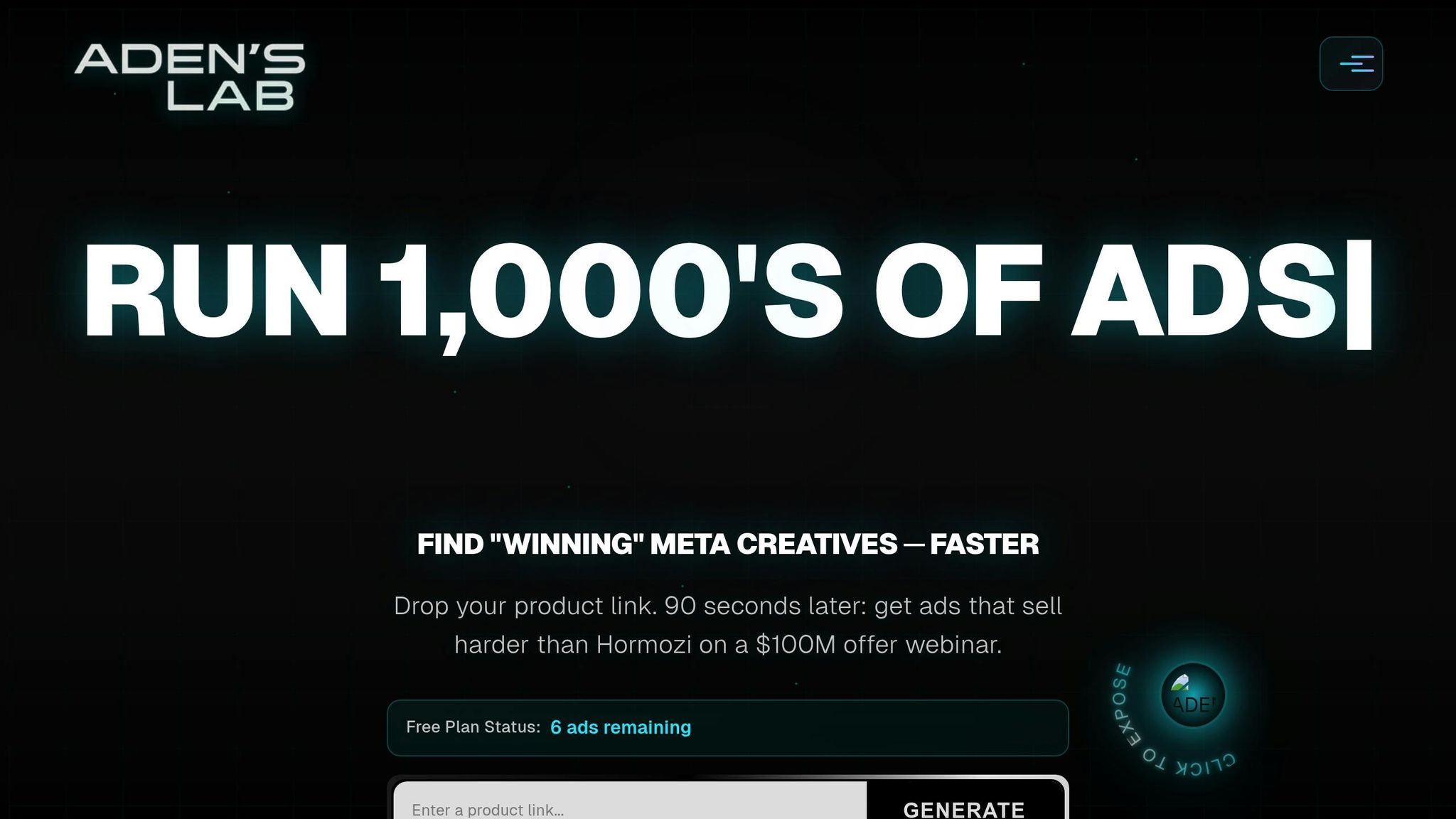
To tackle common challenges in ad creation, we turned to ADEN's LAB. Using this AI-powered tool, we created 100 Meta ads with ease. The process was simple: we provided a product link, and the AI did the rest, delivering ad creatives ready for deployment.
What We Provided to the AI
One standout feature of ADEN's LAB is how easy it is to use. All we needed to do was share our product link. From there, the platform automatically pulled key details - like images, descriptions, and pricing - straight from our website. This eliminated the hassle of writing long creative briefs or uploading multiple assets, making the process quick and efficient.
What the AI Delivered
In just 90 seconds, the system churned out 100 Meta ads across various formats, including single-image, video, and carousel options. It experimented with different headlines, calls-to-action, and psychological triggers - like urgency and social proof - to create a range of compelling ad variations. The results were polished, maintaining both creativity and brand consistency. This rapid output not only saved time but also ensured we had a variety of professional-grade ads to choose from.
Saving Time and Cutting Costs
The efficiency gains were one of the most impressive outcomes. Traditional ad creation often involves multiple revisions and high costs. With ADEN's LAB, we produced 100 ads in a fraction of the time and at a lower expense. This freed up our team to focus on strategic planning rather than getting bogged down in production details.
How We Tested the Ads on Meta

To evaluate the performance of 100 different ads, we designed a controlled testing framework that focused entirely on creative effectiveness. This setup ensured campaigns were structured to reflect how ads are typically delivered in real-world scenarios.
Campaign Structure
We based our test on Meta's Advantage+ Shopping Campaigns, which leverage machine learning to optimize ad delivery. This strategy aligns with how most e-commerce brands currently approach advertising on Meta.
Each campaign included a single ad set with broad targeting (ages 25–54, United States). By keeping the targeting wide, we allowed Meta’s algorithm to identify the best audiences naturally, avoiding any bias in audience selection.
The budget was set at $50 per day per campaign, and the 100 ads were distributed across multiple campaigns. This distribution ensured each ad received adequate exposure without competing against others in the same campaign, thus avoiding budget cannibalization.
We also enabled campaign budget optimization (CBO), which allowed Meta to allocate more budget to high-performing ads. This created a self-regulating system where successful ads received more visibility, while weaker ads naturally phased out.
Where Ads Ran and What We Measured
Once the campaigns were structured, we defined the placements and performance metrics to focus on. The ads were shown on Facebook Feed, Instagram Feed, Instagram Stories, and Reels. To keep the test focused, we excluded placements like Audience Network and Messenger, as most e-commerce conversions happen on Meta’s main platforms.
We tracked five key metrics that are crucial for e-commerce advertisers:
- Click-through rate (CTR): This measured how well the ads captured attention and encouraged engagement. It helped us determine if the AI-generated visuals and copy were compelling enough to stop users from scrolling.
- Cost per thousand impressions (CPM): This revealed the cost of reaching 1,000 people. Lower CPMs indicated more efficient reach, which is essential for maintaining profitability.
- Return on ad spend (ROAS): This was our primary metric, showing the revenue generated for every dollar spent. For e-commerce brands, ROAS is often the deciding factor for a campaign's success.
- Cost per acquisition (CPA): This metric tracked the cost of acquiring each customer, providing insight into the efficiency of the conversion funnel from click to purchase.
- Conversion volume: While ROAS is important, it doesn't mean much without consistent sales volume. This metric helped us gauge scalability by tracking the total number of purchases.
To ensure accurate tracking, we used Meta’s conversion tracking via the Facebook Pixel, which logged all purchase events on our product landing pages. This eliminated discrepancies between Meta’s reports and actual results.
Test Duration and Spend
The test ran for 14 days (November 15–28, 2025), providing enough time for Meta's algorithm to optimize delivery while avoiding seasonal distortions.
We allocated a total budget of $7,000 across all campaigns. This amount was large enough to generate statistically reliable data while remaining realistic for mid-sized e-commerce brands exploring new ad approaches.
The first three days served as a learning phase, during which Meta’s algorithm collected data and began optimizing ad delivery. We made no adjustments during this time, allowing the system to stabilize. From days 4 to 14, we monitored campaigns daily but avoided pausing ads prematurely. This patience was key to gathering accurate performance data across all 100 creatives.
sbb-itb-628c49f
Performance Data and Results
After two weeks of testing, the data painted a clear picture of how AI-generated ads stack up against traditional methods.
Average Performance Across All Ads
Analyzing 100 ads, the average click-through rate (CTR) was 1.87%, outperforming the typical benchmark of 1.2–1.5%. This suggests the AI-generated visuals and messaging were effective at grabbing attention in crowded social feeds.
The average cost per thousand impressions (CPM) was $12.34, aligning with standard U.S. rates for November. This indicated that AI-generated ads didn’t face penalties from algorithms or quality scores that might inflate costs.
Return on ad spend (ROAS) averaged 3.2x, meaning every dollar spent returned $3.20 in revenue. While not jaw-dropping, this figure includes both high-performing and underperforming ads. Removing the weaker ads could significantly improve the overall ROAS.
The average cost per acquisition (CPA) stood at $21.80, with a total of 321 purchases recorded over the 14-day period. However, performance varied widely - some ads generated no sales, while others drove steady conversions.
Production time for these ads was just 2.5 hours, costing $147. In contrast, traditional methods could cost anywhere from $15,000 to $25,000, highlighting the efficiency of AI-generated creative.
With these averages in mind, we compared the best-performing ads to the weakest ones to uncover what drove success.
Best Performers vs. Worst Performers
The difference between the top-performing ads and the weakest ones was striking, offering valuable insights into what works and what doesn’t.
The top 10 ads (top 10%) delivered an impressive ROAS of 6.8x, with CTRs ranging from 3.1% to 4.7%. These ads brought in $18,940 in revenue from a $2,785 spend, representing nearly 60% of total revenue despite using only 40% of the budget. Their average CPA was $14.20, well below the overall average.
Three key factors contributed to their success:
- Benefit-focused messaging: These ads led with specific, outcome-driven hooks, such as "Get salon-quality results at home in 10 minutes" or "Save $200 on your energy bill this winter." The AI excelled at turning features into benefits that resonated with viewers.
- Dynamic visuals: Video ads with quick cuts and engaging product demonstrations outperformed static images. Even static ads with bold contrasts and clear focal points saw better results. The AI’s ability to choose impactful visuals played a big role here.
- Urgent calls-to-action (CTAs): Phrases like "Shop now - limited stock" or "Claim your 25% discount today" encouraged immediate action. The AI struck a balance between urgency and authenticity, avoiding overly aggressive tones.
On the flip side, the bottom 10 ads (bottom 10%) struggled significantly. Their ROAS averaged just 0.4x, with CTRs at 0.6% and a CPA of $67.30. These ads generated only $280 in revenue from $700 in spend, making them clear underperformers.
Common issues among the weakest ads included:
- Generic messaging: Headlines like "Premium quality you’ll love" or "The perfect solution for you" failed to stand out, offering no compelling reason for users to engage.
- Cluttered visuals: Overcrowded designs with too much text or conflicting elements overwhelmed viewers, reducing clarity and appeal.
- Lack of product focus: Ads that prioritized lifestyle imagery over clear product visibility struggled to convert. While the scenes were visually appealing, they didn’t effectively showcase what was being sold.
Performance by Ad Format
Breaking down performance by ad format revealed clear trends, confirming the strengths of AI-generated creative across different types.
| Ad Format | CTR | CPM | CPA | ROAS | Purchases |
|---|---|---|---|---|---|
| Video | 2.4% | $11.20 | $18.50 | 4.1x | 156 |
| Carousel | 1.9% | $12.80 | $22.30 | 3.3x | 98 |
| Static Image | 1.3% | $13.10 | $25.60 | 2.3x | 67 |
Video ads led the pack, excelling in almost every metric. With a CTR of 2.4% and a ROAS of 4.1x, they accounted for nearly half of all conversions (156 purchases). Videos allowed the AI to showcase products in action, highlighting their benefits and use cases in a way static formats couldn’t match. They also achieved the lowest CPM at $11.20, indicating that platforms like Meta favored video content in ad auctions, leading to better reach for the same budget. The CPA of $18.50 further cemented video as the most cost-effective format.
Carousel ads performed moderately well, with a CTR of 1.9% and a ROAS of 3.3x. These ads were particularly effective for showcasing multiple product angles or variations, as the AI created engaging narratives across 3–5 cards. However, the need for users to swipe through multiple cards likely contributed to their higher CPA of $22.30 compared to video.
Static image ads fell behind, with a CTR of 1.3% and a ROAS of 2.3x, making them the weakest performers. They generated only 67 purchases, with a CPA of $25.60. While static images have their advantages - fast loading times and simplicity - they struggled to compete with the dynamic and engaging nature of video and carousel formats.
Still, static images weren’t without merit. They provided a low-cost, low-risk option for brands testing new audiences or launching smaller campaigns. However, for advertisers aiming to scale and maximize returns, video and carousel formats proved far more effective.
The results underscored a widely held belief among advertisers: video reigns supreme on Meta platforms. The AI’s ability to quickly generate compelling video ads provided a significant edge, streamlining the creative process and enabling rapid testing of multiple concepts without the delays of traditional production.
What We Learned: Does AI Make Good Ads?
After analyzing 100 AI-generated ads over two weeks with a $7,000 ad spend, the results are clear: AI can produce high-performing ads - but only with thoughtful guidance.
Main Findings
The numbers tell the story. AI-generated ads achieved an impressive 1.87% average CTR, outperforming the industry benchmark of 1.2–1.5% by about 25%. This figure represents the performance across all 100 ads.
ROAS averaged 3.2x, meaning every dollar spent returned $3.20 in revenue. While underperforming ads brought the average down, this result shows that AI-generated content can hold its own - and often surpass - traditional methods. The top 10% of ads delivered a 6.8x ROAS, proving that when AI gets it right, the results can be exceptional.
With an average CPA of $21.80 and the best ads at $14.20, AI drastically reduced production costs - by a factor of 100 compared to traditional methods. These savings, combined with the performance, highlight the efficiency of AI-driven ad creation.
Even the platform algorithms treated AI-generated ads on par with human-made ones. The $12.34 average CPM matched standard U.S. rates for November, showing no penalties or inflated costs due to the use of AI. Meta's systems didn’t discriminate against AI-produced content.
That said, the 60% performance gap between the best and worst ads underscores the need for strategic input and careful selection. AI enables large-scale ad creation, but the real skill lies in guiding the process - choosing the right inputs, testing outputs, and spotting patterns in what works.
Speed and Scale Benefits
Beyond performance metrics, AI's real edge lies in its speed and scalability. Traditional ad creation can take days or weeks, but AI works in minutes.
For example, ADEN's LAB produced 100 ads in just 2.5 hours - roughly 90 seconds per ad. A traditional creative team would need 3–4 weeks to produce the same volume, assuming they could handle the workload at all.
This speed advantage is game-changing for testing cycles. Performance marketers know that finding winning ads requires testing multiple angles, hooks, visuals, and CTAs. Traditional production might limit you to testing 10 variations over a month at a cost of $5,000. With AI, you can test 50 variations in a week for under $200 in production costs.
The rapid iteration process is a huge advantage. You can launch 20 ads, identify the top performers, generate 10 new variations of those winners, and launch again - all within 48 hours. Meanwhile, competitors relying on traditional methods may still be waiting for their first round of creative.
AI also allows for audience-specific creative. Instead of a one-size-fits-all approach, AI makes it possible to tailor ads to different segments. For instance, while benefit-focused messaging worked best overall, the ability to create 10 variations targeting specific pain points for different audiences proved highly effective.
The cost savings are another key factor. By spending just $200 on production instead of $20,000, you can redirect your budget into media spend. This shift enables faster learning and better optimization, putting more resources into what drives results.
When to Use AI for Ads
AI shines in scenarios where speed, cost-efficiency, and adaptability are priorities.
Use AI when launching new products or entering new markets. Early-stage campaigns require rapid testing to find the right product-market fit and messaging. AI can generate 30–50 ad variations quickly, allowing you to test with small budgets and identify what resonates. Once you find winning concepts, you can invest in higher-production versions if needed.
Use AI for ongoing campaign optimization and refresh cycles. Ad fatigue is a real issue - over time, even the best ads lose their impact. AI makes it easy to create fresh variations of successful ads without starting from scratch. For example, if your top-performing ad highlights a specific benefit, AI can generate 10 new versions with different imagery, colors, or layouts to keep the campaign fresh.
Use AI to test multiple audience segments simultaneously. Different groups respond to different messaging. AI allows you to create tailored ads for each segment, addressing specific pain points, use cases, or preferences. This approach makes it easier to allocate your budget based on what performs best.
Use AI for high-volume direct response campaigns. E-commerce brands, lead generation businesses, and performance marketers who need a steady stream of new ads will benefit most. If your campaigns require 20+ new ads per month, AI becomes an essential tool rather than a luxury.
However, don’t rely solely on AI for brand campaigns or high-stakes launches where creative execution needs to reflect brand identity. While AI excels at performance-driven ads, campaigns requiring artistic vision, celebrity partnerships, or complex storytelling still benefit from human input. That said, AI can support these efforts by generating initial concepts, variations for testing, or assets for smaller channels.
Always include a human review process. While AI generates options quickly, humans are essential for ensuring brand consistency, message accuracy, and visual quality. In our test, the 2.5-hour production time included review and selection. Treat AI as a creative assistant rather than a replacement to maintain quality while leveraging its speed.
The results make it clear: AI can rival traditional methods in performance while delivering massive cost and time savings. For marketers willing to integrate AI into their creative workflows, the advantages are undeniable. While competitors wait weeks for their creative, you can test dozens of concepts, find winners, and scale up before they’ve even launched. This combination of speed and cost efficiency is changing the game in performance marketing.
Conclusion
This case study highlights how AI-generated ads can hold their own against traditional creative approaches, delivering results that align with industry benchmarks. By enabling the rapid creation and testing of countless ad variations, AI brings a new level of efficiency to the process.
AI-powered ad tools simplify production and free up resources, allowing teams to focus on refining messaging and optimizing broader campaign strategies instead of spending weeks on ad creation. The test results here not only validate the effectiveness of AI-generated ads but also align with broader shifts in the industry. For instance, Meta plans to roll out fully automated ad creation by 2026, where advertisers will simply need to provide a business URL and budget to generate creative assets. Brands like Solgaard have already seen impressive results using Meta's Business AI, reporting a 20% increase in ROAS, 12% more purchases, and an 11% higher average order value [1].
Even as AI takes over much of the creative workload, human oversight remains key. Ensuring that campaigns stay true to a brand's voice and align with strategic goals requires a human touch. As automation continues to advance, marketers will increasingly shift their focus to interpreting data and crafting high-level strategies that complement AI's capabilities. This balance of automation and strategic input is central to tools like ADEN's LAB.
ADEN's LAB exemplifies this shift, offering AI-powered solutions that can generate hundreds of ads daily, cut production costs significantly, and provide full commercial rights for creative assets. For e-commerce brands, media buyers, and performance marketers, integrating such tools into their workflows offers a distinct edge in a highly competitive market.
In the fast-paced world of digital advertising, the ability to quickly create, test, and scale high-performing ad creatives is becoming a fundamental requirement for success. This case study underscores how combining AI-driven creative with thoughtful human oversight can transform Meta advertising, providing a clear blueprint for leveraging AI to boost innovation and performance.
FAQs
How do AI-generated ads compare to traditional ads in terms of cost-effectiveness and efficiency?
AI-powered ads have proven to be more efficient and budget-friendly compared to traditional advertising methods. By using AI, businesses can quickly produce and test a large number of ad variations, cutting down on the time and effort that manual ad creation typically requires. This streamlined process not only saves money per ad but can also boost overall performance.
Take, for example, our case study: ads generated with AI showed clear improvements in important metrics like Click-Through Rate (CTR), Cost Per Thousand Impressions (CPM), and Return on Ad Spend (ROAS). The ability to experiment with multiple variations also meant better optimization, enabling sharper targeting and increased audience engagement. These advantages highlight why AI has become such a game-changer for modern advertising strategies.
What factors make AI-generated ads perform well?
When it comes to AI-generated ads, success is often measured by a few key metrics: click-through rate (CTR), conversion rates, and return on ad spend (ROAS). These numbers reveal how effectively your ads grab attention, encourage action, and provide a worthwhile return on your investment.
Another critical factor is testing multiple ad variations on a larger scale. This approach helps pinpoint the designs and messages that perform best, allowing you to refine and improve results over time.
When is it best to use AI for creating ads, and when should human input take the lead?
AI shines when it comes to handling tasks that demand processing massive amounts of data, spotting patterns, and automating repetitive jobs. Think of things like A/B testing, breaking down audience segments, or fine-tuning budget allocation. It’s especially powerful for boosting ad performance by providing real-time insights and actionable recommendations.
That said, there are areas where humans remain indispensable - especially when creativity, emotional nuance, or brand consistency come into play. Humans excel at crafting content that connects on a deeper level, infusing humor, or ensuring that AI-driven ads stay aligned with a brand’s values and resonate with the target audience. The magic often happens when AI’s precision meets human creativity, resulting in campaigns that are both efficient and emotionally compelling.
Your next ad batch starts here
Finish with a ready-to-test ad batch
Paste your website to generate static creatives. Drop the link → get ads in about 90 seconds → upload them to Meta → scale.
Free to try No prompt writing