AI Interest Targeting: Lower CAC, Higher ROAS
Turn the strategy into creatives
Create Meta ads for your product
Paste your product page. ADEN'S LAB turns the offer, audience, and positioning into complete ready-to-use Meta static ads.
Free to try No prompt writing

Meta’s AI-driven ad campaigns are changing the game for advertisers. By replacing manual audience targeting with advanced algorithms, brands are seeing better results and lower costs. Here's what you need to know:
- Higher Returns: Meta Advantage+ campaigns deliver $4.52 for every $1 spent, compared to $3.70 with manual strategies.
- Lower Costs: AI-driven bidding reduces customer acquisition costs (CAC) by 37% on average, with up to a 50% reduction in some industries.
- Improved Efficiency: AI minimizes wasted ad spend by focusing on high-intent and high-value users, cutting CPA by 18% and cost per lead by 10%.
- Creative Variety Matters: Ads with 3–6 distinct concepts perform better, as AI identifies which visuals and messages resonate most with different audiences.
- Data-Driven Targeting: The AI uses real-time signals from Meta Pixel, Conversions API, and App SDK events to match ads to the right users.
Key Takeaway: AI handles targeting, but success depends on providing diverse, high-quality ad content. To maximize results, brands should focus on faster ad production, testing multiple variations, and leveraging tools like Meta’s Conversions API. This new approach isn’t just about better targeting - it’s about smarter, data-driven advertising.
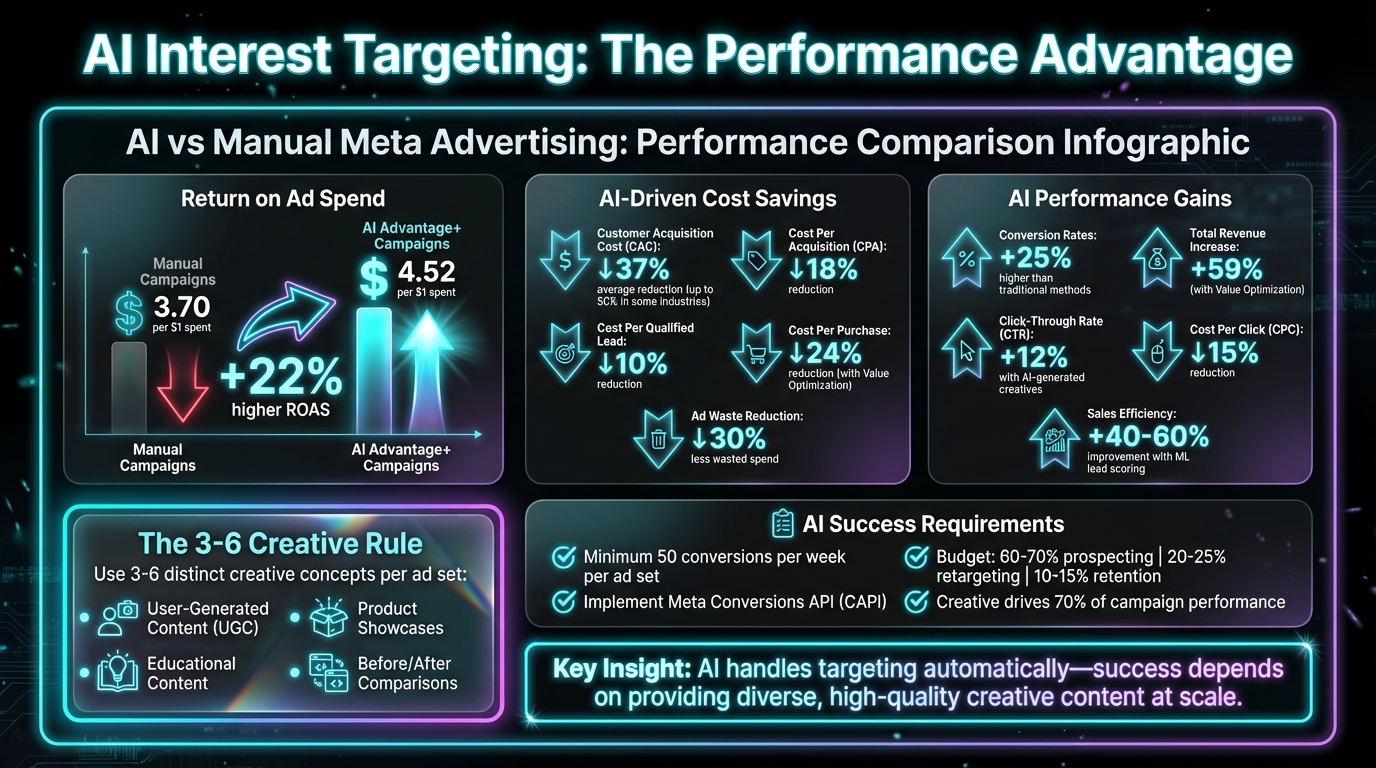
AI vs Manual Meta Ads: Performance Comparison & Cost Savings
Meta's 'Describe Your Audience' Feature: AI Finds Your Perfect Customers (Revolutionary Update!)
Put the playbook to work
Apply this playbook to your page
Paste your website and the Lab will turn the strategy you are reading into a ready-to-test ads.
Free to try No prompt writing
How AI Interest Targeting Works
Meta's AI has changed the game by moving beyond static interest lists. Instead of relying on predefined categories, the system analyzes millions of real-time data points to gauge user intent. It looks at signals like website visits, time spent on product pages, cart additions, and how deeply users engage with videos (completion rates of 75–95% are far more telling than quick 3-second views).
This approach eliminates human bias. For example, a marketer might assume that 30-year-old fitness enthusiasts are the best audience for a campaign. But the AI could reveal that 50-year-old retirees are actually the most profitable group - a segment the marketer might have ignored entirely. The algorithm doesn't rely on assumptions; it lets the data guide decisions.
How AI Matches Ads to Audiences
Traditional targeting used fixed interest categories like "yoga" or "organic food", leaving advertisers to hope their selections reached the right people. AI flips this model on its head. It continuously segments audiences based on real-time behavior, not static labels.
Meta's system pulls data from three main sources: the Meta Pixel (browser tracking), the Conversions API or CAPI (server-side data from platforms like Shopify or CRMs), and App SDK events (actions taken within apps). These inputs fuel a "Black Box" system where the AI determines who sees your ads based on their likelihood to convert, rather than relying on predefined interest categories.
Value Optimization takes this a step further. Instead of targeting anyone who might convert, the AI zeroes in on high-value customers - those who are likely to spend more. Brands using this feature have reported a 24% drop in cost per purchase and a 59% boost in total revenue. The system learns which users are most valuable and focuses on them during ad auctions.
However, the AI needs data to work effectively. Ad sets require at least 50 conversions per week to move past the learning phase and deliver consistent results. For example, if your target CPA is $20, you'll need a weekly budget of at least $1,000 to hit that threshold. Without enough data, the algorithm remains stuck in "Learning Limited" mode and can't optimize its targeting.
This ability to pinpoint audiences sets the stage for leveraging a variety of creative assets, which plays a critical role in enhancing performance.
Why Creative Variety Improves AI Targeting
AI's dynamic segmentation becomes even more powerful when paired with diverse ad creatives. As manual audience targeting fades, the AI depends on varied visuals and messages to identify which audience segments respond best. Different creatives appeal to different groups, and the algorithm uses this feedback to refine its targeting.
The 3-6 Creative Rule is a proven standard: each ad set should include 3 to 6 distinct creative concepts. Examples include user-generated content (UGC), product-focused images, educational listicles, and before-and-after comparisons. These varied formats resonate with different segments, giving the AI more data to fine-tune its audience matching.
Small tweaks, like changing a button color or font, won't cut it. The AI needs fundamentally different visuals to identify which segments respond best. When one creative attracts high-intent users who convert, the algorithm allocates more budget to that creative and its audience. Conversely, if another creative pulls in browsers who don't convert, the system reduces its exposure.
Campaigns that combine well-structured Custom Audiences (first-party data from your CRM or website) with creative variety see 47% lower acquisition costs compared to interest-based targeting alone. The AI automatically aligns your most effective creatives with your most valuable audience segments, adjusting in real time as user behavior evolves.
This combination of dynamic targeting and creative variety not only lowers acquisition costs but also improves ROAS - a topic explored further in the next section.
Research: How AI Reduces Customer Acquisition Costs
AI-powered marketing tools are transforming how businesses approach customer acquisition. Companies leveraging these tools report an average 37% decrease in customer acquisition costs (CAC), with reductions reaching up to 50% in some industries. These savings are reshaping how ad budgets are allocated, making campaigns more efficient and impactful.
For example, Meta's internal benchmarks show that Advantage+ campaigns deliver $4.52 in return for every $1 spent, compared to $3.70 from traditional manual campaigns. The key difference lies in AI’s ability to identify high-value users in real time, bypassing the outdated reliance on static audience assumptions.
AI-driven bidding strategies further enhance efficiency, resulting in an 18% drop in cost per acquisition (CPA) and a 10% reduction in cost per qualified lead. Over time, as the algorithm processes more conversion data, these gains compound, proving how AI not only lowers costs but also optimizes overall budget allocation.
Case Studies on Lower Acquisition Costs
Take Centrepoint, a retail brand that adopted AI-driven Value Optimization within Meta's automated systems. This shift produced impressive results: a 24% reduction in cost per purchase and a 59% increase in total revenue. By focusing on customer lifetime value instead of just high-volume, low-value conversions, the AI prioritized finding high-spending customers. This approach redirected budget away from bargain hunters and toward more profitable buyers.
Centrepoint also simplified its account structure, consolidating into a single Advantage+ Shopping Campaign. This allowed the AI to reach the learning phase faster, eliminating fragmented data and stabilizing targeting. Within weeks, the system uncovered lucrative segments, including older demographics that had previously been overlooked. The AI then adjusted the budget to focus on these high-value groups.
The results speak volumes. Marketing teams using AI report 25% higher conversion rates compared to traditional methods. Additionally, machine learning-based lead scoring enhances sales efficiency by 40% to 60%, enabling sales teams to focus on high-intent prospects rather than wasting time on low-probability leads. On Meta platforms, AI-generated creatives reduce cost-per-click (CPC) by 15% and boost click-through rates (CTR) by 12%, thanks to rapid testing of ad variations that would be nearly impossible for human teams to replicate.
These examples illustrate how AI doesn’t just cut costs - it refines targeting and maximizes every dollar spent.
How AI Eliminates Wasted Ad Spend
Beyond reducing acquisition costs, AI significantly minimizes wasted ad spend. One of its key strengths is identifying and avoiding low-intent audiences that fail to meet the 50 conversions per week threshold needed for algorithm stability. Traditional campaigns often scatter data across multiple ad sets, slowing the AI’s learning process. By consolidating campaigns into a single structure, the algorithm focuses on high-conversion users, eliminating inefficiencies.
AI-driven ad optimization can slash ad waste by 30%, ensuring ads are shown only to relevant audiences. The system continuously evaluates real-time signals like website visits, cart activity, and video engagement, reallocating budget away from underperforming segments. If a particular audience shows low engagement or high bounce rates, the AI automatically adjusts, saving money without requiring manual intervention.
Another game-changer is the Conversions API (CAPI), which bypasses browser limitations and ad blockers. This ensures the AI works with complete, accurate data from the entire customer journey. Without CAPI, algorithms might optimize based on incomplete signals, like users whose actions aren’t tracked due to privacy settings. By feeding first-party data directly to the AI, CAPI ensures the system focuses on genuine high-value actions.
Finally, setting budget caps for existing customers - typically 10–20% of total spend - helps the AI prioritize new customer acquisition. This prevents the algorithm from wasting resources on users who would have purchased anyway, redirecting spend toward growth opportunities and eliminating unnecessary costs. These strategies show how AI not only reduces waste but also amplifies the impact of every advertising dollar.
How AI Personalization Increases ROAS
Earlier, we discussed how creative variety sharpens ad targeting. Now, let's dive into how personalization takes it a step further by tailoring messages to individual behaviors. AI stands out by processing millions of data points - like device usage, time zones, weather conditions, and subtle user actions - to predict conversion potential even before an ad auction begins. This real-time analysis ensures the right message reaches the right person at the exact moment they’re most likely to act.
But it’s not just about driving more conversions - it’s about driving better ones. By shifting focus from "conversion" optimization to "value" optimization, AI prioritizes high-value customers over just any purchase. This approach can lead to a 24% lower cost per purchase and a 59% increase in total revenue. The system learns who the big spenders are and adjusts ad delivery accordingly, ensuring every dollar spent works harder.
Using Predictive Analytics to Improve Ad Relevance
Predictive analytics transforms advertising from reactive adjustments to proactive precision. Using machine learning, AI identifies high-intent prospects before they even click, achieving 85% or higher accuracy in predicting customer behavior.
Take Betabrand, for example. This fashion crowdfunding platform teamed up with Pixis AI in 2025 to refine its Google Ads strategy. By analyzing keyword clusters and generating ad copy on the fly, they boosted their ROAS by 69% while cutting their customer acquisition costs (CAC) by 36%.
Similarly, Mojo, a wellness platform in the UK, worked with Voyantis AI to implement a predictive model focusing on a 90-day timeframe. By analyzing onboarding data, they predicted which free trial users would convert to long-term subscribers. The result? A 22% increase in ROAS and a 20% reduction in CAC.
Another standout is Wonderskin, a beauty brand that used Angler AI’s predictive Conversion API (CAPI) across its US and UK stores. By feeding enriched data - like past orders and quiz responses - into platforms like Meta and TikTok, they achieved a 42% ROAS boost and a 33% reduction in CAC.
Dynamic creative optimization (DCO) takes personalization even further. By combining headlines, images, and videos dynamically, AI delivers the most engaging content for each user. Brands adopting comprehensive AI systems often see ROAS improvements of 25–40%. The AI doesn’t just predict who to target - it also predicts what content will resonate most.
This proactive targeting naturally leads to smarter, real-time ad adjustments, ensuring every dollar is spent effectively.
Real-Time Optimization for Better Performance
What separates AI from traditional campaign management is its ability to optimize in real time. Instead of waiting days or weeks to tweak targeting, AI makes split-second decisions based on live data. It continuously evaluates which placements, audiences, and creatives are performing best, reallocating budgets on the fly.
The Conversions API (CAPI) plays a key role here by feeding high-quality data directly to the AI in real time, bypassing browser limitations and ad blockers. This ensures the algorithm works with complete, accurate data instead of partial information.
Automated "if-then" logic tools add another layer of efficiency. These tools can, for instance, automatically increase ad spend by 15% when ROAS exceeds a set target, keeping campaigns in the sweet spot without constant manual oversight. This lets brands scale their efforts without wasting time on micromanagement.
AI-generated creatives also deliver a 12% higher click-through rate (CTR) on Meta platforms compared to human-designed ads. This edge comes from the AI’s ability to quickly test and identify the most effective visual elements in real time. Meta’s Advantage+ creative optimization further enhances this by layering platform AI on top of AI-generated content, creating a compounding effect that traditional campaigns simply can’t match.
"AI is redefining the category of advertising by moving toward a world where no manual demographics are needed." - Mark Zuckerberg
Why Creative Speed Matters for Performance
Creative production speed is often the bottleneck in running successful campaigns. As of 2026, creative accounts for around 70% of campaign outcomes. The reality is simple: algorithms can only optimize using the creative assets you provide. If it takes days or weeks to roll out new ads, you're missing opportunities - and likely wasting money.
Here's the math: faster creative production allows for 5–10x more ad variations per campaign cycle. More variations mean AI can test, learn, and adapt to audience behavior much faster. This ability to outproduce competitors drives better results by identifying winning ads sooner and staying ahead of shifting trends.
Scaling Creative Testing with AI
Traditional creative workflows just can't keep up with the speed modern AI targeting demands. For example, Meta Advantage+ campaigns require at least 50 conversions per week to move past the volatile "learning phase". Slow creative delivery disrupts this process, limiting the algorithm's ability to optimize effectively.
AI-generated ads solve this issue by not only speeding up production but also delivering results. On Meta, AI-created ads achieve 12% higher click-through rates compared to those made by humans. Teams using AI creative tools also save 20+ hours per week on production, freeing up time for strategy and fine-tuning campaigns. Faster creative cycles ensure the AI has the data it needs to test and optimize ads in real time, boosting overall campaign performance.
ADEN'S LAB is designed to meet this demand. This platform creates high-performing static Meta ads in minutes instead of days, with costs as low as $0.90 per ad on high-volume plans. This efficiency empowers brands to produce hundreds of ads monthly, enabling extensive creative testing. By generating dozens of variations in the time it takes a traditional designer to produce a single ad, brands gain a significant edge in agility and performance.
When rapid testing identifies winning ads, keeping them fresh becomes the next challenge.
Fighting Creative Fatigue
Even the best-performing ads lose their effectiveness over time. This is known as creative fatigue, which happens when the same ad is shown too often, leading to a drop in engagement. When fatigue sets in, the AI may stop prioritizing your ads, causing campaign performance to decline.
The fix isn’t about tweaking your targeting - it’s about maintaining a steady flow of fresh creative assets. Rapid production of new ads prevents fatigue before it impacts performance. Brands that consistently refresh their creative see better ROAS because the algorithm always has new material to test and optimize.
To combat fatigue effectively, focus on introducing multiple distinct creative concepts within each ad set. For example, mix formats like UGC (user-generated content), product showcases, educational content, and comparison ads. This variety lets the algorithm explore different audience segments while systematically replacing underperforming ads with fresh options. The result? Lower CAC, higher ROAS, and campaigns that scale more efficiently.
Best Practices for AI-Driven Interest Targeting
Campaign success thrives on three main pillars: structure, data volume, and creative strategy. These elements form the backbone of any campaign designed to get the most out of AI algorithms. Let’s dive into how creative inputs and budget management can make or break your results.
Optimizing Creative Strategies
AI only works as well as the input it’s given. That’s why a diverse range of creatives is essential for effective AI targeting. A good rule of thumb is the 3-6 Creative Rule - use 3 to 6 distinct creative concepts, such as UGC testimonials, product showcases, educational videos, or comparison charts. This variety gives AI the tools it needs to match your ads with the right audience segments.
Here’s a real-world example: brands like Centrepoint have shown that aligning creative strategies with AI optimization can reduce costs and increase revenue. But the trick isn’t just letting the AI do its thing - it’s feeding it high-quality, varied creative assets that resonate with different types of buyers.
Another key? Brand consistency. AI-generated ads tend to perform well, delivering 12% higher click-through rates on Meta. However, when users recognize an ad as AI-generated, purchase intent drops by 14%, and perceptions of premium quality fall by 17%. The takeaway? Use AI for speed and volume, but ensure humans oversee the process to maintain brand alignment. Tools like ADEN'S LAB can help by generating Meta ads that follow proven direct-response principles, all while keeping visuals and messaging consistent with your brand. Plus, they do it at a cost as low as $0.90 per ad on high-volume plans.
Budget Allocation for AI Campaigns
While creative strategy sets the stage, budget allocation gives AI the fuel it needs to perform. AI thrives on data, and data comes from conversions. To move beyond the learning phase, each ad set needs at least 50 conversions per week. For example, if your target cost per acquisition (CPA) is $20, your weekly budget should be at least $1,000 (50 conversions × $20 CPA). Anything less, and the algorithm won’t have enough data to optimize effectively.
Here’s how to structure your budget for maximum impact:
- Consolidate budgets into 3–5 campaigns. This approach pools data faster, helping AI reach optimization thresholds sooner.
- Allocate 60–70% of your budget to prospecting (finding new customers), 20–25% to retargeting (engaging warm leads), and 10–15% to retention (reactivating past customers).
- For Advantage+ Shopping Campaigns, set a cap of 10–20% on spend for existing customers. This ensures the AI focuses on acquiring new customers rather than retargeting those already familiar with your brand.
To further streamline performance, use Campaign Budget Optimization (CBO) for prospecting campaigns. This allows the algorithm to allocate funds to the best-performing audiences automatically. Once you’ve identified successful campaigns, scale them carefully - increase budgets by no more than 20% per week to avoid disrupting the system.
Lastly, don’t overlook the technical side. Implement Meta's Conversions API (CAPI) alongside your pixel. This server-side connection bypasses cookie limitations, sending higher-quality conversion data to Meta. Brands using CAPI report more accurate attribution and better optimization, which is especially critical as third-party tracking continues to decline.
Conclusion
AI-powered interest targeting is transforming how Meta advertising works. Take Meta Advantage+ campaigns, for instance - they deliver up to 22% higher ROAS, with an average return of $4.52 per $1 spent, compared to just $3.70 for manual campaigns. That’s a game-changer for ad performance economics.
Here’s the critical takeaway: creative now drives around 70% of campaign performance. While AI takes care of targeting and optimization, your success hinges on producing high-quality, diverse ad creatives at scale. The days of manually selecting interests and fine-tuning demographics are over. The new approach? Supply Meta’s algorithm with a variety of creative options, let it identify the winners, and scale those aggressively. This shift puts creative variety at the center of success, making speed in ad production a major advantage.
Speed matters more than ever. Brands that can churn out 5 to 10 times more creative variations per campaign cycle give the algorithm the flexibility it needs to test and optimize effectively. Tools like ADEN'S LAB make this possible, generating eye-catching static Meta ads in under 90 seconds. With pricing as low as $0.90 per ad on high-volume plans, it’s a clear alternative to traditional workflows that cost $30–$50 per ad and take days to complete. This faster creative process is essential for leveraging AI’s targeting capabilities to their fullest.
AI-driven targeting doesn’t just improve ROAS; it also cuts CPA by 18% and lowers the cost per qualified lead by 10%. To stay competitive, brands must meet the algorithm’s demand for fresh, high-performing creative. By 2026, the brands dominating Meta won’t necessarily have the biggest budgets - they’ll be the ones producing more creative variations and letting the data dictate what works.
FAQs
When should I switch from manual targeting to Advantage+?
Switch to Advantage+ when you want to leverage AI-driven automation to boost your campaign results. As manual methods start falling short at scale, Advantage+ steps in to handle the heavy lifting. It fine-tunes targeting, bidding, and delivery in real-time, which can help lower customer acquisition costs (CAC) and increase your return on ad spend (ROAS). This shift is perfect for scaling efficiently, staying agile in a changing market, and cutting down on the time spent tweaking campaigns manually.
How many conversions and how much budget do I need for AI to work?
AI-driven interest targeting performs most effectively when each ad set achieves roughly 50 conversion events per week, allowing it to move beyond the learning phase. While there's no specific budget set in stone, campaigns need to allocate enough resources to hit this target. With services like ADEN'S LAB, which offers scalable ad creation starting at just $59 per month, even smaller budgets can leverage AI optimization - provided the campaigns are thoughtfully designed.
What creative mix should I run to lower CAC and fight fatigue?
To keep customer acquisition costs (CAC) in check and tackle creative fatigue, try using a variety of static ad variations paired with interest-based targeting. Tools powered by AI, like ADEN'S LAB, make it easy to create hundreds of static ads that perform well, allowing for quick testing and adjustments. Regularly refreshing your ad creatives keeps your audience engaged, helps pinpoint the elements that work best, and supports scaling your efforts effectively. This approach not only boosts return on ad spend (ROAS) but also extends the lifespan of your campaigns while keeping expenses under control.
Your next ad batch starts here
Finish with a ready-to-test ad batch
Paste your website to generate static creatives. Drop the link → get ads in about 90 seconds → upload them to Meta → scale.
Free to try No prompt writing