Advantage+ Placements vs Manual Placements: What Actually Performs Better?
Turn the strategy into creatives
Create Meta ads for your product
Paste your product page. ADEN'S LAB turns the offer, audience, and positioning into complete ready-to-use Meta static ads.
Free to try No prompt writing

When running Meta ad campaigns, your placement strategy significantly impacts your results. Should you let Meta's AI manage placements with Advantage+, or manually control where your ads appear? Here's what you need to know:
- Advantage+ Placements: Uses AI to dynamically allocate your budget across platforms like Facebook, Instagram, Messenger, and more. It often delivers lower CPMs (by 10–30%) and broader reach but sacrifices control over specific placements.
- Manual Placements: Lets you choose exactly where your ads appear. This approach provides more control, making it ideal for high-ticket items, niche targeting, or brand safety concerns. However, it can increase CPMs (by 10–30%) and limit reach.
Key Findings:
- E-commerce: Advantage+ excels for products under $200, offering up to 4.8x ROAS. Manual Placements perform better for items over $500, delivering 36% higher ROAS.
- SaaS & B2B: Manual Placements work best, achieving 2.9x ROAS vs. 1.8x for Advantage+.
- Lead Generation: Advantage+ drives more leads at a lower cost, while Manual Placements generate higher-quality leads.
Budget Insights:
- Advantage+ shines with budgets over $300/day, while Manual Placements are better under $100/day.
- Advantage+ requires at least 50 conversions per week to optimize effectively.
Quick Tip: Test both strategies with a A/B test with a 30-day split test to see which aligns better with your goals, budget, and creative resources.
| Scenario | Best Strategy | Why |
|---|---|---|
| Budget under $100/day | Manual Placements | Higher ROAS (~42% better) |
| Budget $300–$1,000/day | Advantage+ Placements | Lower CAC, broader reach |
| High-ticket items ($500+) | Manual Placements | Better retargeting and ROAS |
| Impulse-buy products | Advantage+ Placements | Lower CPMs, higher volume |
Your choice depends on your goals: Advantage+ for scale and efficiency; Manual for precision and control. Keep testing to find the right balance.
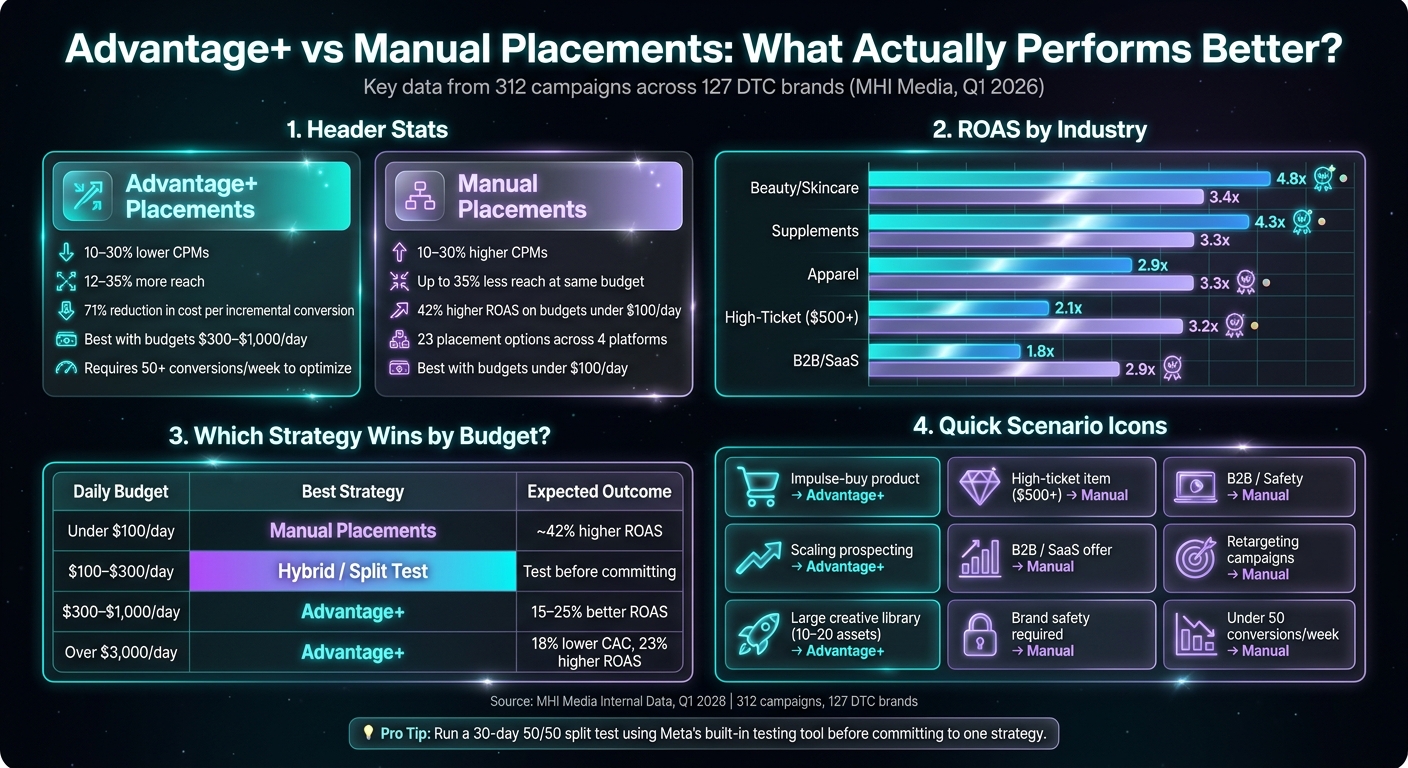
Advantage+ vs Manual Placements: Performance Data by Budget & Industry
Advantage+/Automatic Placements vs Manual Placements: Most Profitable Facebook Ads
Put the playbook to work
Apply this playbook to your page
Paste your website and the Lab will turn the strategy you are reading into a ready-to-test ads.
Free to try No prompt writing
What Are Advantage+ Placements?
Advantage+ Placements is Meta's default setting that uses machine learning to automatically allocate your ad budget across various placements. Instead of manually deciding where your ads should appear, the system dynamically adjusts your budget across Facebook, Instagram, Messenger, Audience Network, and Threads. The goal? To find the placements that deliver the best results for your budget.
How Advantage+ Placements Work
This system doesn’t aim to secure the cheapest cost for each individual placement. Instead, it takes a broader approach, analyzing your entire campaign to determine: "Where can I achieve the most conversions for this budget right now?"
"Meta's algorithm is designed to get you the most conversions at the lowest average cost overall – not the lowest average cost for each placement." - Lebesgue
Budget allocation can shift dynamically between Reels, Facebook Feed, and other placements based on real-time auctions and user behavior. This flexibility allows the algorithm to adapt as conditions change, ensuring your budget is used where it can make the biggest impact.
Benefits and Limitations
Advantage+ Placements leverages your campaign's conversion data to optimize performance across platforms. On average, it delivers 10%–30% lower CPMs and 12%–35% more reach compared to manual placement choices. Advertisers also report an average 71% reduction in cost per incremental conversion when using Advantage+ compared to manual setups.
However, this approach comes with a trade-off: reduced control. You can’t direct your budget toward specific placements, and the algorithm often concentrates impressions - 60%–80% - on a few lower-cost surfaces like Reels, Stories, or Audience Network. This can be challenging if your brand has strict placement preferences or if your creative assets are designed for specific formats.
Despite these limitations, the system is highly effective at driving lower customer acquisition costs (CAC) and improving return on ad spend (ROAS).
Creative Requirements for Advantage+ Placements
For Advantage+ to perform at its best, it needs the right creative assets. For example, if you only provide a square (1:1) image, your ad won’t run on Stories or Reels - placements that often deliver the lowest CPMs.
To maximize performance, you’ll need at least three aspect ratios per ad:
- 1:1 for Feed and Marketplace
- 4:5 for vertical Feed placements
- 9:16 for Reels and Stories
Each format benefits from tailored creative strategies. For instance, 9:16 assets should grab attention quickly with a strong hook in the first 6–10 seconds, while 4:5 creatives can include more detailed messaging.
"Advantage+ Placements requires multiple aspect ratios to ensure pixel-perfect creative across placements." - Pix-Vu
Tools like ADEN's LAB simplify the process by generating static creatives in multiple formats, making it easier to meet the system's requirements. Meta also suggests using 10–20 creative variations to give the algorithm enough material to optimize effectively. For larger campaigns, aim for 3–5 variants per creative angle to provide sufficient diversity for scaling.
Next, we’ll look at how Advantage+ compares to Manual Placements in terms of control and budget allocation.
What Are Manual Placements?
Manual Placements let you take the reins when deciding where your ads appear across platforms like Facebook Feed, Instagram Reels, Messenger, and the Audience Network. With 23 placement options spanning four major platforms, you get the power to fine-tune your ad strategy and spending.
How Manual Placements Work
When setting up your ad, you can choose the device type - Mobile, Desktop, or All Devices. This choice automatically limits certain placements (e.g., selecting Desktop removes Audience Network and Messenger). After that, you can enable or disable platforms and dive into categories like Feeds, Stories & Reels, In-Stream, Search, Messages, and Apps and Sites. This level of detail allows you to match placements with your campaign’s specific needs.
“Manual placements are ideal when ad creative is format-specific or when targeting niche audience behaviors.” - Surfside PPC
Advantages and Challenges
The main benefit of manual placements is control. For example, you can avoid the Audience Network for brand safety, skip In-Stream video if your creative isn’t suited for it, or focus on Facebook Feed for B2B campaigns where longer copy performs well.
But there are trade-offs. Manual placements often result in 10–30% higher CPMs and can reduce reach by up to 35% at the same budget. Overly narrowing your placements - like focusing only on Instagram Feed - can lead to audience fatigue, pushing your ad frequency above 3 within a week and increasing CPC by 15–30%. Adjusting placements frequently can also disrupt the algorithm, restarting the learning phase and temporarily increasing CPA or CPL by 10–35% for up to 96 hours. This is why many advertisers transition toward Meta ads automation to maintain stability.
“By [using manual placements], you’re putting a lot of restrictions on the algorithm, making it hard for it to make the most out of your budget.” - Lebesgue
When Manual Placements Make Sense
Manual placements shine in certain situations. For industries like finance or healthcare, brand safety is critical, and excluding placements like the Audience Network or In-Stream video can help maintain compliance. Similarly, if your creative assets are tailored to specific formats, manual settings ensure your ads perform as intended.
For B2B campaigns or high-consideration offers, focusing on Feed placements can be effective. People scrolling through Facebook or Instagram Feed are often in a discovery mode, making them more likely to engage with detailed copy, save posts, or click through to landing pages - actions that are less common in Stories or Reels. Manual placements are also a go-to for controlled A/B testing, where isolating specific variables like placement is essential for accurate results. While this approach requires more attention, it’s invaluable for aligning ad delivery with strict business goals or regulatory needs.
Performance Comparison by Business Type
Let’s dive into how placement strategies stack up across different industries. By analyzing metrics like CAC and ROAS, we can see how performance varies depending on the type of business.
E-Commerce
For e-commerce brands, Advantage+ tends to deliver stronger results for prospecting - but only under certain conditions. For example, it achieves a 4.8x ROAS for beauty/skincare and 4.3x for supplements, compared to the 3.4x and 3.3x seen with Manual Placements in the same categories. This makes Advantage+ a great option for products under $200, especially impulse buys or brands with large catalogs.
However, when it comes to high-ticket products priced at $500 or more, Manual Placements outperform Advantage+, delivering a 3.2x ROAS versus 2.1x. Between January and February 2026, MHI Media studied 312 campaigns across 127 DTC brands. Their findings showed that while a supplement brand scaling from $200/day to $2,000/day saw its CAC drop by 34% after switching to Advantage+, high-ticket brands achieved 36% better ROAS using manual campaigns. This is largely due to the need for specific retargeting sequences.
Next, let’s see how these trends shift when applied to SaaS and B2B campaigns.
SaaS
SaaS and B2B campaigns consistently lean toward Manual Placements, with a 2.9x ROAS compared to 1.8x for Advantage+ in the B2B/Services category. The reason is simple: SaaS offers, like trial signups or demo requests, require users to fully understand the value proposition before taking action. Advantage+ often allocates too much budget to low-cost, low-intent surfaces, which doesn’t work well for complex offers.
"For high-consideration lead gen that needs reading time, Feeds-weighted MP [Manual Placements] can help quality." - LeadEnforce
Feed placements on platforms like Facebook and Instagram are particularly effective for SaaS campaigns. By manually prioritizing Feed placements, you can keep your ads in front of users who are more likely to seriously consider your offer.
Lead Generation
Lead generation campaigns often face a trade-off between volume and quality. Advantage+ excels at driving more leads at a lower cost per lead, but the quality of those leads can sometimes be lacking. On the other hand, Manual Placements, especially those weighted toward Facebook and Instagram Feeds, tend to generate higher-intent leads.
For lead gen, use Advantage+ to maximize volume with on-platform lead forms, while Manual Placements are better for landing page conversions, where lead quality is the priority.
| Industry | Advantage+ ROAS | Manual ROAS | Recommended Strategy |
|---|---|---|---|
| Beauty/Skincare | 4.8x | 3.4x | Advantage+ for higher budgets |
| Supplements | 4.3x | 3.3x | Advantage+ |
| Apparel | 2.9x | 3.3x | Manual |
| High-Ticket ($500+) | 2.1x | 3.2x | Manual |
| B2B/Services (SaaS) | 1.8x | 2.9x | Manual |
Source: MHI Media Internal Data, Q1 2026
These findings provide a clear roadmap for tailoring your placement strategy to meet specific business objectives.
How to Choose the Right Placement Strategy
Choosing the right placement strategy means aligning your approach with your campaign goals, budget, and creative resources. As MHI Media explains:
"The 'best' campaign type doesn't exist - match your budget, conversion volume, and creative capacity to the right structure." - MHI Media
Factors to Consider
Budget matters more than you might think. According to MHI Media's analysis of 312 campaigns across 127 DTC brands, the performance of Manual Placements and Advantage+ depends heavily on budget levels. For example:
- Manual Placements outperform Advantage+ by about 42% in ROAS when the budget is under $100/day.
- Advantage+ performs better, with 15–25% higher ROAS, when budgets range between $300–$1,000/day.
- There's a "dead zone" between $80–$120/day where neither strategy shines. At this level, the budget isn't enough for Advantage+ to optimize effectively, but it's also too high for Manual Placements to maintain focus.
Advantage+ thrives on data. It needs at least 50 conversions per week to optimize properly. Without this, the algorithm struggles, often making Manual Placements a more reliable option in low-conversion scenarios.
Creative capacity is critical but often overlooked. Advantage+ requires 6–10 creative variations to avoid ad fatigue across its broad audience reach. If your team can only produce 3–5 assets at a time, Manual Placements might be a better fit since they work well with smaller creative sets, thanks to their segmented targeting.
Brand safety and product type also matter. If your campaign needs to avoid certain environments, like Audience Network or In-Stream video, Manual Placements offer the control you need. This is especially important for high-ticket or B2B products, where users often require more time and information before converting.
Given all these factors, testing becomes a cornerstone of finding the right strategy, often requiring a pre-launch ad checklist to ensure all variables are controlled.
How to Test and Evaluate Results
The best way to compare Manual Placements and Advantage+ is through a 30-day A/B test using Meta's built-in testing tool. Here's how to do it:
- Split your budget evenly (50/50) between the two strategies.
- Use the same creative assets and conversion objectives to ensure placement is the only variable.
Patience is key during testing. Avoid making edits during the first 7–10 days of the campaign. Frequent changes during the learning phase can increase CPA by 10–35% for up to 96 hours after each adjustment. Once the learning phase is complete, focus on downstream metrics like ROAS, CAC, and qualified lead rate. These provide a clearer picture than surface-level stats like CTR or CPC, as Advantage+ can sometimes prioritize cheap clicks that fail to convert.
Transitioning strategies requires gradual changes and a structured AI budget allocation method to maintain stability. If you're shifting from Manual to Advantage+, reallocate 10–20% of your budget weekly. This helps maintain performance while the algorithm gathers enough data to optimize effectively.
Decision Matrix
Here's a quick guide to help you decide:
| Campaign Scenario | Recommended Strategy | Expected Outcome |
|---|---|---|
| Budget under $100/day | Manual Placements | ~42% higher ROAS vs. Advantage+ |
| Budget $100–$300/day | Hybrid / Split Test | Results vary; test before committing |
| Budget $300–$1,000/day | Advantage+ Placements | 15–25% better ROAS than Manual |
| Budget over $3,000/day | Advantage+ Placements | 18% lower CAC, 23% higher ROAS |
| High-ticket product ($500+) | Manual Placements | 36% better ROAS vs. Advantage+ |
| Impulse-buy / low AOV product | Advantage+ Placements | Broader reach, lower CPM |
| Under 50 conversions/week | Manual Placements | More stable without sufficient AI signal |
| Brand safety requirements | Manual Placements | Full control over placement exclusions |
For accounts spending more than $500/day and generating enough conversion data, a hybrid approach often works best. Allocate 50–60% of your budget to Advantage+ for broad prospecting, and dedicate 20–40% to Manual Placements for retargeting specific segments like cart abandoners.
Conclusion
There’s no one-size-fits-all approach here - your choice between strategies depends on factors like budget, conversion volume, creative resources, and product type. For campaigns running on budgets above $3,000 per day, Advantage+ tends to deliver lower CAC and higher ROAS. On the other hand, for budgets under $100 per day, Manual Placements often outperform, offering around 42% higher ROAS. Interestingly, combining both strategies in a hybrid approach can lead to a 15% increase in blended ROAS.
Each strategy has its strengths: Advantage+ is excellent for scaling prospecting efforts, while Manual Placements shine when precision is needed, such as for high-ticket items or retargeting campaigns.
As Murat Bock, Founder of AdLibrary, explains:
"Advantage+ is a delivery layer, not a strategy layer. It does not invent a creative angle, pick an offer, or decide who your ICP is."
To get the most out of Advantage+, you need to feed it clean signals, compelling creatives, and a well-tested offer. However, it’s not a magic fix for campaigns with weak foundations.
The key takeaway? Testing is non-negotiable. Run a 30-day split test, track metrics like ROAS and CAC, and let the data steer your strategy. This includes implementing real-time bid adjustments to maximize efficiency. By aligning your decisions with measurable outcomes, you can optimize your Meta campaigns for the best results.
FAQs
How do I know if I’m getting enough conversions for Advantage+ to optimize?
Advantage+ campaigns usually need at least 50 conversions per week to perform at their best. This benchmark gives the system enough data to fine-tune and improve your campaign outcomes effectively.
Which placements should I exclude first for brand safety without killing performance?
To keep your brand safe while still achieving strong results, it’s smart to exclude placements that are harder to control and more likely to show content in contexts that don’t align with your brand. For example, platforms like Audience Network, Messenger, and Instagram Reels or Stories often offer wide reach but can come with higher risks to brand safety. Instead, prioritize creating optimized content for Facebook Feed or Instagram Feed, where you have more control over how your ads appear. Make it a habit to regularly check performance and brand safety metrics so you can adjust your exclusions as needed.
What’s the simplest way to run a clean 30-day split test between the two?
To evaluate which placement strategy works best for your advertising goals, create two separate ad campaigns or ad sets:
- One using Advantage+ Placements
- The other using Manual Placements
Keep everything else consistent - this means using the same budgets, targeting criteria, and creative assets for both campaigns. Run these campaigns simultaneously for 30 days, and avoid making major adjustments during this period.
Track key metrics like Customer Acquisition Cost (CAC) and Return on Ad Spend (ROAS). Once the test concludes, compare the performance of both strategies to identify which approach delivers better results for your objectives.
Your next ad batch starts here
Finish with a ready-to-test ad batch
Paste your website to generate static creatives. Drop the link → get ads in about 90 seconds → upload them to Meta → scale.
Free to try No prompt writing