Ad Creative Generator for DTC Brands: Replace Slow Designers With AI Made Meta Ads
Try the workflow instead of comparing it
See what an AI ad generator makes from your product
Paste your product page and get a complete Meta ad batch—creative concepts, images, headlines, and copy—without another tool stack.
Free to try No prompt writing

Running Meta ads for your DTC brand? Here's the deal: slow ad production is costing you money. Ad fatigue sets in after 7–14 days, driving up costs and killing your ROAS. Traditional workflows take weeks to deliver a few ads, leaving you behind competitors. Enter AI tools for Meta ads like Aden's Lab - producing 100+ ads in under 90 seconds at less than $1 each. Faster production means more testing, lower CPAs, and better scalability. Why wait weeks for new ads when you can launch them today?
Watch me create 100 winning ecommerce ads in 30 minutes (using AI)
Put the playbook to work
Apply this playbook to your page
Paste your website and the Lab will turn the strategy you are reading into a ready-to-test ads.
Free to try No prompt writing
Why DTC Brands Need Fast Creative Production on Meta
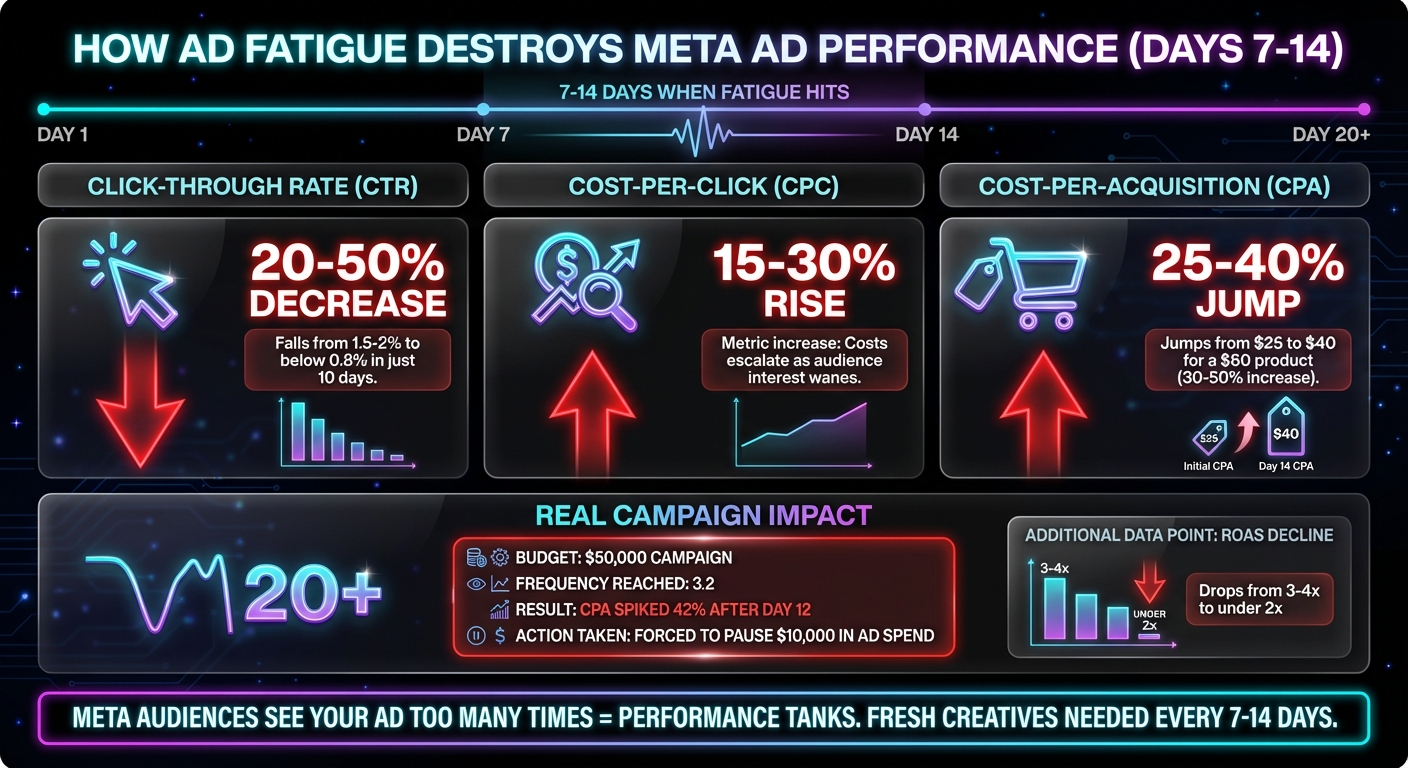
Ad Fatigue Impact on Meta Campaign Performance: CTR, CPC, and CPA Changes
Meta thrives on a steady flow of fresh ad creatives. With high ad budgets at play, every day without new material means lost opportunities. The brands dominating right now aren't necessarily those with the best products or deepest pockets - they're the ones that can churn out and test new ads faster than their competitors.
Why Designer-Based Workflows Slow Everything Down
Traditional design workflows can feel like a bottleneck. Here’s the typical breakdown: writing a creative brief takes 1–2 days, getting initial drafts takes another 2–3 days, feedback and revisions drag on for 4–6 days, and final approvals and exports add another day. That’s 7–14 days per ad set.
Now imagine you need 10 new creatives. You’re staring at a turnaround time of at least 2–4 weeks. Take the example of a DTC skincare brand that waited three weeks for just eight creatives because their design team was swamped. The delay meant they missed their peak sales window, costing them $15,000 in potential revenue from untested ads. Miscommunications, endless revisions, and slow approvals don’t just waste time - they leave your campaigns lagging behind while competitors move ahead. Worse, these delays set the stage for early ad fatigue.
Ad Fatigue Hits Hard After 7–14 Days
Meta audiences have short attention spans. Once people see your ad too many times, performance tanks. Click-through rates (CTR) can drop by 20–50%, cost-per-click (CPC) rises by 15–30%, and cost-per-acquisition (CPA) jumps by 25–40%. For brands spending $5,000 or more per ad set, this decline hits fast - usually within 7–14 days, especially in cold traffic campaigns where competition is fierce.
Here’s what the numbers show: CTR often falls from 1.5–2% to below 0.8% in just 10 days. Meanwhile, CPA can skyrocket by 30–50% - for instance, going from $25 to $40 for a $60 product. Return on ad spend (ROAS) drops from 3–4× to under 2×, grinding your scaling efforts to a halt. In one campaign with a $50,000 budget, a single creative hit a frequency of 3.2, causing CPA to spike by 42% after day 12. This forced the brand to pause $10,000 in ad spend. Meta’s algorithm rewards fresh, engaging creatives. Without rolling out 5–10 new variants weekly, you risk wasting money on ads that no longer perform while your competitors grab your audience’s attention.
The True Cost of Slow Creative Production
The price of delays goes beyond declining performance - it also eats into your budget.
Running outdated ads for longer periods inflates CPAs by 20–40%. For example, a supplement brand delayed new creatives by 10 days, leading their CPA to jump from $22 to $35. That added $13,000 in extra costs just to acquire the same 1,000 customers. On top of that, limited testing capacity means you’re missing out on the 2–3× winning variants that could supercharge your campaigns.
Brands testing only 4–6 creatives a week miss out on 70–80% of potential winners. Scaling becomes nearly impossible beyond $20,000 in daily spend without proven variants, and profitability collapses as ROAS drops below 2.5×. On the other hand, brands testing 20+ creatives weekly scale three times faster and achieve ROAS of 4×, compared to just 2× for those testing fewer ads. Campaigns with 14-day creative cycles see lifetime CPAs climb by 25–35%. One DTC brand spending $100,000 per month lost $45,000 in monthly profit because a two-week production delay prevented them from scaling effectively. Speed isn’t just a bonus - it’s the line between profitability and wasted money.
How AI Fixes the Creative Production Problem
AI doesn’t just speed up the creative process - it completely transforms it. What used to take days of back-and-forth with briefs, revisions, and approvals now takes under 90 seconds. With tools like Aden's Lab, you simply drop in a link, and AI generates ads ready to launch on Meta the same day. It pulls images, crafts compelling Meta ad copy, and aligns everything with your brand’s positioning - all automatically. No more brainstorming sessions or endless debates over fonts and layouts. The entire production timeline shrinks from weeks to just minutes, giving you the ability to test and launch campaigns as soon as inspiration strikes. Let’s dive into why AI outpaces traditional workflows and how it ensures quality doesn’t take a hit.
Why AI Produces Ads Faster Than Any Designer
Human designers have limits. They need time to process briefs, develop concepts, refine designs, and finalize deliverables. AI skips all of that. It scans your product page, identifies key selling points, and generates ads using frameworks built from analyzing billions in ad spend. While a designer might deliver 3–5 ad variations in a week, AI can churn out over 100 ready-to-launch ads in a single day. This allows you to test multiple hooks, visuals, and CTAs simultaneously. For brands spending $10,000 or more per month on ads, this speed and volume can mean the difference between stalled campaigns and scaling aggressively. But speed alone isn’t enough - AI also ensures that quality remains consistent across every ad.
How AI Maintains Quality Across Hundreds of Ads
One of the biggest challenges with human designers is inconsistency. Different designers might interpret the same brief in wildly different ways - one might lean toward bold, vibrant designs, while another opts for a minimalist approach. This can lead to branding inconsistencies that confuse your audience. AI eliminates this issue entirely. It adheres to your brand guidelines - fonts, colors, layouts, and messaging principles - on every single ad. No more creative drift or off-brand experiments. Brands using AI report near-zero branding errors, a stark contrast to the inconsistencies that often arise when managing multiple freelancers or overburdened internal teams. This level of consistency not only strengthens your brand identity but also contributes to better performance for your Meta ads.
Why Static Ads Work Best on Meta
Videos may seem like the obvious choice for grabbing attention, but for most DTC brands, they’re more trouble than they’re worth. Video production is expensive, takes time, and slows down your testing cycles. Static ads, on the other hand, cost less than $2 each when generated by AI and allow you to test 10x more variations in the same timeframe. Meta’s algorithm favors quick-loading creatives, and static images consistently perform better in feeds and stories because they don’t cause delays or drop-offs. When ad fatigue sets in every 7–14 days, the ability to crank out 20 fresh static ads in an afternoon gives you a serious edge over competitors stuck waiting weeks for a single video edit. Static ads aren’t a compromise - they’re the format that lets you stay agile, outpace competitors, and keep costs low while driving results.
sbb-itb-628c49f
How Aden's Lab Generates Meta Ads from a Single Link
Aden's Lab takes a refreshingly simple approach to ad creation. Instead of relying on prompts or requiring users to upload assets, you just need to paste your product or landing page URL. The platform does the heavy lifting - automatically pulling images, benefits, reviews, and key positioning details to create Meta-ready static ads in just 90 seconds. No lengthy briefs, no back-and-forth. What used to take days or weeks is now reduced to mere minutes, delivering ads that are ready to launch.
Drop a Link, Get Ads in 90 Seconds
It doesn’t get much simpler than this. Paste your URL, and Aden's Lab extracts everything it needs - visuals, copy, and selling points - directly from your site. The platform then formats this information into static ads tailored for Facebook and Instagram feeds and stories. In just 90 seconds, you’ll have a batch of ads ready for review. For instance, Fashion Forward Co., a clothing brand, used Aden's Lab to produce over 200 ad variations in a single day. To put that into perspective, their agency had previously taken three weeks to create just 10 ads.
Built on Direct-Response Principles That Convert
Speed isn’t the only advantage. Every ad generated by Aden's Lab is designed with direct-response principles in mind, ensuring they’re optimized to drive action. Instead of relying on generic templates, the AI focuses on what works: highlighting your product’s core benefits, integrating social proof or urgency signals when available, and structuring ads with clear calls-to-action that align with your landing page. The AI’s training - rooted in data from billions in ad spend - means it knows how to craft hooks that grab attention and layouts that encourage clicks.
Take TechGadget Pro, for example. After switching from agency-produced ads to Aden's Lab-generated creatives, their click-through rate skyrocketed by 520% - a testament to the platform's ability to create ads that convert. The difference wasn’t about aesthetics; it was about effectiveness.
Pricing: From $0.90 to $1.97 Per Ad
Aden's Lab offers pricing plans that are far more affordable than traditional design services. The Lift Off plan, priced at $59 per month, includes 30 ads - breaking down to about $1.97 per ad. This plan is ideal for startups experimenting with different messaging and offers. The Hyperstream plan, at $89 per month for 50 ads (around $1.78 per ad), is perfect for brands needing a steady flow of fresh creatives to combat ad fatigue. For businesses in growth mode, the Apex Mode plan delivers 200 ads for $179 per month - just $0.90 per ad.
To put this in perspective, freelancers typically charge $50–$150 per ad, while in-house teams often produce only 20–30 ads per month at a much higher cost. Wellness Plus, a health-focused brand, slashed its creative expenses from $10,000 per month with an agency to just a few hundred dollars using Aden's Lab. The result? An additional $3.1 million in revenue generated by these cost-effective ads.
How Fast Creative Testing Helps You Scale Meta Campaigns
Speeding up creative production opens the door to what really drives success: testing a large number of variations to find the ones that work. Scaling Meta campaigns isn't about creating one flawless ad - it’s about discovering which combinations of hooks, visuals, and angles connect with your audience. Top Meta advertisers excel by testing dozens, sometimes hundreds, of variations at the same time. They quickly identify underperformers, often within 48 hours, and shift their budgets toward the ads that deliver results. This approach separates campaigns that waste money from those that consistently generate revenue.
Why Testing Hooks, Angles, and Visuals Matters
By testing a variety of creative options, you allow Meta's algorithm to uncover what resonates, instead of relying on guesswork. Out of 50 ads, it’s common for just 2–5 to emerge as top performers. These winning creatives can significantly cut your cost per acquisition (CPA) - for example, dropping it from $25 to $15 - while boosting return on ad spend (ROAS) from 2x to 4x.
The key elements to test include:
- Hooks: The opening statement or visual that grabs attention and stops the scroll.
- Angles: The main benefit or problem your ad addresses.
- Visuals: This could be product shots, lifestyle images, or graphics that highlight benefits.
For example, a direct-to-consumer (DTC) supplement brand used Aden's Lab to generate 150 ads, tested 50 of them on Meta, and found 3 high-performing creatives. These ads delivered a 3.5x ROAS compared to their baseline of 1.8x. Within two weeks, they scaled their daily spend from $5,000 to $40,000 while cutting their CPA by 28%. This kind of testing strategy is what sets the stage for rapid scaling.
How Aden's Lab Lets You Test 10x More Creatives
Traditional design workflows can severely limit how many ads you can test. A designer might take days to create a batch, leaving you with only 20–30 variations in a month. Aden's Lab changes the game. By simply pasting your URL, you can generate a batch of static Meta ads in just 90 seconds. This allows you to test over 100 ads per week - far more than the typical manual process.
At a cost of $0.90 to $1.97 per ad, the financial risk is low. You can launch 20–30 ads with different hooks and angles, spending $50–$100 on each over 24–48 hours. From there, you drop the underperformers and scale the winners with a 10x budget increase. This high-speed, high-volume testing approach keeps you ahead of the competition, something that’s nearly impossible with slower, manual workflows.
Faster Creatives Mean Better Performance and Lower Costs
Slow creative production can seriously derail campaigns, dragging down performance metrics. When ad creatives aren’t refreshed quickly enough, fatigue sets in fast. Click-through rates plummet, and customer acquisition costs skyrocket. For brands stuck in traditional designer workflows, the impact can be harsh - revenue drops by 41%, and acquisition costs jump by 32%, all because they can’t keep pace with Meta’s relentless demand for fresh creatives. Worse still, they often end up wasting money on outdated ads that no longer deliver results.
The more creatives you test, the more potential winners you uncover. If you’re limited to designing just 5–10 ads a week, your ability to experiment with new angles is severely restricted. But imagine producing 50–100 variations in the same timeframe. Meta’s algorithm thrives on that kind of data. That’s where Aden’s Lab steps in, transforming a simple page link into dozens of ready-to-launch static ads. Brands using AI-driven creative tools like this have seen up to 44.5% higher click-through rates (CTR) and 22% better return on ad spend (ROAS) compared to slower, manual workflows. This isn’t just theory - it’s a proven way to eliminate production bottlenecks and enhance results.
Speeding up creative production doesn’t just save time - it amplifies your testing capacity and campaign scalability. With Aden’s Lab, what used to take weeks can now be done in just 90 seconds. Drop in your product page link, and you’ll receive a batch of static Meta ads crafted with direct-response principles designed to convert. At just $0.90–$1.97 per ad, you can afford to launch 30 variations, test them all, cut underperformers, and double down on the winners.
Winning on Meta isn’t about having the sharpest creative instincts - it’s about outproducing your competition. While others wait weeks for new ads, you can launch fresh ones daily, keeping you consistently ahead. Faster testing means better-performing ads, lower costs, and more scalable campaigns. By slashing production times to mere minutes, you gain a competitive edge that slower workflows simply can’t match.
This isn’t about sidelining human creativity - it’s about eliminating the production delays that hold you back. Aden’s Lab empowers you to produce at scale without the usual overhead, delays, or second-guessing.
FAQs
How often should I refresh Meta ad creatives?
Most businesses should update their Meta ad creatives every 2 to 4 weeks. Why? To avoid creative fatigue - that point when your audience gets tired of seeing the same ads over and over. Refreshing your ads regularly keeps them interesting and relevant, which helps maintain steady performance and strong engagement.
How do I test 50+ ads without wasting budget?
To test 50+ ads without blowing your budget, focus on speed and strategy. Start by creating multiple ad variations quickly - tools like Aden’s Lab can help you generate high-quality ads in just seconds. Once you have your variations, run them with a small budget to see which ones perform best. From there, scale up the winning ads and pause or tweak the underperformers. This approach minimizes waste and helps you zero in on high-converting creatives effectively.
Will AI-made static ads still match my brand?
Yes, AI-generated static ads can align perfectly with your brand - when built using a system that truly understands your product and audience. Aden’s Lab creates visually appealing ads that reflect your brand’s message by analyzing your product link. This automated approach delivers consistent, effective creatives while eliminating the need for manual effort. The result? Your brand identity stays intact, and creative fatigue becomes a thing of the past.
Your next ad batch starts here
Finish with a ready-to-test ad batch
Paste your website to generate static creatives. Drop the link → get ads in about 90 seconds → upload them to Meta → scale.
Free to try No prompt writing