How Agencies Use AI to Produce Creatives for Clients (Steal This System)
Turn the strategy into creatives
Create Meta ads for your product
Paste your product page. ADEN'S LAB turns the offer, audience, and positioning into complete ready-to-use Meta static ads.
Free to try No prompt writing
Agencies are under growing pressure to deliver more ads, faster, and with better results - without increasing costs. AI offers a way out by automating repetitive tasks like resizing assets, generating ad variations, and drafting copy. This frees up teams to focus on higher-value work while meeting tight deadlines and scaling operations.
Key takeaways from this guide:
- AI saves time and reduces costs: Automating tasks can slash production costs by up to 100x compared to traditional methods.
- ADEN'S LAB simplifies ad production: Generate hundreds of Meta ad variations in under 90 seconds, all aligned with brand guidelines.
- AI enhances efficiency: Agencies using machine learning are 74% more likely to analyze consumer behavior effectively.
- Step-by-step system: From mapping workflows to scaling ad production, the guide outlines a repeatable process to integrate AI seamlessly.
The bottom line: AI isn't just a tool; it's a system that enables agencies to deliver faster results, maintain quality, and improve profitability.
AI Tools to Replace Your $10k+ Creative Agency
Put the playbook to work
Apply this playbook to your page
Paste your website and the Lab will turn the strategy you are reading into a ready-to-test ads.
Free to try No prompt writing
How to Map and Improve Your Creative Workflow
Before diving into AI integration, it’s essential to map out your current workflow. This helps identify where delays occur and highlights areas that could be optimized for better efficiency and profitability. Think of it as laying the groundwork for smoother, faster, and higher-quality ad production.
What a Standard Creative Pipeline Looks Like
A typical creative pipeline in an agency follows a predictable series of steps, but each stage can come with its own challenges and delays:
- Client Brief and Discovery: This is where it all begins. Your team meets with the client to gather requirements and align on business objectives. If the brief is unclear or incomplete, timelines can quickly stretch as you try to clarify expectations.
- Creative Concepting: Senior designers take the lead here, brainstorming ideas, sketching concepts, and developing initial directions. This stage is highly creative but can also slow down if alignment on ideas isn’t reached quickly.
- Asset Production: This is the heavy-lifting phase, where designers create the final ad materials - images, copy, layouts, and multiple variations. The time required here depends on the project’s complexity and the formats needed, making it one of the most time-intensive stages.
- Internal Review and Revisions: Creative directors step in to refine the work, providing feedback and requesting edits. While essential for quality control, this step can introduce delays if revisions pile up.
- Client Presentation and Delivery: The work is presented to the client, feedback is gathered, and final tweaks are made before the final delivery.
Even for straightforward projects, these steps can take weeks to complete. A significant portion of your team’s time often gets consumed by repetitive tasks, leaving less room for strategic, high-impact creative work. This breakdown sets the stage for transitioning from manual workflows to AI-assisted ones.
Manual Work vs. AI-Assisted Work
Shifting from manual processes to AI-assisted workflows can transform how your team operates. Traditionally, tasks like creating multiple ad variations, resizing assets for different platforms, or drafting diverse ad copy require a lot of manual effort. AI can handle these repetitive tasks with ease, freeing your team to focus on higher-level creative decisions.
With AI in the mix, agencies can work faster, meet tighter deadlines, and take on more campaigns without sacrificing quality. This means more time for strategic thinking, better turnaround times, and the ability to scale operations efficiently.
How to Build a Process Map
Creating a visual map of your workflow is a simple yet powerful way to identify inefficiencies and areas for improvement. Here’s how to do it:
- Outline Each Stage: Start by listing every step in your current process, from the initial client brief to final delivery. Use a whiteboard or a tool like Google Docs to detail each task, noting who is responsible and what triggers the next step.
- Spot Manual Bottlenecks: Look for tasks that are repetitive or don’t require much creative judgment. These are often the culprits slowing down your workflow.
- Determine AI’s Role: For each bottleneck, decide if AI can fully automate the task or assist with human oversight still in place.
- Redraw Your Workflow: Update your workflow to clearly separate tasks that require human input - like strategic planning and client communication - from those that can be automated, such as resizing assets or generating ad variations.
- Quantify the Time Savings: Estimate how much time AI could save on each task. These numbers can help justify investments in AI tools and demonstrate the potential for streamlining your process.
Once you’ve mapped out your improved workflow, you’ll be ready to integrate AI into your creative production seamlessly, boosting both efficiency and output.
How to Build an AI System for Meta Ad Production
Creating a system to produce Meta ads at scale can transform your team's workflow. By automating repetitive tasks, your team can focus on strategy and big-picture creative decisions. This approach seamlessly combines strategic thinking with automation, setting a new benchmark for ad production.
How AI Simplifies Meta Ad Production
AI takes the heavy lifting out of ad creation by generating variations, tailored copy, and asset adjustments in mere seconds.
Here’s how it works: You provide the input - product links, key features, and brand guidelines. The AI then creates multiple ad concepts, each showcasing a unique angle and message.
Copy generation is fully automated. The AI crafts headlines, primary text, and calls-to-action tailored to different audience segments. It produces variations that highlight different benefits, tones, or pain points - no manual effort required.
The same process applies to visuals. AI designs ad creatives that match your brand’s style, offering variations in imagery and layouts. It even uses insights on what visual elements perform best on Meta platforms.
The result? Hundreds of ad variations that continuously improve through performance data analysis. This feedback loop refines future outputs, ensuring your ads stay effective.
How ADEN'S LAB Fits Into Your Workflow
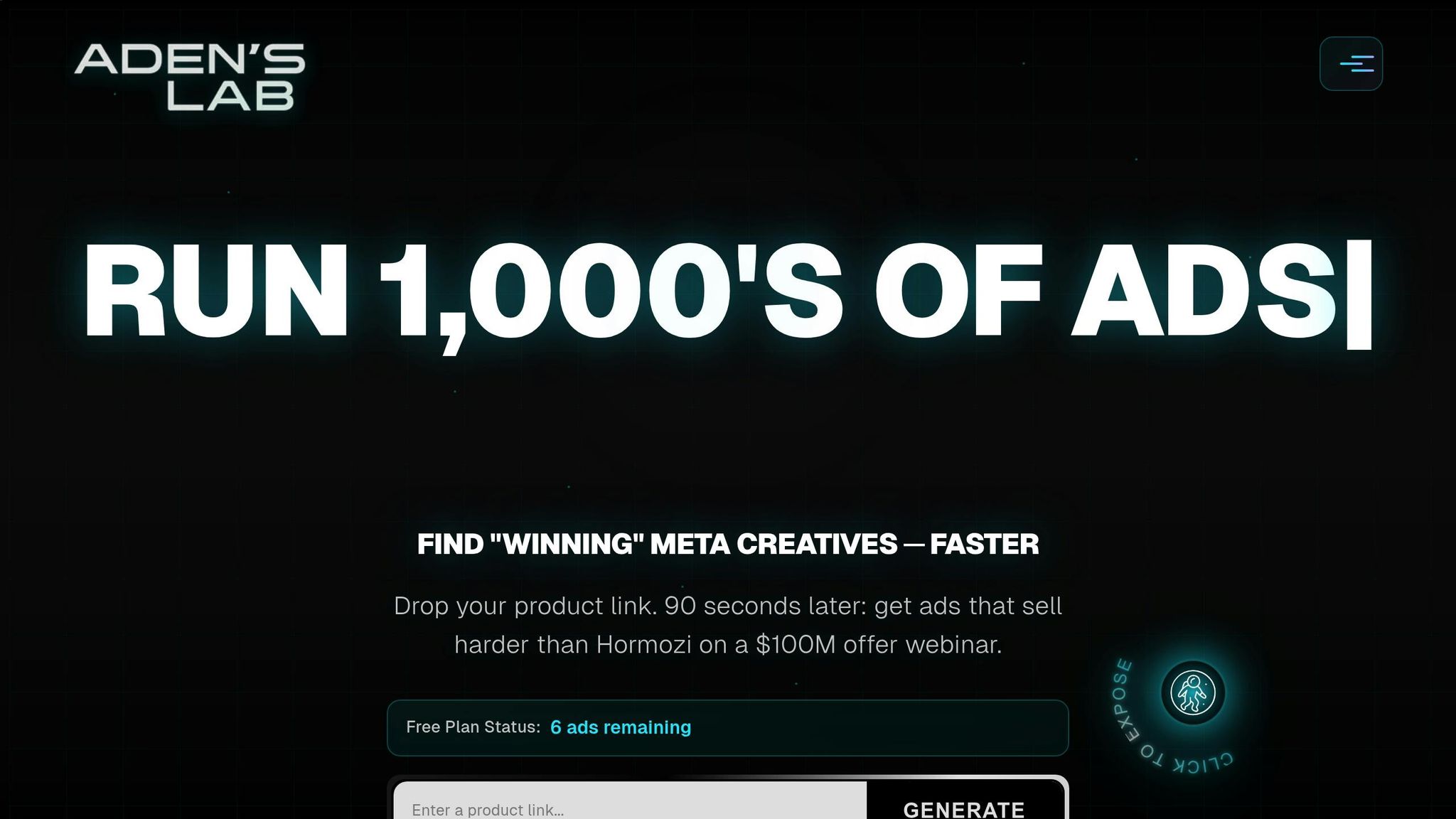
ADEN'S LAB makes this process even easier by ensuring every ad aligns with your brand guidelines. Acting as the backbone of your AI workflow, it bridges the gap between creative strategy and campaign execution.
With ADEN'S LAB, you can quickly upload your brand assets - logos, color palettes, fonts, and style preferences. Once configured, the platform ensures every ad reflects your brand identity.
When you’re ready to create ads, simply drop in a product link. ADEN'S LAB analyzes the product, pulls key details, and generates high-performing Meta ads in about 90 seconds.
Instead of single creatives, ADEN'S LAB produces complete ad sets. Each set includes multiple variations with different headlines, copy angles, visuals, and layouts, giving your media buyers plenty of options to test.
With paid plans, you also get commercial rights, so every ad is ready for immediate use in campaigns - no licensing headaches. Designed for agencies managing multiple accounts, ADEN'S LAB can scale to produce over 1,000 ads per day. Its psychology-driven approach ensures the ads not only look good but are designed to drive action.
The Complete System You Can Copy
Step 1: Set Up Your Client Intake Process
Start with a standardized form to collect essential details like product links, brand assets, target audience, campaign goals, and messaging requirements.
Step 2: Configure Brand Settings in ADEN'S LAB
Upload your logo, set colors and fonts, and define style preferences. This one-time setup ensures all ads align with your brand identity.
Step 3: Generate Initial Ad Sets
Enter the product link and let ADEN'S LAB create your first batch of ads. You’ll get multiple variations with different creative angles, copy styles, and visual treatments to test.
Step 4: Review and Refine
Have a senior creative review the ads, selecting the strongest concepts and making any minor tweaks to align with the campaign’s strategy.
Step 5: Client Preview and Approval
Share the top-performing options with your client. Providing a variety of strong choices helps gather focused feedback and minimizes revision cycles.
Step 6: Deploy to Ad Accounts
Upload the ads directly to Meta Ads Manager. Since ADEN'S LAB generates ads in the correct formats, there’s no need for additional adjustments.
Step 7: Monitor and Iterate
Track performance as the campaign runs. Identify what’s working and use those insights to refine future ad sets.
Step 8: Scale Production as Needed
For new products, seasonal campaigns, or broader testing, repeat the process. With brand settings already configured, generating new ads is quick and hassle-free.
This system allows even a small creative team to handle large production volumes efficiently. By automating repetitive tasks, your team can focus on strategic planning and building stronger client relationships. It’s a practical shift from manual to AI-enhanced production that delivers results.
How to Scale Volume, Quality, and Cost Efficiency
For growing agencies, balancing creative output, quality, and cost efficiency can feel like a juggling act. AI is reshaping this process by automating repetitive tasks, speeding up production, and cutting costs - all without compromising on quality.
How to Produce More Ads Faster
The problem isn't coming up with ideas - it’s the time it takes to bring them to life. Manually creating multiple ad variations can take days, but AI can handle the same workload in just minutes.
With batch creation, you can generate entire campaigns in one session. Simply upload a few product links, and you’ll have a full set of ad variations ready for testing in no time. This efficiency becomes even more valuable as you take on more clients. While AI handles the heavy lifting, your creative team can focus on strategy and client relationships, enabling your agency to scale without adding significant staff.
AI also makes quick iterations a breeze. Need fresh variations? Adjust the inputs, regenerate, and deliver updated ads almost instantly. This agility not only keeps clients happy but also highlights your agency’s ability to adapt and perform under tight deadlines.
Speed matters, but it’s only part of the equation. Excellence is just as important.
How to Maintain Quality Standards
Fast production is meaningless if the quality doesn’t hold up. The trick to scaling effectively is integrating quality control into every step of your workflow.
ADEN'S LAB makes this easier with configurable brand settings, which act as built-in guardrails to ensure consistency. This setup reduces the errors and inconsistencies that often come with manual production.
However, human oversight is still essential. While AI creates the initial drafts, experienced team members should review and refine the output before delivering it to clients. A tiered review process works well here: senior creatives can thoroughly review high-stakes campaigns, while smaller or proven projects might only need a lighter touch. Saved brand profiles also help maintain consistency, enabling even new team members to create on-brand content quickly.
To further ensure quality, use checklists covering key areas like brand alignment, message clarity, visual hierarchy, and the strength of your call-to-action. Tracking which ads perform best provides valuable insights, allowing you to refine your quality standards based on real-world results.
How to Control Costs and Increase Profit Margins
Traditional ad production - whether through freelancers, in-house designers, or agencies - can get expensive fast. High per-ad costs often eat into profit margins, making it harder to grow.
AI-powered tools like ADEN'S LAB flip the script. By automating production, you can create large volumes of ads at a fraction of the cost. This cost reduction frees up resources for other growth opportunities, while still delivering the quality and quantity your clients expect.
The speed of AI production also allows your agency to handle more projects simultaneously without increasing overhead. By shifting repetitive tasks to AI, you can reassign your creative team to higher-value work like strategic planning and client engagement. This not only improves profit margins but also strengthens client relationships, as your team can focus on delivering strategic insights rather than just production work.
sbb-itb-628c49f
How to Connect AI Creatives to Campaign Results
Creating ads is just the beginning - tying those ads to measurable results is what turns creative efforts into a powerful strategic tool. Once you’ve streamlined the creative workflow, the next step is to link ad performance directly to campaign outcomes. When you can clearly show how your AI-generated ads perform, you shift creative production from being just an expense to becoming a competitive advantage.
How to Track Creative Performance
Without proper tracking, understanding how your ads perform is nearly impossible. To get started, establish clear naming conventions and tagging systems. Each ad should include essential details like the date, product name, variation number, and any tested elements such as headline styles. For instance, a label like "2025-12-09_ProductA_Var03_BenefitHeadline" can quickly tell you everything you need to know at a glance. Additionally, take advantage of Meta's labeling tools to tag ads effectively, especially for variations produced by ADEN'S LAB or specific creative strategies being tested.
Consider using AI-powered platforms that sync with your Meta ad accounts. These tools can automatically group your creatives, analyze their elements, and connect specific design choices to performance metrics. This eliminates the hassle of manual data exports and spreadsheet comparisons, giving you real-time insights into which creative variations are driving results.
Keep a tracking dashboard or spreadsheet updated with key performance indicators like click-through rate (CTR), cost per click (CPC), conversion rate, and return on ad spend (ROAS). Regularly updating this data - ideally daily for active campaigns - helps you spot trends early and make informed decisions for future creative strategies.
Also, document the unique elements of each ADEN'S LAB variation, such as the product angle, headline style, or visual design. This level of detail allows you to quickly pinpoint which approaches are most effective, creating a foundation for clear and actionable client reporting.
How to Present Results to Clients
Once you’ve gathered accurate performance data, it’s time to present it in a way that aligns with your client’s goals. Clients care about the story behind the metrics, so focus on what matters most to them - whether that’s maximizing return on ad spend, boosting brand awareness, or improving cost efficiency. Tailor your reports to highlight these priorities. Visual aids like comparison charts can be especially helpful, as they make it easy to see which creative variations performed best.
Don’t just share numbers - explain what they mean. For example, if one ad outperformed another, dig into the reasons why. Was it the headline? The visual? The audience targeting? Providing this context positions your agency as a strategic partner, not just a service provider.
Before-and-after comparisons are another powerful way to showcase results. Highlighting how performance improved over time demonstrates the value of AI-driven creative testing. It’s also a great opportunity to emphasize the speed and scale benefits of using AI. Showing that you were able to test a wide range of creative ideas quickly reinforces the efficiency and depth of your process.
For clarity, create a concise one-page summary for each campaign. This summary should include the number of AI-generated variations tested, the top-performing creatives with their key metrics, the insights you’ve gained, and your recommendations for next steps. These summaries are easy for clients to review and share with their teams.
Lastly, be upfront about your process. Make it clear that while ADEN'S LAB handles the initial creative production, your team ensures the work aligns with the client’s brand and strategy. This transparency shows that AI is a tool that enhances your expertise, not a replacement for it.
How to Document Your AI Creative System
Documenting your AI creative system is crucial for keeping your agency’s processes consistent and efficient. Without proper documentation, essential know-how can slip through the cracks. By recording your AI workflow, you turn a fragile setup into a dependable system that your entire team can follow with ease.
This type of documentation also secures your agency’s competitive edge. For example, if you’ve mastered using AI tools like ADEN'S LAB to create high-quality ads at scale, that expertise becomes a valuable resource. Writing it all down allows you to replicate your success across different clients, onboard new hires faster, and maintain high standards as your team grows. Below, we’ll break down how to create a playbook that integrates seamlessly with your AI-driven processes.
How to Create an Internal AI Playbook
An AI playbook should be a practical, straightforward guide that walks your team through the creative process from start to finish. The goal is to create a reference document that’s actually useful in day-to-day work.
Start by outlining a workflow overview that maps out every stage of your creative process. This should clearly show where AI fits into your existing workflow and how it interacts with other tasks. For example, document the journey from receiving a client brief to delivering final ads: client intake, product research, using ADEN'S LAB, creative review, client approval, and campaign launch. Include timeframes for each stage and assign responsibilities to specific team members.
Next, provide step-by-step instructions for using ADEN'S LAB. Break down the process into detailed steps, such as inputting product links, adjusting settings for specific client needs, and choosing the right number of variations. For instance, if you’ve found that generating 15 variations works better than 10 for e-commerce clients, make sure to include that insight. If certain product categories require unique strategies, note those as well.
Clearly define team roles and responsibilities to ensure everyone knows their part in the process. Assign distinct tasks for generating AI content, reviewing creative output, and approving final versions. This clarity helps avoid confusion and keeps things running smoothly, especially when multiple people are involved in a single account.
Establish quality standards and brand guidelines to maintain consistency. Create a checklist for reviewers to follow: Does the ad reflect the client’s brand voice? Are product details accurate? Does the visual style match the client’s existing assets? Is the message clear and engaging? These checkpoints help safeguard quality at every stage.
Include a troubleshooting section to address common issues. For example, what should your team do if ADEN'S LAB generates ads that don’t align with a client’s style? How can you handle products with limited visual assets? What’s the process if a client requests significant revisions? Having these solutions documented can save time and reduce stress when challenges arise.
Finally, add templates and examples to illustrate what success looks like. Include screenshots of effective ADEN'S LAB outputs, client briefs that led to strong results, and performance reports that highlight value. These examples give your team concrete models to follow and clarify expectations.
Make sure your playbook is easy to update and access. Platforms like Google Docs, Notion, or an internal wiki are great options because they allow for quick revisions as your process evolves. Set a quarterly reminder to review and refine the playbook, incorporating new learnings and adjusting for changes in your workflow.
How to Train Teams and Set Guidelines
Even the most detailed documentation won’t help if your team doesn’t know it exists or doesn’t understand how to use it. Training your staff on AI tools requires a mix of technical instruction and strategic thinking.
Start with hands-on ADEN'S LAB training sessions. Don’t just explain how it works - guide your team through real client projects. Walk them through the entire workflow: inputting a product link, generating variations, reviewing the output, and making adjustments. Practical experience like this builds confidence much faster than a lecture or manual. Use examples from your playbook during training to connect theory to real-world application.
Design role-specific training paths tailored to different team members. For example, account managers should understand what AI can deliver and how to set client expectations, but they don’t need to master every technical detail. Creative reviewers, on the other hand, should focus on evaluating AI output and ensuring brand consistency. Media buyers might need to learn how AI-generated ads fit into broader campaign strategies and performance tracking.
Set clear approval processes for AI-generated content before it’s shared with clients. A simple three-tier system works well: junior team members handle initial quality checks, senior creatives review for brand alignment and strategy, and account leads give final approval. This structure ensures high quality while keeping things efficient.
Emphasize data security and client confidentiality in your training. Make sure your team understands how to handle client information when using AI tools. Establish clear rules about what data can be input into ADEN'S LAB, how to securely store generated content, and what information must remain confidential. Even though ADEN'S LAB is a professional tool, your agency should have its own protocols for protecting client assets.
Host monthly review meetings to discuss workflow improvements and address any gaps in training. These sessions often reveal insights that should be added to your playbook and help identify areas where additional training is needed.
Create quick-reference guides for common tasks. For example, a one-page cheat sheet for generating ads for different product types, a troubleshooting guide for frequent issues, or a visual workflow diagram can be incredibly helpful for team members who need answers on the spot.
Pair newer team members with experienced ones for mentorship and knowledge sharing. Having a more seasoned colleague available to answer questions and provide guidance can speed up learning and boost confidence. This also helps you identify areas where your documentation might need improvement - if the same questions keep coming up, those topics likely need more clarity in the playbook.
Make training an ongoing effort, not a one-time event. As your AI creative system evolves, update your training materials and hold refresher sessions. When you discover new techniques or ADEN'S LAB releases new features, share that knowledge with your team promptly. Agencies that treat learning as a continuous process tend to get the most out of AI tools.
Finally, encourage your team to experiment within guidelines. While consistency is important, you don’t want your documentation to stifle creativity. Give your team room to test new approaches and share their findings. Some of the best workflow improvements come from those using the system daily and finding smarter ways to get things done.
Conclusion
AI is changing the way creative production works, leaving outdated methods behind. Agencies that weave AI into their workflows are producing more ads, maintaining quality, and cutting costs - all at the same time.
But this isn't just about using new tools here and there. It's about building a system - a structured, repeatable process that maps out your workflow, pinpoints inefficiencies, and uses AI to make a real impact. When you document your processes, train your team effectively, and tie creative output directly to campaign results, AI becomes more than just another tool - it becomes a game-changer.
ADEN'S LAB is at the heart of this transformation for Meta ad production. By automating repetitive tasks, it complements your workflow from brainstorming to generating multiple ad variations. This frees your team to focus on what really matters: strategy, client relationships, and optimization. With the capability to create hundreds of ads daily, ADEN'S LAB allows you to test more ideas, serve more clients, and adapt quickly to market changes - without getting bogged down by manual production.
The agencies thriving with AI aren't necessarily the biggest or the oldest. They're the ones that have embraced AI as a core part of their strategy, not just an experiment.
Your approach will evolve as your team sharpens its skills, ADEN'S LAB rolls out new features, and performance data shapes your decisions. By treating this as a continuous process rather than a one-and-done implementation, your agency can stay ahead of the curve. Start building this framework now to secure your competitive edge.
Sticking to old methods limits how many clients you can serve, slows your ability to seize opportunities, and cuts into profits. It's time to transform how you approach creative production.
FAQs
How can agencies use AI to create ads that stay true to a brand's identity and quality standards?
Agencies can use AI tools to keep a consistent tone and message across all advertising materials, ensuring they reflect the brand's identity. Features like standardized templates and automated checks help enforce brand guidelines efficiently. However, human creatives remain essential in fine-tuning AI-generated content, guaranteeing it meets top-quality standards and connects with the intended audience effectively.
What are the first steps an agency should take to successfully integrate AI into their creative workflow?
To seamlessly bring AI into your agency's creative workflow, begin by identifying clear objectives, project scope, and timelines. This step ensures everyone is aligned and sets a strong foundation for success. Then, take a close look at your existing processes to pinpoint any bottlenecks or repetitive tasks where AI could step in to save time and effort. Once you've identified these areas, select AI tools that match your agency's specific needs and test them in a controlled setting before rolling them out fully.
It's also important to promote a mindset of ongoing learning and flexibility within your team. Equip your staff with the knowledge and skills to use AI effectively, and encourage them to explore its potential. Make it a habit to regularly evaluate how well the AI tools are performing and tweak your workflow as needed. This approach helps ensure you're delivering better results while cutting down on unnecessary time and expenses.
How does ADEN'S LAB make Meta ad production faster and more efficient than traditional methods?
ADEN'S LAB simplifies the process of creating Meta ads by using AI-powered tools to handle essential creative tasks. These tools can produce top-notch visuals, write engaging ad copy, and fine-tune designs for better performance - all in a fraction of the time compared to traditional methods.
By cutting down on manual work, ADEN'S LAB helps agencies produce more ads without sacrificing quality. This efficiency not only reduces costs but also frees up teams to concentrate on strategy and fresh ideas, leading to stronger outcomes for their clients.
Your next ad batch starts here
Finish with a ready-to-test ad batch
Paste your website to generate static creatives. Drop the link → get ads in about 90 seconds → upload them to Meta → scale.
Free to try No prompt writing