Inside the AI Creative Stack Used by High-Spend Meta Advertisers
Turn the strategy into creatives
Create Meta ads for your product
Paste your product page. ADEN'S LAB turns the offer, audience, and positioning into complete ready-to-use Meta static ads.
Free to try No prompt writing

Meta ads have shifted focus from manual audience targeting to ad content quality and variety. Here's what changed and how top advertisers are staying ahead:
- Meta's Andromeda AI engine, launched in late 2025, uses ad content to determine audience targeting, replacing older manual methods.
- Advertisers now need 50–200 new ads monthly to maintain performance, as Meta's algorithm prioritizes fresh, varied content.
- Tools like Advantage+ Creative and AI Sandbox automate ad creation, producing multiple variations of text, headlines, and layouts in minutes.
- High-budget campaigns favor static ads over videos for faster production and testing, keeping costs low and response times fast.
- Platforms like Aden's Lab generate hundreds of ads for as little as $0.90 each, compared to $30–$50 per ad with manual designers.
Key takeaway: Success on Meta now depends on producing a high volume of diverse ads, testing continuously, and leveraging AI tools to reduce costs and boost efficiency.
The ULTIMATE Guide to using AI to make Facebook Ads (Full Step-by-Step Walkthrough)
Put the playbook to work
Apply this playbook to your page
Paste your website and the Lab will turn the strategy you are reading into a ready-to-test ads.
Free to try No prompt writing
Why Creative Assets Now Drive Meta Ad Performance
Before Meta introduced Andromeda, success in ad campaigns relied heavily on precise audience targeting. Advertisers could fine-tune their campaigns by layering interests, behaviors, and lookalike audiences, manually controlling who saw their ads and when. But with Andromeda, the game has changed. Now, the creative itself has become the key driver of targeting.
The Andromeda algorithm analyzes your ad’s visuals, copy, and overall angle to determine the best audience for your content. It’s lightning-fast - 100 times quicker at matching ads to users and capable of processing 10,000 times more ad variations simultaneously than before. This shift means that if your ad resonates with a specific audience, the AI will amplify its reach. If it doesn’t, no amount of manual tweaks will salvage its performance.
“In the Andromeda era, creative acts as the primary signal for targeting. To succeed, you need a diverse library of assets that speak to different angles and stages of the customer journey.” - Tara Zirker, Founder, Successful Ads Club
During its beta phase in Q2 2024, Andromeda boosted ad conversions on Instagram by 5%. By Q3, that improvement had doubled. Advertisers who adapted early by consistently producing diverse creatives saw their costs decrease, while those relying on outdated strategies faced rising CPMs. High-budget accounts now treat creative production as an ongoing process, similar to manufacturing, rather than a one-off design project. This shift has created a new challenge: maintaining a steady flow of fresh, varied assets.
The Volume Problem: Why You Need More Ads Than You Think
One of the biggest mistakes advertisers make is not producing enough ads. Many create a handful of “winning” ads and let them run until performance declines. By the time CPMs rise and ROAS drops, they’re left scrambling to recover.
Meta’s algorithm adapts quickly. When an ad starts losing engagement, the platform reduces its reach, driving up CPMs and making conversions more expensive. Smaller advertisers might get by with monthly creative refreshes, but for high-spend accounts, fresh assets are needed weekly. This often means launching anywhere from 50 to over 200 ads every month to maintain consistent performance.
Here’s a real-world example: In late 2025, Karina Gardner, founder of a design bootcamp, saw her Meta ad costs spike to $86 per conversion after an algorithm update. To address this, she implemented a new creative strategy that included eight diverse assets - one carousel, three images, and several AI-generated variations. Within 24 hours, her cost per result dropped to $13.87. This wasn’t about better targeting; it was about having enough variety and volume.
Spending $50,000 a month on Meta ads while running the same five creatives is a recipe for wasted money. High-spend advertisers approach creative production as a daily operation, constantly testing new ideas, cutting underperformers, and scaling winners before they lose traction. Companies like Aden’s Lab have emerged to meet this demand, offering quick-turnaround creative solutions for Meta campaigns.
While producing a high volume of ads is crucial, the quality of variation within those ads is equally important.
How Meta's AI Uses Fresh Creatives to Optimize Delivery
Meta’s AI thrives on genuine variation. Minor tweaks - like swapping out a headline on the same image - aren’t enough. The algorithm can recognize recycled concepts, and relying on them often results in higher CPMs. What works is introducing entirely new angles, tones, and visual styles.
“Creative iteration (changing the hook) ≠ creative variation (changing the concept). Your ad library should look like a film festival, not a casting call.” - Anchour
The Andromeda algorithm rewards diversity. Formats like carousels, text-only images, and vertical 9x16 ads are performing particularly well right now. In fact, as of 2026, 90% of Meta’s ad inventory is vertical. If you’re still running square or horizontal ads, you’re likely missing out on significant reach. Additionally, broad targeting - removing restrictions like age, gender, and interests - gives the algorithm more data to find your ideal audience. But even the best targeting won’t save you if your creative library feels outdated.
A good metric to watch is CPMr (cost per 1,000 reach). When CPMr starts to climb, it’s often a sign of creative fatigue, not a bidding issue. The solution isn’t to adjust your bids - it’s to launch fresh ads. Successful advertisers always have new creatives ready to go, ensuring they can respond immediately to performance dips. This proactive approach is what separates profitable scaling from shrinking margins.
The AI Creative Stack High-Spend Advertisers Actually Use
When you're spending over $100,000 a month on Meta ads, relying on a single designer to produce a few ads each week simply won't cut it. At this scale, you're competing in a high-stakes game that demands hundreds of fresh creatives every month to stay ahead of Meta's appetite for variety. To meet these demands, high-spend advertisers have ditched traditional design workflows in favor of systems powered by Meta's AI tools and specialized platforms designed to eliminate creative bottlenecks.
At the heart of this system are Meta's Advantage+ Creative and AI Sandbox tools. These tools take product images and brand guidelines and churn out multiple variations of text, headlines, descriptions, and layouts in minutes. For instance, Advantage+ Creative can generate 5–10 primary text options and 8–15 headline variations almost instantly. High-spend advertisers manage this entire process directly in Ads Manager, bypassing external design tools or lengthy revision cycles. As campaigns run, the system analyzes performance data to fine-tune what works best for your audience.
Behind the scenes, GEM (Generative Ads Recommendation Model) powers this intelligence. It processes engagement data from millions of campaigns to predict which visuals, hooks, and messaging will resonate with specific audience segments. In late 2025, Meta doubled GEM's GPU capacity, significantly improving its ability to select and optimize ads. By uploading a diverse set of creatives - say, 50 different ads instead of just five - you give GEM more room to analyze and enhance delivery performance.
But advertisers don't stop with Meta's tools. Many pair them with external platforms to supercharge creative production. These platforms can transform a single product link into launch-ready static ads, skipping time-consuming creative briefs and mockups. This streamlined process enables advertisers to produce 200+ ads monthly, embedding conversion-focused elements like compelling hooks, clear benefits, and strong calls-to-action.
This isn't just about speed; it's about testing velocity. With the ability to create 50 ad variations in a single afternoon, you can quickly test different hooks, visuals, and angles, identify the winners, and scale them before creative fatigue sets in.
Automated Ad Generation: How to Produce 200+ Ads Per Month
For many advertisers, the biggest challenge in scaling Meta ads is keeping up with creative production. Without a steady stream of fresh ads, audience fatigue sets in, and performance declines. The solution? Automated ad generation.
Platforms like Aden's Lab solve this problem by turning a single product or landing page link into dozens of Meta-ready static ads - no prompts, templates, or lengthy creative briefs required. Simply drop in a URL, and the platform analyzes your product, pulls key benefits, aligns with your brand's style, and generates eye-catching variations ready to launch. This approach allows advertisers to produce 20–50 new ad variations weekly, a volume that used to require an entire creative team.
Cost is another factor where automation shines. Aden's Lab starts at $59 per month for 30 ads, with costs dropping to $0.90 per ad on larger plans. Compare that to the $30–$50 per ad you'd typically pay a designer, and it's clear why automation is the more scalable option.
The real game-changer, though, is the ability to test at scale. By generating 50 variations in a single afternoon, advertisers can test different angles and visuals, quickly identify what works, and scale those ads before Meta's algorithm moves on.
Why Static Ads Beat Video for High-Budget Campaigns
While video ads often dominate social media feeds, high-budget campaigns - those spending $10,000+ daily - find static ads to be a smarter choice. Why? Because video production involves scripting, filming, editing, and rendering, which can take days or even weeks. Static ads, on the other hand, can be created in minutes, allowing advertisers to refresh creatives far more frequently.
Meta's Advantage+ Creative can generate dozens of static ad variations in the time it takes to produce a single video. These variations include different copy, headlines, and visual arrangements, all of which can be tested independently. Within 24–48 hours, you’ll know which combinations perform best. For high-budget campaigns, this ability to pivot quickly is crucial - you’re not stuck waiting on lengthy production timelines while your audience moves on.
Static ads also allow for more granular testing. You can experiment with different hooks, benefit statements, and visual styles without the delays associated with video production. In high-budget campaigns, static ads are typically used for testing, while video ads serve as an amplification tool once winning concepts have been identified.
Common Mistakes That Kill AI-Generated Ad Performance
AI-generated ads can fall flat when they feel generic. A common mistake is using tools that create ads in isolation, ignoring your product's unique selling points, your audience's needs, or proven psychological triggers. Sometimes, the difference between a $2 CPC and a $0.50 CPC comes down to whether the creative highlights a specific benefit, includes a clear call-to-action, or taps into a psychological driver that resonates with your audience.
To avoid this, high-performing AI ads focus on three principles:
- Brand fit: Ads must align with your brand's tone, style, and positioning, rather than relying on generic messaging.
- Conversion psychology: Effective ads use proven hooks like urgency, social proof, and clear benefits.
- Audience relevance: Ads should be tailored to resonate with specific demographic and behavioral segments.
Tools that generate creatives from a single product link often embed these principles automatically, ensuring each variation is optimized for conversions.
Another mistake is skipping human oversight. Even the best AI systems can produce lackluster results, so reviewing and refining the output for tone and consistency is essential. This hybrid approach - combining AI's speed with human judgment - can mean the difference between a profitable campaign and wasted ad spend.
Finally, treating AI as a "set it and forget it" solution is a misstep. AI-generated ads can still experience fatigue, but automation allows you to respond instantly. When performance dips, you don’t wait for a designer - you generate fresh variations and launch them the same day. This continuous refresh cycle keeps your campaigns competitive and performing at their peak.
How to Test and Scale Creatives at $100M+ Spend Levels
When you're managing ad spend at $100M+ levels, standard A/B testing won't cut it. Instead, you need a high-output creative system where sheer testing volume outweighs the pursuit of isolated perfection. Creative fatigue is a constant challenge, and the best defense is rapid, large-scale testing. The most successful advertisers aren't perfecting five ads a month - they're testing upwards of 50 variations daily, leveraging Meta's AI to quickly identify the winners.
The mindset shift here is crucial. Instead of debating whether a single ad is “good enough,” the focus becomes generating enough ads to let Meta's algorithm do its job. Meta's GEM system, trained on trillions of data points, can detect performance trends within hours. By launching 50 variations instead of just five, you give the system more chances to find the right creative-audience match. And with production costs as low as $0.90 per ad, the cost of a losing ad is negligible compared to the risk of not testing enough angles. Let’s dive into the daily workflow that powers high-performing campaigns and why AI-generated ads are changing the game.
The Daily Testing Pipeline for High-Spend Campaigns
To keep up with the demands of high-volume creative production, a structured daily testing pipeline is essential. Here’s how it works: you start by producing 50+ ad variations and launching them within a single broad Advantage+ campaign. Over the next 72 hours, you monitor performance and pause any ads that fail to meet your efficiency standards. Typically, this threshold is set at the campaign’s average cost-per-result with a 20–30% buffer. For example, if your average cost-per-conversion is $15, you’d pause ads costing $18–$20 within three days.
Why stick to a 72-hour window? At high daily spend levels, Meta’s AI collects performance data extremely fast. Even small dips in performance, like 5%, can translate into significant losses when scaled across thousands of impressions. Instead of waiting for perfect statistical confidence, decisions are made based on early indicators. Ads that meet or exceed benchmarks are scaled immediately.
This process is continuous. While today's ads are being tested, a fresh batch for tomorrow is already in production. High-spend advertisers often juggle 200–300 active ad variations at any given time, with 50+ new variations launched weekly. This constant refresh cycle is critical to combating creative fatigue when your ads are seen by millions daily.
Cost Breakdown: Manual Designers vs. AI Ad Generation
This high-speed testing approach isn’t just about efficiency - it’s also far more cost-effective than traditional manual design. With manual designers charging $30–$50 per ad, testing 50 variations daily becomes prohibitively expensive. You’d be looking at $1,500–$2,500 per day - or $45,000–$75,000 a month - before factoring in revision cycles and approval delays.
AI-generated ads offer a much leaner alternative. Take Aden’s Lab, for instance, which produces ads for around $0.90 each on its volume plans. Generating 200 ads a month would cost just $180, compared to the $6,000–$10,000 you’d spend using manual designers.
| Production Method | Cost Per Ad | 50 Ads Daily | Monthly Cost (1,500 ads) |
|---|---|---|---|
| Manual Designer | $30–$50 | $1,500–$2,500 | $45,000–$75,000 |
| Aden’s Lab (Apex Mode) | $0.90 | $45 | $1,350 |
The benefits go beyond cost. Speed is another major advantage. While a designer might take days to create 10 ads, Aden’s Lab can churn out 50 in just a few hours. When you’re spending over $10,000 daily, addressing creative fatigue in mere hours instead of weeks can be the difference between maintaining strong performance and watching your cost-per-acquisition climb.
Combining AI Creatives with Meta's Advanced Campaign Tools
Pairing AI-generated ads with Meta's automation tools can supercharge your ad performance. Once you've established a steady flow of creative assets, the next logical step is to use Meta's advanced campaign tools to maximize delivery. By combining a high volume of AI-generated creatives with Advantage+ campaigns and broad targeting, you give Meta's algorithm the flexibility it needs to optimize delivery faster and at a lower cost.
Using Advantage+ Campaigns with AI-Generated Ads
Start by generating over 200 static ad variations using Aden's Lab. Simply input your product or landing page link, and within minutes, you'll have a wide array of ads ready to upload into an Advantage+ campaign. Setting a daily budget of $500 or more allows you to bypass restrictive audience settings. Avoid narrowing your audience with interest targeting, small lookalike groups, or placement exclusions. Broad targeting is key - it gives Meta's AI the freedom to fully optimize.
Why does this strategy work? Meta's AI models, such as GEM and Andromeda, focus more on creative signals than on rigid audience parameters. Recent updates have significantly sped up the ad optimization process, shortening the learning phase and boosting return on ad spend (ROAS) by 22% overall. By providing 50 or more creative variations rather than just a handful, the algorithm can identify top-performing combinations 2–3 times faster, sidestepping the delays caused by restrictive targeting.
"With Meta's Advantage+ AI tools we've been able to unlock new levels of creative efficiency." – Clive Record, President of Global Solutions at Dentsu (June 2025)
Campaigns that leverage diverse AI-generated creatives achieve stable ROAS much faster compared to those relying solely on manual ads. This difference can save thousands of dollars by minimizing wasted spend during the learning phase. Integrating this approach with daily testing routines ensures a constant flow of fresh data into the system. Advantage+ campaigns combined with broad targeting make the most of this creative diversity, allowing Meta's AI to work at its full potential.
Targeting Mistakes That Waste Your Budget
While increasing creative volume is essential, a poor targeting strategy can undo these gains. One of the most common (and costly) mistakes is using overly narrow targeting. For example, targeting "25–34-year-old women interested in fitness" might seem precise, but it restricts Meta's algorithm from reaching potential buyers outside that narrow group. This kind of targeting can increase cost per acquisition (CPA) by 20–30% compared to broad targeting setups.
Meta's algorithm now prioritizes matching based on the creative itself - your ad's visuals and text - rather than rigid audience filters. Narrow targeting forces the system to work with limited data, reducing its ability to optimize effectively. High-spend advertisers, managing campaigns with budgets exceeding $100 million, have largely shifted to broad targeting. They rely on testing a large volume of ad variations, letting the AI identify which combinations resonate most with different users.
The financial impact is clear. If you're spending $10,000 daily, narrow targeting could cost you an additional $75,000 each month. On the other hand, broad targeting paired with AI-generated creatives eliminates this inefficiency. Since tools like Aden's Lab can produce ads for as little as $0.90 each, you can test 50 different creative angles simultaneously without the high costs of manual design. This strategy allows you to uncover what truly works, rather than relying on outdated assumptions about your audience.
The Real Cost of Scaling Creative Production
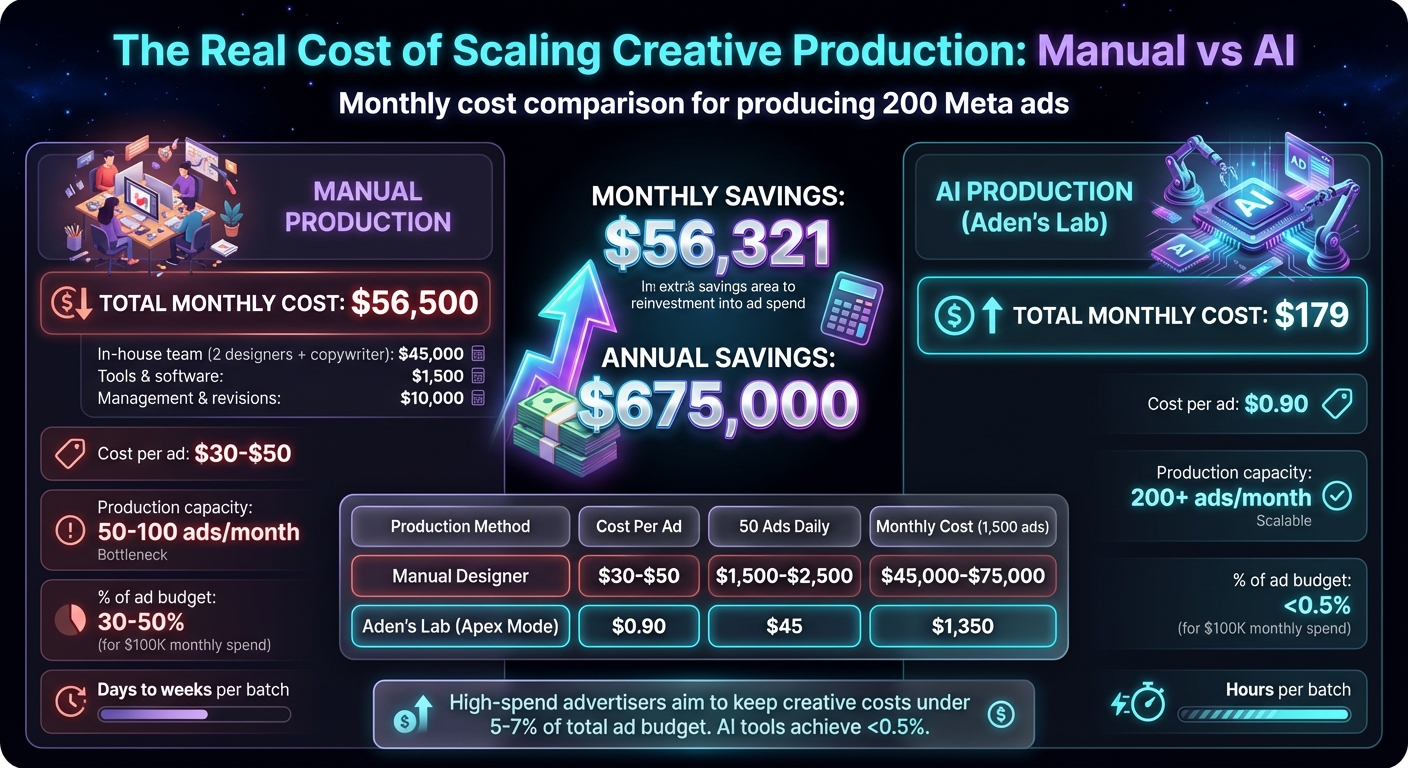
AI vs Manual Ad Production: Cost and Volume Comparison for Meta Advertisers
When you're spending over $100,000 a month on ads, creative production can eat up anywhere from 10% to 50% of your budget if managed manually. This often leads to slower testing cycles and inefficiencies that can hold back your campaigns.
Pricing Comparison: AI Tools vs. Creative Teams
Producing 200 static ads per month the traditional way comes with a hefty price tag. Let’s break it down: a small in-house team with two designers and a copywriter costs about $45,000 in salaries. Add another $1,500 for tools and $10,000 for management and revisions, and you're looking at $56,500 per month. Hiring freelancers doesn’t save much either, with costs ranging between $30,000 and $60,000 for the same output.
Now, compare that to Aden's Lab, which delivers the same volume of creatives for just $179 per month - that’s roughly $0.90 per ad. All you need to do is drop a link, and you’ve got ads ready to launch on Meta. This approach saves you over $56,000 every month, or close to $675,000 annually. Beyond cutting costs, these savings open the door to scaling your campaigns more aggressively.
How Cheap, Fast Creative Production Enables Aggressive Scaling
With drastically reduced production costs, AI-powered tools make rapid scaling possible. When each creative costs less than $1, you can confidently launch 10–20 new ads daily, ensuring a constant stream of fresh assets. This steady flow is exactly what Meta’s ad optimization systems thrive on, allowing them to fine-tune delivery and maximize performance. By cutting creative costs, advertisers can reinvest those savings into broader testing and faster iterations.
While manual teams might only test 5–10 ads per week, AI tools let you test 50–100 ads, helping you find winning strategies faster. This speed enables scaling from $10,000 to $1 million in daily spend while maintaining a strong 3–4x ROAS.
Traditional teams often hit a ceiling at 50–100 ads per month due to burnout, delays, and quality issues. This bottleneck can lead to 30–50% of ad spend being wasted on poor creatives, stalling Meta’s algorithm during its crucial early learning phase. High-spend advertisers typically aim to keep creative costs under 5–7% of their total budget. For a $100,000 monthly spend, that’s $5,000–$7,000. Manual teams often blow past this limit, dragging ROAS down to break-even levels.
AI tools like Aden’s Lab flip the script, keeping creative costs under 0.5% of total spend while delivering at scale. This efficiency not only outperforms traditional teams but also ensures Meta’s algorithm is consistently fed with fresh, diverse creatives. The result? More testing, better optimization, and a stronger ROAS - all at a fraction of the cost.
Final Thoughts: Why Creative Volume Wins on Meta
Meta's advanced AI systems - GEM, Andromeda, and Lattice - are designed to analyze trillions of ad signals. Their focus? Matching creatives to users rather than just pairing audiences with ads. What does this mean for advertisers? The more ad variations you provide, the better Meta's algorithm performs. This isn't just a theory; it's how the platform fundamentally operates, and this approach is only gaining momentum.
If you're producing just 10–20 ads a month, you're severely limiting Meta's ability to test and optimize effectively. On the other hand, generating 200+ ad variations gives the algorithm a vast pool to work with, increasing the chances of identifying winning creatives. It’s not about crafting perfect ads - it’s about testing quickly and offering enough options for the algorithm to find what works.
From firsthand experience managing $100M+ ad spend, I've seen campaigns hit a wall simply because teams couldn't keep up with Meta's fast-paced optimization cycles. Brands that thrive are the ones consistently launching fresh ad variants and scaling successful ones without long delays. Waiting weeks for designers to create new ads can leave campaigns stagnant.
This demand for speed and high-volume creative production is why automated solutions are becoming essential. For instance, Aden's Lab makes it easy to meet this challenge. With just a link, you can generate 200 ad variations for $179 per month - no prompts, no setup, no delays. That’s less than $1 per ad, a fraction of what manual creative teams charge, which can run into thousands each month. And this isn't just about cost savings; it’s about empowering aggressive scaling without ballooning creative expenses.
Success on Meta boils down to maintaining relentless creative output. In this game, volume beats perfection. Advertisers who can outproduce their competition are the ones who dominate the platform. Relying on slow, manual creative methods? That’s a losing strategy in today’s fast-moving ad landscape.
FAQs
How does Meta's Andromeda AI impact ad targeting strategies?
Meta's Andromeda AI is shaking up ad targeting by putting creativity at the core of its strategy. Instead of relying on traditional audience segments, this AI-driven system uses machine learning to evaluate ad performance and group similar creatives. The result? Ads are matched to users based on how well they engage with the content, rather than sticking to predefined demographics or behaviors.
This shift means broader targeting often yields better results. Andromeda continuously fine-tunes audience selection in real time, allowing advertisers to focus on crafting a variety of high-quality creatives. Tools like Aden’s Lab make this process even smoother by instantly generating Meta ads from just a website link. This approach helps advertisers adapt quickly while keeping campaigns both effective and scalable.
Why is producing a high volume of ad creatives important for success on Meta platforms?
Producing a lot of ad creatives is key to succeeding on Meta platforms like Facebook and Instagram. Why? Because the more creatives you test, the better your chances of finding ads that really click with your audience. Testing different styles and messages helps you figure out what leads to higher click-through rates (CTR) and more conversions. Plus, it helps you avoid creative fatigue - the moment when people see the same ad too often and just tune it out.
When you create ads in high volume, you can test and tweak faster, keeping your campaigns fresh and in step with Meta’s constantly changing ad ecosystem. With the right tools, churning out and launching new creatives becomes a breeze. This keeps your campaigns relevant, engaging, and cost-efficient. The result? Less wasted ad spend and a better return on ad spend (ROAS), giving you the confidence to scale your campaigns effectively.
How does using AI-generated ads save money compared to traditional design methods?
AI-generated ads are a game-changer when it comes to saving money. Instead of spending weeks on manual design work that often requires endless revisions, AI steps in to create high-quality ads in a fraction of the time.
This means you can cut back on the need for pricey design teams or freelancers. In fact, advertisers have reported slashing creative costs by up to 50%. By eliminating inefficiencies, you can reallocate your budget toward scaling campaigns instead of pouring it into repeated design tweaks.
Your next ad batch starts here
Finish with a ready-to-test ad batch
Paste your website to generate static creatives. Drop the link → get ads in about 90 seconds → upload them to Meta → scale.
Free to try No prompt writing